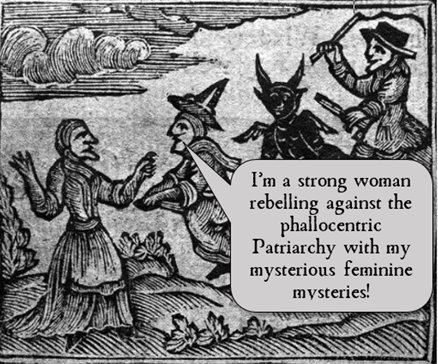
As All Hollows Eve hurtles towards us like an out of control orange and black bus full of sweets and hyperactive kids, I thought I’d write a little on how witchcraft has been used as a weapon in the ongoing progressive kulturkampf. I’m not suggesting the lefties are gathering in woods and cellars, holding masses of colour, casting spells and sticking pins into tangerine coloured, blond haired mommet dolls chanting “Orange Man Bad…”. Well, some of them probably are, but their actions have no effect. No, I’m talking about how the history of witchcraft has been used, especially by feminists, as a stick to beat Western Christian civilisation.
Let’s look at our perception of historical witchcraft and how it is represented as compared to the actual history. Much like the “Golden Age” of Caribbean piracy the history of witchcraft, or rather, the persecution of witches, has been considerably sexed up in popular culture, both loom much larger in our perception of those times than history justifies and both have also been subtly (and often not so subtly) politicised. Again, as with piracy, the reality is much less exciting and alluring, and much less supportive of the modern political interpretations that have become the accepted narrative.
Something wicked this way comes…
The modern feminist version of the story of witchcraft in late medieval/early modern Europe and the American colonies sees it as the persecution of the female practitioners of ancient wisdom by the mechanistic, male, Christian establishment. This view draws heavily from the Murray Hypothesis, the discredited (but still popular and widely believed) ideas of British Egyptologist Margaret Murray. Writing in the 1920s and 30s, she claimed that pre-Christian fertility religion survived in Europe and that the witches persecuted by Roman Catholic and Protestant authorities in Europe and the Americas from the late 1400s to the 1700s were the practitioners of that religion, re-cast as followers of Satan by the Christians. Women involved in the deep and mysterious power of the sacred feminine being burned by brutal men was too good for modern feminists to leave alone.
Although Murray’s theories have long been heavily criticised by academics, they gained ground in popular culture, especially from the 1950s and 60s onwards. Along with English occultist Gerald Gardner, Murray provides the material from which much of our modern conception of witchcraft is built. For example, the word coven is largely unused in English until Murray claims it is the word for a group of thirteen witches in her 1921 book The Witch Cult in Western Europe.
These shaky foundations have been built on by modern feminists, perhaps most influentially by Anne Llewellyn Barstow in her 1994 book Witchcraze. This decidedly gender conflict-based view has been taken up with glee in popular culture. There are numerous examples, perhaps the most prominent is the series Charmed, where strong young women use their inheritance of mystical witch power to fight largely male evils. You won’t be surprised to hear that the 2018 reboot is even more self consciously “woke”. As one review says; “So political it forgot to be fun.” Another says; “Charmed Reboot takes on Rape Culture and Trump”. ‘Nuff said.
A casual glance at a Wikipedia entry on witchcraft in Britain throws light on the sort of “history” that is informing these pop-culture interpretations. On James VI & I’s motivation for persecuting witches “One goal was to divert suspicion away from male homosociality…and focus fear on female communities”. Quite how the execution of an old woman in Lancashire diverts suspicion from the goings on at Court, of which the mass of the population would be ignorant, is unclear. I’m not sure what “female communities” there were in Jacobean England. There were no nunneries or convents in England from the Reformation until the 1830s and although the male and female spheres of life were much more separate than they are today, men and women lived together in then same communities.
From factional fiction to factual history
Let’s look at some historical facts. It is certainly true that our ancestors, or at least most of them, did believe in witchcraft. It is also true that people, usually (but by no means exclusively) women, were tried and executed for witchcraft. Here we need to tease out the fact from fiction. In popular culture there is a tendency to lump the whole of European history from the 1400s to the 1700s, as if it was all one thing. (It’s all the olden days innit?). Nothing could be further from the truth.
For example, in Bamberg, Bavaria between 1626-31 nearly 1,000 people were burned for witchcraft (so many that they abandoned the stake and built a crematorium in some eerie historical foreshadowing). Contrast this with the records of the Assizes for the well populated English county of Surrey for the whole of the reign of Elizabeth I. During the 45-year period there are only 30 cases of witchcraft brought, resulting in 8 convictions and only one execution, a hanging. That single outbreak of witch frenzy in Bamberg killed more alleged witches than were executed in all of England for the whole of the period we’re looking at. There are, of course, reasons for these differences.
Firstly, there was not one law in force across Christendom. Although the church held more sway then than now the various national and regional administrations had their own law. Notice that the one execution in Elizabeth I’s Surrey was by hanging. In English law people were convicted of maleficia, of causing harm by witchcraft, not of being a witch and so were hanged like any other criminal. Also, being England, the accused were innocent until proven guilty.
On the Continent and in Scotland people were charged with being a witch and consorting with the Devil, a religious crime like heresy, as such the punishment was burning at the stake, to purge the body and save the soul. They also had to prove their innocence.
It is worth noting that although the authorities were exclusively male, and the accused mostly female (around 80%) very often the accusers were women too. Look at Elizabethan Surrey, and indeed England as a whole. Acquittal rates were in the order of 70-80%. many of the alleged witches were accused by other women, but were tried, and acquitted by men. On the Continent acquittal rates were lower of course, but the proportion of men being tried was higher. Indeed, around Europe’s north-eastern edges more men were accused of witchcraft than women. Although the general view of the times that women were the “weaker vessel” and more susceptible to sin certainly played a part, it really isn’t as simple as Patriarchy versus women.
Although there were isolated witchcraft trials here and there a great many cases are part of big outbreaks of witch mania. These were often associated with other factors. One big, often over-looked, factor is that the witch craze period dovetails closely with the Little Ice Age, when temperatures were consistently lower then than they are now; or they had been during the preceding medieval warm period. These low temperatures often led to bad harvests and witches were often blamed for crop failures. The Bamberg witch trials coincided with bad harvests.
Likewise, the very worst outbreak of witch frenzy in England, the reign of terror of the self-styled “Witchfinder General”, Matthew Hopkins, took place from 1644 to 1647. At this time England was convulsed by the Civil War. The system of the King’s authority had broken down in the largely Puritan and Parliamentarian east of England where Hopkins operated, but Parliamentarian authorities had the war on their hands and Hopkins was able to literally get away with murder, highly profitable murder at that.
He travelled from town to town, ridding the towns of the terrible scourge of witchcraft and relieving them of money for his services. Ipswich even instituted a new local tax to pay him. By late 1646 the war was coming to a temporary end and opposition to him was growing. The Vicar of Great Staughton preached against him in the pulpit and when he was called to account for his actions by the Norfolk justices, he sniffed the changing wind and decided to retire. He died in August 1647, sadly not executed as a witch himself, as popular tradition often asserts, but of TB.
In the absence of the usual legal procedures Hopkins was able to use his own special methods and in a little over two years he was responsible for the deaths of around 300 people. This represents around 50% to 60% of all the executions for witchcraft in England from the little more than two centuries that the witch craze lasted.
His influence outlasted his death. He published a book, The Discovery of Witchcraft, copies of which went over to the American colonies. In 1647 Alse Young became the first posthumous victim of Hopkins, at Hertford, Connecticut. From her death to the famous Salem witch trials another eleven people were hanged for witchcraft in Connecticut and Massachusetts. In 1692 came Salem, arguably the most closely studied outbreak of witch mania. Central to this particular case are hysterical denunciations by young girls. (In 2019 it’s all too easy to see a pig tailed puritan maid standing before the court. “How DARE you!?” she proclaims in her wide-eyed breathless anger as some thoughtless adult asks for evidence of her assertions.) What often escapes attention is that Salem effectively ended the witch trials in America. Far from being ubiquitous in the early American colonies witchcraft trials were something of a rarity, a handful from the 1640s to the 1690s and then one big, traumatic convulsion.
Americans and the British are often accused of viewing history from their own perspective (well, of course we do, it’s our perspective) but in the case of witchcraft we do so to a culpable degree. In our enlightened times we beat ourselves up over the deaths of people in Salem and East Anglia in the 1600s, as if these were the worst of the witch craze, when in fact our ancestors were highly restrained and relatively rational. The oh so sophisticated Europeans killed between 40,000 and 50,000 people for witchcraft in the time we’re looking at. So, awful and embarrassing as it is that our ancestors executed anyone for “witchcraft” at all, it was not a war on women (whatever amulet bedecked feminist “witches” may say) and it was far less prevalent than TV and Hollywood would have you believe.
Happy Halloween
One reply on “Halloween Special”
Well said, Sir!