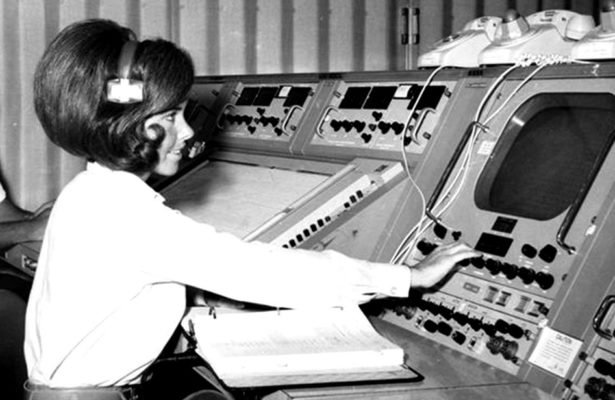

Judy Sullivan was a math and science teacher who joined NASA in 1966 as the first woman engineer in Spacecraft Operations, working closely with the astronauts. She was lead engineer for the biomedical system for the Apollo 11 mission and the first woman engineer hired by NASA to support spacecraft testing. As preparations were underway for Apollo 11 in mid-1969, the 26-year-old Sullivan was one of only 100 women, including 16 engineers, serving in top positions at the Florida spaceport.
“Men were careful not to use questionable language over the loop when they knew a woman was listening,” Sullivan recalled. “People asked me what it was like to work with all those men, but my college experience had prepared me. Few women were registered in math and science classes.”
Sullivan was in the suit lab as Neil Armstrong dressed for his historic launch. During the countdown, she monitored the data returned by the astronauts’ biomedical sensors from the control room and communicated with the pad regarding crew readiness. She was the only woman in the room.
Shortly after the launch of Apollo 11, Sullivan represented NASA on the television game show, “To Tell the Truth.” A panel of celebrities tried to choose the “real” biomedical space engineer by asking job-related questions of a group of three women, all claiming to work for NASA. “Miniskirts were in fashion so they shortened my hemline, and I wore ruffles. They were totally fooled,” Sullivan recalled. “I won $500 and had a great time seeing New York City.”
In this image, Judy Sullivan monitors a console in the Kennedy Space Center’s Manned Spacecraft Operations Building (now the Neil Armstrong Operations and Checkout Building) during a training exercise for the first lunar landing mission. When astronauts were training for Apollo missions, they were fitted with small sensors that would provide crucial data about respiration, body temperature and heartbeats. As was the case in Projects Mercury and Gemini, the sensors kept flight surgeons informed on the health of the astronauts during the trips into space. Sullivan would monitor the equipment and ensure the information was provided to the proper sources.
3 replies on “Judy Sullivan, Lead Engineer for the Apollo 11 Biomedical System”
Thank you! I recently finished “Rocket Girl” about the woman who invented hydyne, which fueled the Redstone rocket, which was the first satellite launch vehicle. I can recommend it (3 to 4 stars) for the science and history lessons, if not for the “creative writing” used to fill in the gaps.
Rocket Girl: The Story of Mary Sherman Morgan, America’s First Female Rocket Scientist
LIKE THE FEMALE SCIENTISTS PORTRAYED IN HIDDEN FIGURES, MARY SHERMAN MORGAN WAS ANOTHERUNSUNG HEROINE OF THE SPACE AGE-NOWHER STORY IS FINALLY TOLD.This is the extraordinary true story of America’s first female rocket scientist. Told by her son, it describes Mary Sherman Morgan’s crucial contribution to launching America’s first satellite and the author’s labyrinthine journey to uncover his mother’s lost legacy–one buried deep under a lifetime of secrets political, technological, and personal.In 1938, a young German rocket enthusiast named Wernher von Braun had dreams of building a rocket that could fly him to the moon. In Ray, North Dakota, a young farm girl named Mary Sherman was attending high school. In an age when girls rarely dreamed of a career in science, Mary wanted to be a chemist. A decade later the dreams of these two disparate individuals would coalesce in ways neither could have imagined.World War II and the Cold War space race with the Russians changed the fates of both von Braun and Mary Sherman Morgan. When von Braun and other top engineers could not find a solution to the repeated failures that plagued the nascent US rocket program, North American Aviation, where Sherman Morgan then worked, was given the challenge. Recognizing her talent for chemistry, company management turned the assignment over to young Mary.In the end, America succeeded in launching rockets into space, but only because of the joint efforts of the brilliant farm girl from North Dakota and the famous German scientist. While von Braun went on to become a high-profile figure in NASA’s manned space flight, Mary Sherman Morgan and her contributions fell into obscurity–until now.
here she is now plus a nice gallery of her and her work