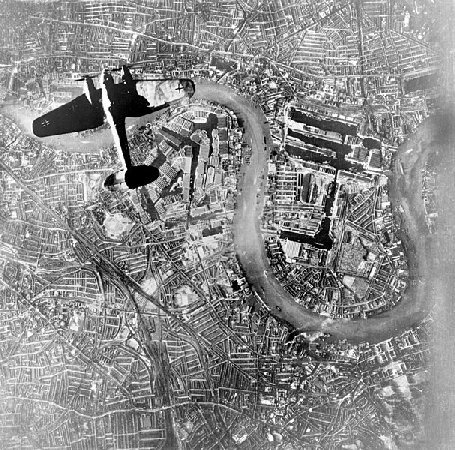
Here is my first attempt at creating a video. It’s a very simple commemoration of the Blitz, which began on 7th Sept 1940 and ran on until May 1941. In early October the bombing was extended to other British cities. The video shows photos from the most bombed cities in ascending order. More than 40,000 people were killed, 100,000+ injured and over 2 million houses destroyed, 60% of them in London.
I grew up hearing stories of the Blitz from my family. Southall, where we lived, was not heavily bombed, being well to the western side of Greater London, but it was still on the wrong end of 30 or so bombs. In fact, it was far enough out that children were not evacuated by the government, unlike in central and east London. My grandparents did send my mum, who was seven at the time, up to stay with family in Dundee, although she was brought back well before the war ended.
Here is a map of the bombs that fell in our neighbourhood, The blue circle is where my family lived during the war and the green circle is where I grew up.

For some years I lived in a road in Hounslow, a few miles south of Southall, the road was half 1860s terraced houses and half 1880s, except for a small block of post war flats where a bomb destoyed a couple of houses. Reminders of the Blitz are everywhere in London.
As with everything else in British history the story of the Blitz and the idea of the “Blitz Spirit” is under attack from revisionists. Here is my way of countering those attacks.
3 replies on “The Blitz, 80 years on.”
It wasn’t until WWII that the concept and application of “total war” came to the human condition. Until the advent of long range bomber aircraft it just wasn’t possible to rain death from the skies on your enemies from far, far away.
The Germans did this with The Blitz, their object was to terrorize and demoralize the British and reduce their will to fight. It had the opposite of that effect.
The Allies did likewise bomb civilian targets. Generally the idea was to sap the enemy’s war production capacity. By isolating a component necessary in the production of all types of vehicle; from bicycles to fighter planes to trucks to tanks — This component was attacked and civilians in ball bearing factories died in those attacks.
Up until long range bombers came on the scene this was just not possible. If two forces met they fought, if there were civilians in the area they left or suffered the consequences. There are examples of total destruction like Sherman’s march to the sea and his “scorched earth” policy but those required actual troops on the ground carrying rifles and torches to accomplish. Soldiers had to burn the fields and factories which severely limited the reach of such operations and precluded a general targeting of the entire production of war material. Thus such historical examples while quite bloody and violent came no where near the destruction of “total war” wherein an enemy population was an integral part of war material production and thus became an intentional and legitimate target.
The Germans did it for terror, the Allies did it to sap war production but they did it even so. The fire bombing of Dresden killed a lot of people who didn’t work in factories that produced war materials.
I’m not making excuses for the Nazis nor condemning the Allies. I’m just pointing out that WWII was a turning point in history with multiple Black Swan Events. Referring back to General Sherman again … “War is hell” and it becomes more hellish from WWII onward.
It makes Covid-19 look tame… People today should have to experience this visually at least
Very powerful visuals of the absolute devastation… I had no idea of the extent…