Like perhaps 74 million or so people in the US, I have been struggling to keep an optimistic outlook on the future of this country. Some days I can muster a positive and upbeat attitude, but each day since the installation of Biden as president has brought new challenges to maintaining my “stiff upper lip”. Today I heard that the US Embassy in Israel changed its Twitter name to “U.S. Ambassador to Israel, the West Bank, and Gaza”, which set off in me another bout of frustration and anger. The name apparently was changed back to “U.S. Ambassador to Israel” a couple of hours later, along with the disclaimer that the change was an “inadvertent edit”, but the fact that someone consciously made that temporary change tells me all I need to know about what this administration has in store.
Bombarded by a mountain of negative news that has kept me quite depressed (yes, I have had moments of true depression), I have also found reasons to be optimistic, mostly through the words of other like-minded people… friends, pundits, bloggers, a random “celebrity”, and others. I have also been falling back on the words of others who through their writings have encouraged and inspired me for years, and their words have stiffened my resolve to stay the course and follow what I know is right, regardless of how bleak the future currently looks.
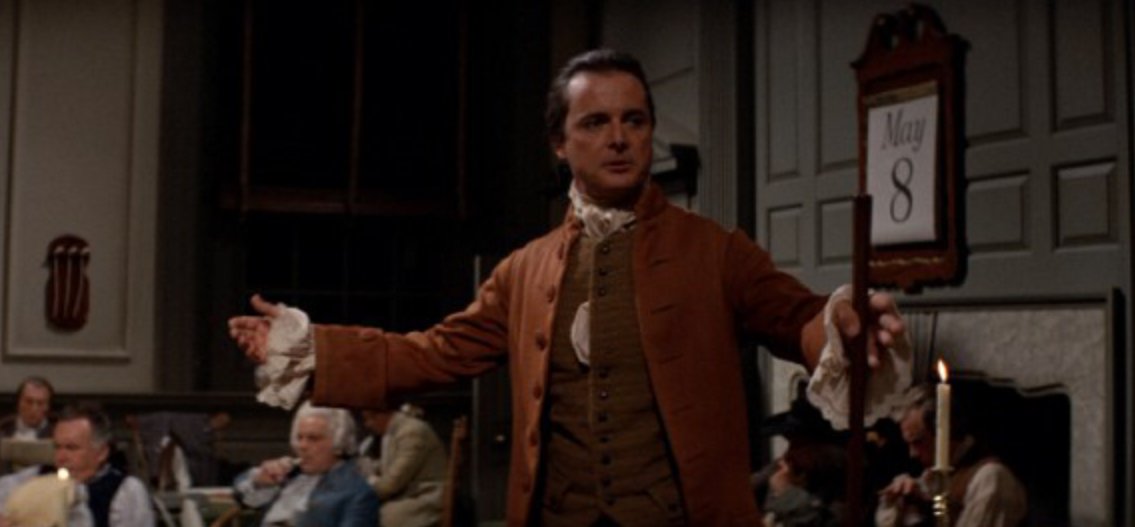
This past weekend, I was looking for a movie to watch on cable tv, but instead I pulled out my copy of the film “1776” and put it in my DVD player. It had been a few years since I’d watched the film, and I’ve always appreciated the clever writing and the performances of William Daniels as John Adams, Howard Da Silva as Ben Franklin, and Ken Howard as Thomas Jefferson. I thought that now was a good time to give the film another watch… and, boy, was I right. The story of the signing of the Declaration of Independence as told by playwright Peter Stone and lyricist Sherman Edwards is not only entertaining, but truly inspiring. By the end of the film, my resolve to continue my opposition to those who are leading this country into a dark and troubling place was invigorated.
I will share with you some of the things that inspired and uplifted me… but first, a couple of disclaimers:
First, this film is based on the Broadway musical of the same name. Yes, I did say “musical”. Founding fathers sing while an invisible orchestra plays, and there is even a smattering of choreography here and there. The thing is, the concept works. The best musicals – like the best art in general – capture the spirit of the characters and drive the plot forward, and 1776 does this particularly well.
Second, the script takes a lot of liberties with the history on which it is based. Some people have real issues with authors taking poetic license with history – I once did – but as I got older and (I hope) wiser, I realized that sometimes it takes a captivating story – a novel, a movie, or even a musical – that plays fast and loose with the actual events to get a person interested in finding out more about a moment in time, and that as the person delves deeper into the subject they discover a more detailed and accurate account of history. If a musical or a film can spark a person’s interest in history – especially a young person – and inspire them to learn more, then I can forgive a bit of fudging of events, so long as it doesn’t fundamentally change the message.
This may be the only time I quote an article from Salon in a positive light, but Matthew Rozsa addressed the issue of historical inaccuracy in his 2017 article Fourth of July viewing: Before there was “Hamilton,” there was “1776”:
“Like ‘Hamilton,’ ‘1776’ takes a lot of liberties with historical accuracy, but not in the ways that count the most. Much of the dialogue and song lyrics are direct quotes from the letters and memoirs of the participants at the Second Continental Congress, and the various topics touched upon by the main characters were indeed the focus of fierce debate: the abolition of slavery, whether the colonies had indeed became [sic] nations of their own, the proper role of government in the lives of its citizens.”
Those who are familiar with the Revolutionary War era will appreciate the significant amount of dialogue that comes from actual source material, and the playwright works the actual words of the Founders into the script in an effective and meaningful way. Even if all the musical numbers were taken out, I believe the script could stand on its own as a drama. It is interesting to note that “1776” holds the record for the longest time in a musical without any musical interlude… over 40 minutes.
As for the historical inaccuracies, there are valid dramatic reasons for them, and I have found no better discussion of these than in the four-part historical review of “1776” on the YouTube channel Dealing With Nihilism. I recommend this series for those who want to compare the actual history with the dramatic license taken with history in the musical, and how those alterations served the telling of the story of this nation’s founding.
I promised earlier to mention some of the things in this film that inspired me, but there are so many that I will only offer one example, one that comes late in the film. The members of Congress are recommending various alterations to Jefferson’s draft of The Declaration when Edward Rutledge demands that the paragraph about black slavery be struck from the document. After an argument with John Adams, Rutledge – who represents the South Carolina delegation – storms out, and the delegates of the southern states follow his lead. Franklin then tells Adams that they have no choice… the slavery paragraph must go. Adams, growing increasingly desperate and agitated, lashes out at Franklin, saying he’s no better than Rutledge if he supports taking out that passage. Franklin dresses Adams down and leaves the hall. Adams is left alone in the chamber, at the lowest point – emotionally – in the entire film. On the eve of having his dream of independence pulled out from under him in the final hours of the official vote, he shares his vision with us in the song, “Is Anybody There?”
They want me to quit.
They say, “John, give up the fight”
Still to England I say,
“Goodnight, forever. Goodnight!”
For I have crossed the Rubicon.
Let the bridge be burned behind me.
Come what may, come what may.
Commitment!
The croakers all say
We’ll rue the day,
There’ll be hell to pay
In fiery purgatory.
Through all the gloom
Through all the gloom,
I can see the rays of ravishing light
And glory!
Is anybody there?
Does anybody care?
Does anybody see
What I see?
I see fireworks.
I see the pageantry, pomp, and parade.
I hear the bells ringing out.
I hear the cannons roar.
I see Americans,
ALL Americans
Free… forever more!
As I watched Adams singing this song, I felt a kinship with him, more deeply than I ever had. This song had a relevance to me – now, today, in 2021 – that it never had before. The events of this election season and the consequences of the result have changed me, changed my outlook on what it means to be an American, here and now. Before, the act of standing up to tyranny like the Founding Fathers did was an action that I could only observe through the lens of time… understanding it, but almost in an abstract or detached way. Defending my God-given rights against an increasingly tyrannical government has now become a tangible act that has a direct and immediate connection to my life. Our opponents – if I may call them that – are saying we will rue the day and that there will be hell to pay for our dissention, for our refusal to kowtow to their demands. Through all the gloom we are now experiencing, I can still see the rays of light, the promise of a free country. It still exists. As long as it exists, there is still hope.
If you get an opportunity, watch the film “1776” and – I hope – it uplifts and inspires you as it does me. While you’re at it, read as much as you can find about the Founding Fathers… an amazing group of men who stood up against the most powerful country on Earth and created the most moral and ethical form of government the world has ever seen. We truly stand on the shoulders of giants.
2 replies on “Finding Inspiration From the Founding Fathers. Well, sort of….”
Thanks for the suggestion and recounting why “1776” inspires you. 🙂
Replacing Andrew Jackson on the $20 bill with Harriet Tubman is another step in their direction affirming America as a nation fraught with sin which needs reckoning. I don’t care that Tubman is black. I don’t care that Tubman is a woman. I don’t care that she helped to free slaves. The questions should be:
1) Why are we replacing Andrew Jackson (and don’t give me Zinn’s one-sided communist version of U.S. history)?
and
2) If Jackson is to be replaced, is Tubman the best replacement? This was never put to a national debate. Someone in government just decided it.
3) What’s to prevent some government official from deciding the Washington Monument, the Jefferson Memorial and the Lincoln Memorial need to be replaced without consulting the rest of the nation?
Who the hell do these people think they are?