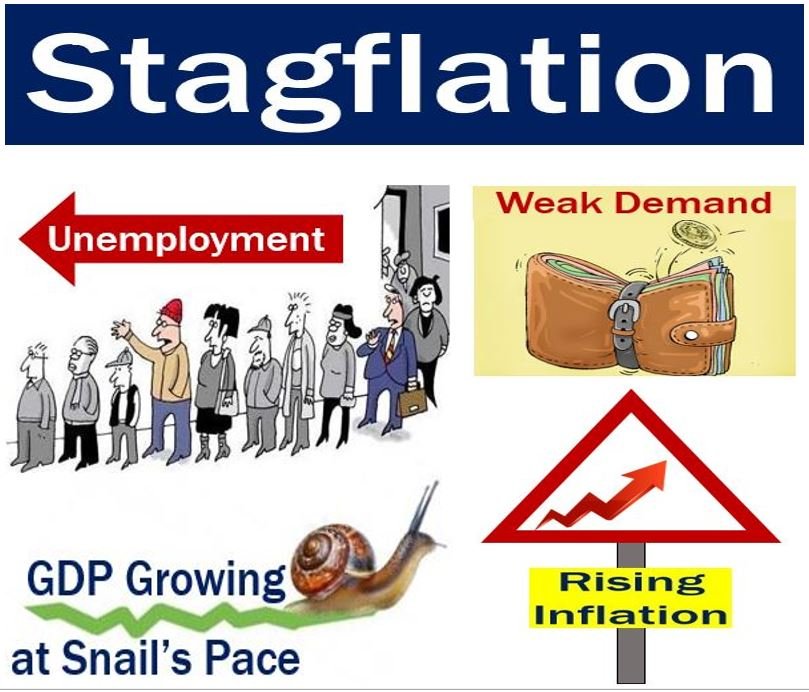
I was watching a podcast by Tim (forgot his last name – my fiance watches mostly), and he was talking about how people are sitting on unprecedented levels of cash, and how the pandemic has prevented people from spending that cash. Plus the stimulus checks, which incentivize people to stay home instead of work. His push was that we’d see a drop in manufacturing, and that goods themselves would become scarce, thus driving up the price even more, even if the demand is lower than usual.
One thought I had is that the impact we’d see is a drop in American-made items, but not necessarily in items i.e. we’d see even more Made-in-China stickers. But more importantly, my fiance and I discussed the concept of “stagflation,” which occurred first (well, was first recognized) in 1970’s UK.
Lenin is said to have declared that the best way to destroy the Capitalist System was to debauch the currency. By a continuing process of inflation, governments can confiscate, secretly and unobserved, an important part of the wealth of their citizens. By this method they not only confiscate, but they confiscate arbitrarily; and, while the process impoverishes many, it actually enriches some. […] Lenin was certainly right. There is no subtler, no surer means of overturning the existing basis of society than to debauch the currency. The process engages all the hidden forces of economic law on the side of destruction, and does it in a manner which not one man in a million is able to diagnose.
The presumption of a spurious value for the currency, by the force of law expressed in the regulation of prices, contains in itself, however, the seeds of final economic decay, and soon dries up the sources of ultimate supply. If a man is compelled to exchange the fruits of his labours for paper which, as experience soon teaches him, he cannot use to purchase what he requires at a price comparable to that which he has received for his own products, he will keep his produce for himself, dispose of it to his friends and neighbours as a favour, or relax his efforts in producing it. A system of compelling the exchange of commodities at what is not their real relative value not only relaxes production, but leads finally to the waste and inefficiency of barter.
That was pulled from the Wikipedia page on stagflation as a quote of John Maynard Keynes. In practice, I’ve seen this myself: the farmers I’m getting to know from his side of the family almost don’t participate in the modern market. They just sell to friends and colleagues in exchange for goods from friends and colleagues. One rents out a corner of his land to someone in order to cover the taxes on it… and everything else goes into his network instead of to grocers/people he doesn’t know.
Given that, what are some suggestions for riding out this particular difficulty (if indeed it is a threat)?
One reply on “Stagflation: Rapid Inflation + People not Working”
Sounds like Tim Poole