I’m sure the long march of Marxists, fellow travellers, and useful idiots through the education systems of the Anglosphere is something that the folk on BW.com need no convincing of. Given the recent tendency to be more brazen and extreme about it we sometimes forget how long it’s been going on. I thought I’d document an example of leftist bias in the teaching of history from my own schooling, one that I didn’t realise was such until years later.
I grew up in west London/Middlesex, in a place called Southall. The canal and the railways, and later Heathrow Airport, were big factors in the town’s growth. In around 1979/80 I recall us being shown a short film as part of a history lesson.
The film was a dramatization of a race, in the mid-1800s, between a canal boat and the new railway to get a certain product somewhere (from Birmingham to London, I think). The railway won, and we were told that is why the canals died as a viable commercial form of haulage.
At the time I accepted this, and like much of what the left says, it does contain a small amount of truth. However, later a book and a film told me more about the reality behind the downfall of the canal network.
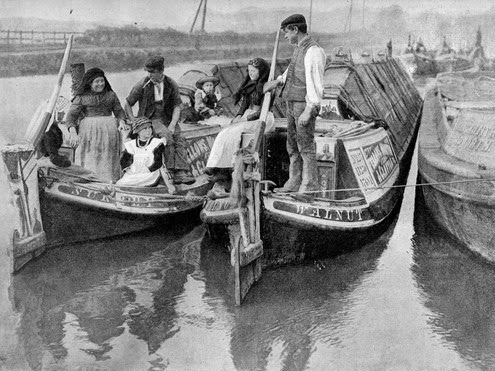
One day I took out a book out of our local library (built by Andrew Carnegie, an ornate red brick temple of knowledge, from the days when libraries still had books in them). The book was a memoir by a Land Girl in the Second World War. The Land Girls were young women who took on agricultural tasks while the men were away fighting. This young woman was unusual though, she and her friend worked a pair of narrow boats on the canal network, moving much needed fuel and materials around the country. While reading about her adventures on the canal that was only 50 yards from our front door, something hit me. The canal was still being used to move goods in the 1940s! Nearly a century after we’d been told it had been killed off by the trains. I was not yet the political animal I am now and thought no more of it.
Years after I was watching an old comedy (The Bargee) starring Ronnie Barker and Harry H. Corbet. They were also working a pair of narrow boats on the canal. The film was made and set in 1964. It was clear from the film that they were at the end of an era, and that the canals were indeed at the end of their commercial life. It was also clear that the men were not owner operators, as the early bargees had been, but employees. Not employees of a private company, but of British Waterways, a government statutory body, set up in 1962.
So, the canals had been nationalised! Before the late 1940s the canals were owned and run by the various private rail companies as a viable part of the haulage network. As such they were nationalised when the railways themselves were in that baleful year, 1948. They limped on until 1962, when they were given their own special government body to take care of them, British Waterways. Sadly, as is so often the case with government bodies, British Waterways took care of the canals in much the same way Mafia soldiers “take care” of rivals for the Capo. Within a decade the canal network was no longer a meaningful part of the commercial haulage network of the UK.
Now, it is true that factors such as the building of motorways and the reduced need for coal adversely affected the canals, but I would contend that private companies faced with such difficulties might have been innovative and made opportunities out of challenges. As it was British Waterways merely managed the orderly decline of Britain’s canal network. It might be unfair to blame BW 100% for the demise of the canals, but it happened on their watch, in the mid-20th century after nationalisation, NOT in the 19th century due to commercial competition from the railways.
Just one little, insignificant element in the educational campaign to “accentuate the positive” when it comes to socialism, and to cover up the negatives as much as possible.