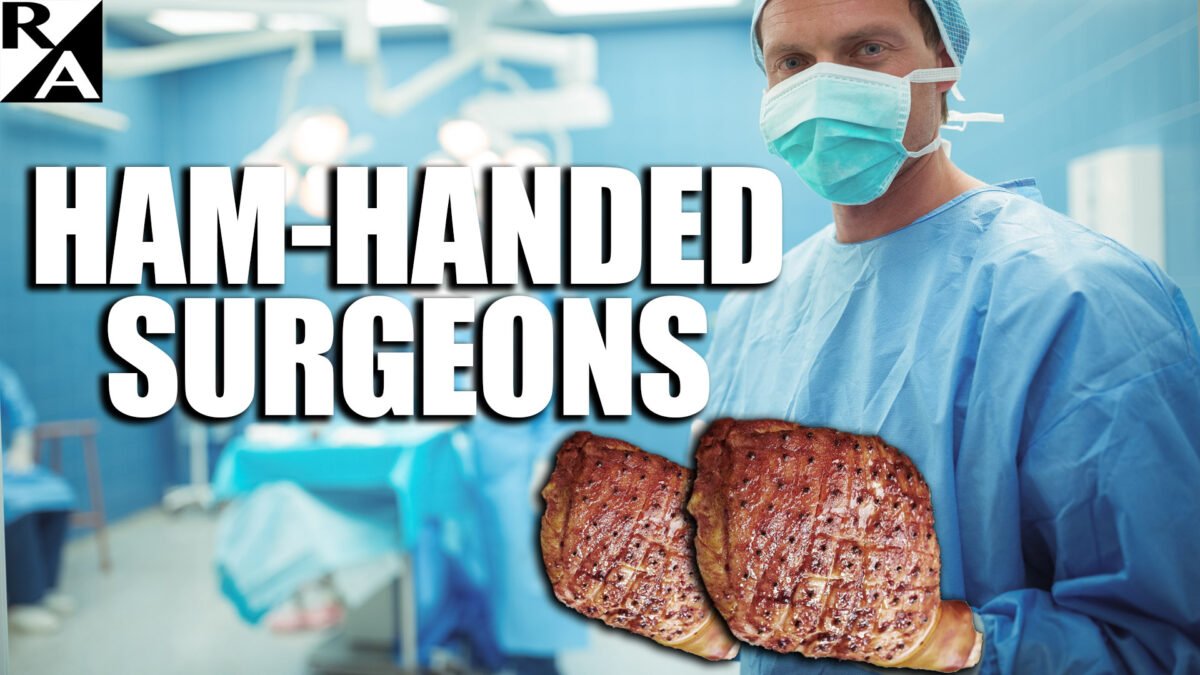
Medicine — especially surgical procedures — has improved remarkably over the last century. But lately, three hour procedures have begun to take up to six hours. Why? Well, because an entire generation of young surgeons, raised on tablets and smart phones, simply do not possess the manual dexterity of their screw-turning, sewing, musical-instrument playing teachers… and there doesn’t seem to be much that we can do about it.
Join our elite squad of anti-elitists by becoming a Citizen Producer today:
https://billwhittlecom.wpenginepowered.com/register/
60 replies on “Ham-Handed Surgeons”
Mention of the “Operation” game reminded me of this Bruce Jenner version.
I saw this on the YT a couple days ago and thought it should go here.
This is an individual who has the manual dextrosity that the surgeons mentioned in this RA lack!
Deft Hands (starts slow, ff to about a minute in)
“Ham handed” huh. What a timely subject. One of my Marines (Ret) got to go for a bore scope (Colonoscopy) today. At 78 I did what I HOPE will be my last in July.
The segment he recorded a few years ago, as I said in an earlier post, was called Five Alarm Fire. It’s up on YT at this link. I checked it again and it still works.
https://youtu.be/ot9Kx2KRJ-8
.
My handwriting is awful. I’m full qualified to be a GP doctor.
Bill, (rhetorically of course cause he rarely reads these comments but should) the episode of yours was an Afterburner called Five Alarm Fire. One of your best.
I’m 64 and about 5 years ago I treated myself to a ShopSmith saw, router, wood lathe, drill press, jointer…basically an everything-garage-woodshop. It has a manual book about 2 inches thick with photos showing parts of the tool. Black and white photos and a bit grainy.
While going through the manual one night, I caught myself, not once or twice, but throughout the evening, trying to swipe or pinch or spread/enlarge the printed photo….with my FINGERS! Each time I did this, I’d say “now that was stupid”… and repeat the habit minutes later. It’s not just happening to children and 20 somethings !
OK, that’s funny as hell and not something I would have admitted.
Good on you for having the ability to laugh at oneself.
So, “Ron”….are you saying that you’ve done it but you wouldn’t admit it?
I’m with ALL of you, I learned cursive in 1st, 2nd, 3rd and 4th grades. Then hand written printing took over. Never looked back. Drafting class in the 7th grade held the near-dead Cursive under the water, and 8th grade Typing class grabbed the neck of Cursive, which Drafting Class held under water, and choked the life out of it, then shot it 6 times for good measure. Buh-Bye Cursive.
And typing class in 8th grade meant manual typewriters, like one step above the old Royal machines. Carriage returns, black ink ribbons, and white out, lots of white out (thanks, Michael Nesmith’s mom!). The instructor told us that we were neither talented enough nor disciplined enough to be taught on the brand new IBM electrics. That was for professional secretaries, He said!
Yay for drafting. I have been doing block lettering since 6th grade. And I was a pretty good typist, even on those POS machines.
Steve …. Testor’s Dull Coat is that magical elixir in a rattle can, that makes the plastic appearance of styrene go away!
Perhaps this lack of dexterity situation is the inspiration and cause for the robotic operating machine systems that are currently gaining favor in hospitals around the country!?!?
Retired OR nurse here.
A) It’s eye-hand coordination (the eyes see first), not hand-eye.
B) Playing video games enhances laparoscopic skills, since you’re looking in one place at the monitor and working in another.p (i.e., the patient).
That being said, if the surgeon doesn’t have the baseline hands-on skills and the laparoscopic case run into difficulties, it’s a problem for the patient.
I agree with Rick. One of the first places I worked made parts for aviation navigation systems. A large part was 1/2″ dia and 2″ long. Very fine work done under microscope. Nearly all of the employees in some departments were middle aged women. Their smaller hands had more dexterity and they also had the patience to perform welding and soldering under a microscope.
Kind of eye-opening at 21 to see them churn out manufactured goods in what most people would have seen as a “man’s” job. Some of them were extraordinarily good at it.
I have not seen the surgeon’s interface with the da Vinci robotic surgical system. I have had the great pleasure of performing a nuclear stress test on a 39 year old man one day post coronary bypass surgery of his left anterior descending artery. The young man had 3 holes in his chest and abdomen where the robotic arms were used to perform the surgery. We ran him on a treadmill for 10 minutes. It was the most amazing thing I have seen, but like I said I do not know the interface between the surgeon and the device. I think it still calls for substantial dexterity of the surgeon. I have hope it will become like a video game for these young doctors.
The surgeon uses a VR headset while the assistant uses normal video monitors. I have only seen a video of it in use, not in real life.
It is, in effect, the next level of regular laparoscopic surgery, using video on a 2 foot stick along with 2 foot long adapted surgical instruments.
The title has had me humming Hard Hearted Hannah all day.
How about tying your shoelaces? Or cutting things out of construction paper? Coloring in a book or putting a puzzle together also takes manual dexterity. In high school I really got into macrame and made plant holders, belts, chokers, and even a Tiffany lamp!
Susan – you tripped a memory for me. I had posted earlier that my neighbor (our pediatrician) and my mom were pushing not too subtly for me to go to med school. After your post about macramé I now know that my aunt was in on it.
As a young child she got me into needlepoint of all things. She used reverse psychology on a highly competitive 6 yr old by telling me it was too hard for me. I got really good at it, too. She actually had kept a pillow I did with a pretty complex nature scene when I was 9. Nice, tight stitches. If it wasn’t for the patient part, I might have been pretty good, but I think you have to really want that to go through the gauntlet to get there.
By the time I was 10 I had discovered baseball and the time spent with needles went away. But they had a plan these three ladies.
You’re in good company — Rosie Grier used to do needlepoint, too!
OH, that’s right. Forgot that, too! I am seeing a pattern 😉
1) not to be all misogynist, or anything, but it does seem that women’s penmanship has always been better or more flowing or attractive than that of most men. Any ideas as to why that might be? Sewing classes vs. lego’s, etc. seem pretty comparable in hand-eye coordination, even if different. Less force on the pen? My wife’s and my mother’s writing is/ was very attractive and readable, while my father’s was atrocious and mine is no great shakes.
2) and get the kids doing it right before they graduate to arthritis, as many of us beyond a certain age are experiencing. I suspect I really should submit updated signature cards at the bank and at the supervisor of elections office. Then again, the tax collecting offices won’t care as long as the check or EFT clears [a case where even signatures in cursive are no longer required.
3) pretty sad to think we need street gang warfare or nation to nation warfare to develop surgeons with the necessary skills, knowledge, and dexterity for faster and more reliable surgeries. I do suspect robotic surgery will help overcome some of this, as the transfer from hand control to in-the-body movements can be programmed to allow for large scale movement outside the body being matched by much smaller movements inside (more room for “error” or reduced precision.)
4) I am not sure but I suspect the fine motor work also translates somewhat into better imaging of things in 3D from 2D views.
5) some of that “dropping of screws” stuff is really just poor design for maintenance and repairability. It can and should usually be just the reverse of assemble-ability, so each newly added component goes on top of the previously installed one (and thus in reverse as well). Of course many things now go together using plastic or metallic spring clips, rather than screws, which become more difficult to find the release points and release those points. Some may have been intended to never be removed for repair (like the plug and socket for the ice maker in my freezer!!).
6) perhaps we should also explore selecting surgeons from former butcher shop employees? At least they are familiar with hams.
Women tend to have better eye-hand coordination. They tend to pick up handgun shooting more easily as well.
Rifles too. My paternal grandmother was a natural crack shot. She never had any formal marksmanship training. Yet with an old Remington single shot .22 bolt rifle I’ve seen her light kitchen matches at 10 paces (so a bit under 30 yards) and she was instant death on sparrows that tried to nest in her marten house. She’d shoot ’em right through the eye, every single time.
Sometime after I grew up I heard or read the saying “aim small, miss small” and knew instantly what that meant because of grandma.
Handgunnery is a different sort of critter. I’ve heard people say that women are superior handgunners but that has not been my experience in real life. From what I’ve seen both sexes are pretty close to the same and the difference lies in how much the person is willing to put into it. I’ve taught both combat handgunning and have never noticed that one sex had any advantage over the other.
Something unrelated and kind of weird about that. Some of the very worst handgunners I’ve ever seen have been cops. Even some FBI agents are just gawd-awful handgun shooters. You’d think that people who carry a sidearm every day and rely in it to save their life would get downright proficient with that tool but no. Oh, there are good and bad, cops that can shoot and cops that can’t. The ones who can’t shoot for a darn are common enough to be noticable, a significant percentage that isn’t an anomaly, it’s pretty common.
So if, God forbid, you ever see a cop clearing his sidearm, find cover post haste. He’s probably going to mag dump on his threat and if he connects more than two or three out of that high capacity magazine it would be remarkable.
Great episode. In grade school (70’s)…. I learned cursive and much art. My parents bought a piano, and I took lessons. Built countless models, rockets, etc. Played sports outside almost every day. Got dirty in the garden, under the hood, and in the barn. Another suggestion…. learn how to juggle…. great for hand/eye coordination and even the rest of the body as you progress with ability and learn tricks.
Well the timing of this topic is lovely! I’m going to have my retina operated on by a youngster who’s done 2000 of my exact procedure (remove an epiretinal membrane) in the 3 years since he’s been out of school, only managing to detach a single retina!
So somehow I gather this youngster either had a magical upbringing, or children are somehow still having to use their hands in other countries. Maybe they still play with marbles before they get their first iPhone?
I guess being internet literate, handy with devices, comes at a price, that price being paid for by us oldsters who need a dexterous surgeon.
Maybe Dr. Jackson can provide details, but how much physical dexterity will surgeons need?
For instance, with laparoscopic-type surgeries, how much fine muscle control will surgeons need? When they took out my gall bladder and appendix, they only needed about 4 holes in my abdomen, not a big gash. Even though my gall bladder had shrunken, they did everything laparoscopically. While–thank God–I was not awake for the surgery, I imagine they were using a touch screen and/or a joystick to control the tools they used.
As another example: they used to have to do open heart surgery to replace a valve–now they are able to go through a vein and do the valve replacement without going through the rib cage and opening the heart up. (I have a cousin who works for a company that makes the equipment that does this and he assists with the surgeries with his nursing skills.)
I’d guess they need much finer control since the openings are so tiny, that a fairly small movement, a slight twitch of the surgeon’s muscle, would throw a tool across their complete operative field, which may be all of an inch for all I know.
It is incredibly difficult to do surgery without manual dexterity, as you might imagine. Even an ENT doctor removing a tonsil needs skills. Not that long ago the number one morbidity and mortality operation in America was tonsillectomy. That’s because large blood vessels are nearby and some of them can even be anomalous in their location. When the throat is filling with blood squirting from one side to the other, it takes dexterity to sew deep inside a throat, or worse case, have to enter the neck externally to clamp the vessel from the inside feeding the surgical site. And that’s a risk with “simple” tonsils. In my earlier years I separated cancer from the carotid artery routinely when treating cancer spread into the neck. (I have “people” now to do that, as it pays very poorly, is a whole lot of effort, has high risk, did I mention pays really poorly, and my partners still enjoy the thrill, allowing me to ‘assist’ if they get into trouble. Of course, assisting pays even less.) I’ve dissected a thyroid tumor off the arch of the aorta, tumors in the sinuses off the brain using a scope in the nose and long-handled tools. You cannot be unprepared or unskilled. Most surgeons learn their limitations quickly. The threat of lawsuits – because there is no risk in surgery, you know, and everyone should always do well, so suing is necessary for unforeseen complications – keeps many from doing anything that isn’t rote. You can make a whole lot more injecting BOTOX in foreheads and fillers in lips.
Tonsillectomies are still mostly hands-on, not with telescopes.
OK. I’m officially in awe…..
Your “lap chole” was done with manually-operated long instruments, video camera, and (typically) 2 video screens—one at each patient shoulder. No touch screens. Sorry. 😉
I went for years not writing in cursive and doing everything on a keyboard. My hands “forgot” how to write legibly and my handwriting was never all that legible to begin with. During that period the only thing I recall writing with a pen or pencil was my signature.
A situation arose where I had to write in cursive and I was amazed at how badly I had lost the muscle memory to write properly.
So I tossed every ball point pen I owned except for one really good one that I use for things like signing the back of bank and credit cards and took up fountain pens. Fountain pens can be a PITA but they’re fun to write with.
Since then I’ve rediscovered the fun of penmanship and now make a point of using something in my collection of fountain pens and ink whenever possible.
You’re right! Manual dexterity is crucial to almost everything. Right now the U.S. Navy is offering carrier pilots about to leave the service a $105,000 bonus to reenlist as pilots and promising them quicker promotions so they will stay and also train new pilots. you can’t learn complex Airel maneuvers or how to dog fight at mach 2 overnight!
Bill’s point about dexterity being a perishable skill was all too apparent to me this past week.
Last week, I had to change and set the ignition points and condenser on my Morgan. The operation involves tiny screws, tiny tolerances and the possibility of dropping one of those little screws down into the distributor body.
When I was younger, I used to re-adjust the points every week, just for the pride and fun of it and I’d replace them regularly with hardly a thought. It was easy-peasy.
Nowadays, I replace them with the great anxiety because of my fear of dropping one of those little screws, because I don’t have the dexterity that I used to.
On a side note, I have had to replace the points and condenser several times in a very short period, because modern condensers (made in China) feature several design and manufacturing problems which cause them to fail and burn the points very quickly. I went through three condensers before I finally found one that worked. And the jury is still out on how long it will last.
These are Lucas condensers, but I understand that there are also very similar problem with Delco condensers. That means you Bill (unless your Camero has electronic ignition.)
Three of my grandsons have started tying fishing flies, youngest was 7 when he started. All of my grandchildren are very active with toys like legos and other such thing. Yes they play video games but not exclusively. It’s sad that this entire issue has come up.
I see surgery going to robots. The best surgeons of the future will be very knowledgeable about what needs to be done and very deft at handling a robot to do the actual work.
Building models, LOTS of models, balsa wood airplanes, and numerous Heath Kits and Knight Kit electronic devices and radios, along with an internship in an electronic shop helped me with my hand facility. Working on hot rods and race cars and some welding. Then a year of “microsurgery” under the scope, putting fingers back on and “free flaps” which required the ability to use your hands. I have always thought of it as a vocational school!!! But we have always had “bad operators” in the surgical profession. Also present in the Veterinarian ranks as well. Good surgeons will never be replaced by administrators!! To Scotts point, Trauma Centers make good surgeons, in time of less armed conflicts abroad.
Good hands are job security.
Mrs. Ron taught 4,5 and 6 year old kids for 33 years. She always told me that blocks were one of the most important “play” time activities. That and “art” for which she had an easel and brushes. The whole point was manual dexterity and the size of the building material and the brushes got smaller as they got older. When we were first dating I thought that was counter intuitive, until she asked me about some of my models.
Want to impress a retired K and 1st grade teacher, ask them about having kids “cross the mid-line”. Apparently, young kids don’t move their hands across the middle of their torso. It is one of the reasons teachers do dances like the macarena, they are looking for development appropriate to age (well, they are looking for that if they are good teachers. Some are just jumping around trying to get the kids tired.)
One of the changes that let Mrs. Ron know it was time to leave was when Kindergarten stopped having “play” time in favor of more workbooks and such. She knew that this play was necessary for coordination and dexterity development. Can’t fight city hall and really hard to fight when City Hall is stupid.
I think, and I’m not a teacher so this is just my own personal opinion, that “play time” in early grades is also important to get the kids settled with a positive attitude towards going to school.
I hated school for a lot of reasons. Probably one of which was we moved from one state to another in the month of my birthday which is also the month school generally starts in most states. My mom fudged my enrollment to attend the local public school and said I had been through kindergarten elsewhere. So that I would be in a grade with people my own age and not “held back” a year to do kindergarten. She felt, and rightly so I think, that holding me back to a younger class, essentially “flunking” kindergarten because I had not attended it before, was a non-starter. Pun intended.
This would also have had the effect of setting my graduation from high school back a year. Which would have set my whole life back a year. So yeah, I’m glad she did that.
So I never went to any pre-schools or kindergarten. I went straight into first grade.
What you did in first grade back then is what is K or even pre-K now. Pains me to see 6 yr old kids sitting like robots at desks.
Pre-K and K were half day to get acclimated to the idea of school. It was mostly day care, but now it is much more scholastic. Can’t imagine they would have pushed against your mom too much. I know when we moved to the house in which I grew up, I was only 3 but my sister was 6 and my brother was 9. They put my sister in second grade just due to age even though she had been in K at the Christian school where my brother attended.
Many military medics spend time at the Martin Luther King Hospital emergency ward, Los Angeles, because there they can get “battle field” experience before shipping out
I wonder if this will reverse the trend of shortening the hours in residence programs. when i worked in the hospitals most surgical residents had multiple skills- music, art etc – most only learned about computers if it helped with the craft.
I agree with Dr. Jackson but I have other concerns.
The first is the near total abdication by the medical establishment (net spread widely) over their responsibility to permit open and contentious discussion about pretty much anything. e.g. debate over gender theories, the origins of the Chinese Flu and the treatment of it, and the increasing trend of prioritizing DIE over talent in the acceptance of students into medical school. This list could go on for a while.
Very few medical doctors ever operate on their patients. Most never see much blood or guts in their practices. Most often they do most exams and office visits with minimal physical contact with their patients; governmental computer entries are more important than the touchy-feely stuff.
The physical/emotional/inquiring side of medical practice seems to be disappearing; remoteness seems to be the new normal.
Not good for the healing profession.
Even physicians “trained” in physical diagnosis often miss diagnoses that a good physical examination would have nailed. This often leads to wrong treatment. When I change the diagnosis based on my exam, I frequently tell the inquiring patient that “my tools to examine are better”. Then I wink. I tell them that the difference between a primary care giver and a specialist is that I can see what I’m doing.
Telemedicine pours gasoline on missed diagnoses. “Artificial Intelligence” will add fire to the flames. Fortunately, antibiotics can treat different illnesses even if the diagnosis is incorrect. And other issues will mostly go away on their own. Nationalized health care in Great Britain relies on these facts, with “death by queue” a fact of life if nature itself isn’t sufficient to cure.
Ok. Here comes “bragging” and confession time. In college I was an amateur magician. Did the “Miser’s dream” which was picking coins from mid air and putting them into an empty bag (most of the time. I messed up every so often.) Many card tricks. Still can do some “flourishes”. And often instead of picking things up with first finger and thumb, I often use first and second finger. That ability was important for some tricks.
Why? I can reach further. But its not as strong of a grip.
I also painted 28mm figurines for table top role playing. 28mm for typical human height. I painted the eyes too, also including the pupil. Some people had me paint theirs since I did great detail and contrast. Probably still could. Been years.
I also do beautiful calligraphy.
Now for the confession. My cursive stinks. Mainly because since I mainly write for myself and can read it, I do it very quickly. If I take my time, it’s not bad. (Typically still not beautiful).That’s the key
Reptition, practice, and taking my time is the key.
Now my ability to read my bad handwriting leads to often ability to read other peoples bad writing. I was considered the “Hieroglyphics” expert in many places I worked. I could read just about anybodies.
But one vice president of the company?
Nope.
I was considered the “Hieroglyphics” expert in many places I worked. I could read just about anybodies.
Harry – in one of my first jobs out of Grad school, our manager walks into my office as I am running a program that used the chemical composition of the fluid and desired pressure to make an approximation of the needed compressor size. He starts spitting out data and I am taking notes. I am writing them down very quickly when he stops, looks at my pad, and says in his German accent – What is that, hieroglyphics?
He made me read everything back to him and just shook his head. He thought I had my own short hand, but it was just sloppy. I could read it, though.
Maybe we should form a “Hieroglyphs” expert club. First test is if you have horrible writing you can read.
Fail that, and you better prove it!
Yeah, 25mm minis (before the 28mm came out – now the beautiful Mithril miniatures are in 31mm). Prior to that, 1/72 scale (slightly smaller than 25mm) plastics. Napoleonics and WWII, largely. I could paint the Screamin’ Eagles patches and the US flag patches on the paratroopers. My father was a whizz at the SS camouflage scheme. And all the tanks, planes, and ships (We had the 1/72 scale Flower class corvette, and used Airfix USAAF personnel to supplement the sailors). A Mercedes Benz staff car complete with der Fuhrer, mustache and all. beady little eyes.
Really learned how to paint repainting the Napoleonics. Seems I mangled their paint job when I played with them in the second grade. So in the eighth grade, I repainted them all and gave them back to my father for Christmas. Osprey books were great as paint guides. Latest trick has been kitbashing 1795 era Austrian Grenadiers to sculpt 1776 era 2d Rhode Island regiment. Have yet to paint them.
Never did the Napoleonics for myself. Mine was more fantasy role playing. But i did a set of about 20 (can’t remember for sure) for someone else. I did the normal troops in assembly line fashion. Start with one color, do them all and then go on to other colors. The specialty figures went a bit slower.
And yes, he was pleased with it. I charged nothing. I wanted the practice.
Four or five dozen WWII model airplanes hung from my bedroom ceiling to make room for the USS Enterprise and various vintage roadsters on the dressers. Under my bed were Lincoln logs, various forts and soldiers, and an Erector set. Before I hit my teens I was building model rockets and experimenting with a huge chemistry set from Edmund Scientific.
All those things were in the physical world, not on an LCD screen. They were things you touched and manipulated in real-time. And when you finished building or creating, there was an enormous sense of accomplishment and satisfaction. You had something real to show for your hard work. Winning digital images of trophies in computer games will never compare.
Ditto with chemistry set, model rockets, Lincoln logs and for me, tinker toys and model kits of various types. If Legos had existed, I probably would have gone broke buying them. See other comment about 28mm figurines.
My parents’ rule for the chemistry set – don’t burn down the house. A small, controllable conflagration was ok, we had the appropriate extinguisher and my dad showed me how to use it. Safety was important.
The Erector Set – I always wanted bigger motors. I actually like the tinker toys as then I could imagine I was building space structures. I a bit myopic as a young kid. Blame Gene Roddenberry and George Lucas.
I asked for a chemistry set one Christmas. It was the Christmas after I got my first real microscope. I figured the microscope went over so well the next step was a chemistry set.
I was met with an immediate and resounding “NO!”. They figured I’d make explosives and they were right. That was what I wanted a chemistry set for. Didn’t matter, I figured out how to make explosives anyway.
I would drive my mom to hysteria with resounding, window rattling “BOOM!”‘s coming from the back pasture. I was punished, accepted and weathered whatever the punishment was, and went right back to crafting homemade explosives.
Except of course when I managed to swipe fuses, caps and actual dynamite from grandpa’s machine shed. Those were great, I loved the sight and sound of falling debris.
I never blew up anything significant. But I would spend days making an “enemy fort” and then blow it up, stuff like that.
Looking back on this after I had my own kids I realized what a nightmare this was for my parents.
Never blew up anything with my chemistry set. M80s, other fireworks, yes. (And I did “modify” some bottle rockets to explode in various colors. White or blue looked best. Green and red were ok. Yellow was very weak and “muddy”)
Now, when you make your own nitroglycerin…..
Ok, didn’t blow up anything but the nitroglycerin itself. Had to to make sure it worked.
I lived in an extremely rural area so there were no other kids nearby to paint models or figures or any of that stuff to then play with. The nearest neighbor with kids my age was over a mile away and I’d ride my bike there, or they to my house, but that wasn’t something that we did every day. Or even every week.
I spent every minute I could beg, borrow or steal in the woods. Always with a firearm. From the age of 7, I was allowed to use a .22 or .410 anytime I wanted to. I wasn’t allowed unlimited ammunition, ammo is expensive so I had an ammo “allowance”. Guns were just a part of everyday life there and then.
Guns are expensive too so the guns I had access to were the cheaper ones in my Dad’s gun rack. Specifically an old Mossberg bolt action .410 with a polychoke and a J.C. Higgens .22 bolt action. A good way to get serious time with a willow switch and lose my gun privileges was to swipe my Dad’s .22 Marlin semi-auto scoped carbine or anything bigger/more expensive.
I had to keep the guns permitted me in good repair if I wanted to use them so I learned gunsmithing where the other kids in town were doing the stuff you guys were talking about.
I learned to fabricate parts with a hacksaw, grinder and a file. I got pretty good at that too.
While the town kids were doing stuff like playing with models and figurines and all that, I was in the woods. This wasn’t particularly ‘weird’ for that age and place. Lots of us country kids were just like me. Turns out we mostly all made decent military personnel, go figure.
Let’s assume that they are correct in describing the next generation of surgeons as “ham handed.” After all, I haven’t proctored a surgeon in 5 years. I wonder if the quality of talent in recent surgical trainees is a reflection of something different. When I trained for surgery, you had to be surpassingly talented to even be accepted to a surgical training program. And then there was a pyramid to the next year of training, the surgeons not making the next level falling into alternative careers in emergency medicine, for instance. Now, because of the time required and sacrifices, you’d have to be promised a pot-o-gold at the end of the rainbow. But general surgeons are not compensated like they used to be. Thoracic (heart and lung surgeons) and brain surgeons aren’t paid like you’d assume. That’s why most neurosurgeons just do spine surgery, which pays better.
Not that long ago there was the tragic instance that of the ?128 spots available for heart surgery training, ?27 were filled. (the exact number I forget, but you get the gist). And most of those were foreign born. Those of us in my generation should drop to our knees and thank these Indian and Pakistani cultures for venerating the profession above the pay. Next generation they will not.
I also wonder if there is a bit of self-selection going on. My next door neighbor was our pediatrician and she tried very hard to get me to go into medicine along with a good push from my mom (dual BS in Chemistry and Biology). But I wanted to build space stations.
Now, bright young people can get paid a lot of money to code working for big companies like Google, Apple, Netflix (a co-workers kid who is 28 lives in Austin a writes code for Netflix. He told me what she makes and I about crapped myself). If you can make that kind of money working in a comfy office or at home with just 4 years of college, why put yourself through the gauntlet to become a surgeon, or even a GP.
People still go where the money is, and it is not in medicine right now.
(BTW – it wasn’t in building space stations either, maybe I should have listened better!)
This is why the next generation of Asians will no longer go into medicine.
Fortunately for us, my experience is that most of the younger surgeons I have proctored through the years are just fine. The hospitals where I have worked require that new surgeons all be proctored by experienced surgeons from other, competing groups. I have failed surgeons in the past – a real risk from a legal standpoint in terms of restraint of trade – but this is rare and was not increasing statistically (by me) over the years.
What has changed is the training. It is not a myth that surgeons in training programs used to be much more malignant, demeaning, cruel, and particular. In front of the teaching institution OR staff they were challenge your competence in the harshest way you could imagine. It made you practice harder, sure, but it also helped you operate under pressure. And we often hadn’t slept in 2 1/2 days more than a couple of hours.
Those training methods are gone, and probably for the better. HR would insist on better treatment of trainees and sleep deprivation is too dangerous for the patients.
As a dentist I understand and agree with you. I have other concerns; please see below.