This will not be short, my apologies.
The killing of George Floyd has brought the issue of statues and public monuments to centre stage under a glaring spotlight. Moves to remove certain controversial memorials had rumbled on both in the US and the UK for some time, but now those rumbles have become an explosion, the shock waves of which are being felt not just by statues, but across our culture.
Commemorating figures of note with public monuments, especially statues, is something of a Renaissance idea, harking back (as the Renaissance was wont to do) to the Romans. As in ancient Rome, it has not been unusual for statues and images of fallen rulers to also be toppled. In our own time we’ve seen Saddam Hussein and various Marxist figures torn down. What we are seeing now is something quite different.
The people tearing down Saddam and Lenin had lived and suffered under Ba’athist or Communist rule, the victorious Allied troops who blew up and torn down swastikas and images of Hitler had been fighting the National Socialist regime. The men whose images they destroyed had actually constructed and ruled those vicious, evil regimes. The connections to their crimes were direct, immediate and strong.
What is being demanded now does not have this strong immediate connection. The statues in the firing line are not, for the most part, of rulers, but of generals, explorers, businessmen, founders of towns, philanthropists and all manner of folk. Their “crimes” are rather more subtle than orchestrating the deaths of millions. In some cases, they are to be removed because of something they said, rather than did. The common thread is their association with the transatlantic slave trade, slave owning, or colonialism in general. Given the ubiquity of these things in European and north American history from the 16th to early 20th centuries if we apply the “seven degrees of separation” principle there is hardly a statue from San Francisco to Moscow that would be left standing. Which is, of course, the point.
Make no mistake, although many people supporting this campaign have good intentions (save us) and although many of the memorials can be questioned in good faith due to their history, the campaign itself is motivated by the desire to impose a revolutionary Year Zero on our society by removing all they can from our culture and history. There are too many memorials under threat to go through them one by one, but here I’ll outline some prominent examples and then look at some of the issues.
Edward Colstan was a merchant from Bristol in the late 17th/early 18th century. He traded in sugar and tobacco as well as slaves and made a great deal of money. He founded schools, hospitals and alms-houses with his money, as well and funding the building of a theatre and giving money to churches. Many of these still exist today. David Hughson, writing in 1808, says he spent over £70,000 on good works. Converting historical currency to modern values is not an exact science. The theoretical equivalent in today’s money is over £8 million/$10million, however, it is also quoted as the equivalent of over 770,000 days’ pay for a skilled tradesman at the time. I leave it to you to calculate how much you’d have to pay an electrician for over 2,000 years of work!
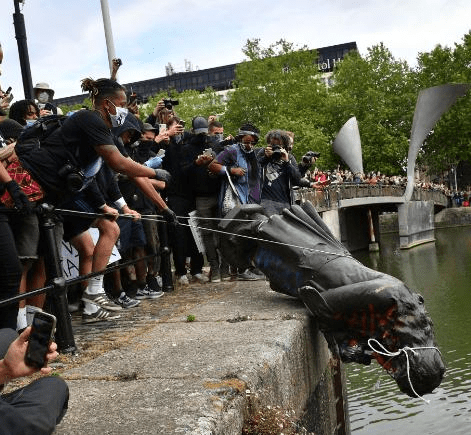
As a great benefactor of the city of Bristol, a statue was put up to Colston in 1895, he is also commemorated in many ways around the city. Since the 1990s the statue has been a source of contention and a new plaque detailing his involvement in slavery was added. In the reaction to the killing of Floyd the statue fell victim to a mob and was torn down and dumped in the harbour. The plan now is for it to be retired to a museum, as has been done with a statue of Robert Milligan, a late 18th/early 19th century slave trader and founder of the West India Docks in London.
I can sympathise with the view that the money spent of charity was tainted by how it was got. I was in Bristol in 2018 and the plaque made it clear how Colston made his money. I would have been fine with him being exiled to a museum, if that was what the people of Bristol had decided, but for it to happen as a result of mob rule sticks in my craw. Also, to continue to benefit from his bequests is just hypocrisy.
The main focus in the US has long been memorials to specific Confederate generals and Confederate war memorials. It’s not for me to tell an overwhelming American audience the issues around these memorials, but I would like to give you my perspective. I can see the argument for removing many of these to museums where they can be given context. Whatever revisionists say the American Civil War was fundamentally about slavery, there were other issues, but I simply don’t see how a war would have started without the incendiary issue of slavery. The Confederacy was trying to keep slavery and therefore those fighting for the South, even if they did not own slaves themselves (and only around one in four did), were fighting to maintain the institution.
That said, the undeniable courage of Confederate soldiers and the dogged resistance against a stronger opponent is clearly something that is part of the heritage of many in the south, a part of the self-image. Even if the cause was not a just one, I can’t help feeling men who died for it deserve to be remembered. It was, after all, a civil war, and civil wars require reconciliation, not just a peace treaty. I can sympathise with both sides on this one (Lord, I loathe sitting on the fence), it might seem like a cop out but I feel strongly that whatever decisions are made it should be at most local possible level, in the communities where each memorial is. Either way, mob rule cannot be justified or tolerated. Those tearing down statues were never slaves, nor do they know anyone who was.
The civil war theme brings me nicely to the Lord Protector, Oliver Cromwell. As part of this whole campaign the crosshairs of the Tofu Taliban have focused on his statue outside the Houses of Parliament. In this case the crime is not slavery, although he can certainly be connected with it, but with his campaign in Ireland in the 1650s. I’m not going to pretend that Cromwell was anything but severe and ruthless in Ireland. He massacred the (largely English) garrisons at Drogheda and Wexford and drove Irish Catholic landowners from their estates in the east and caused the death of many thousands in Ireland. Unacceptable by our standards, unexceptional by the standards of the mid-1600s.
As with many other threatened statues it’s important to look at the whole picture. Cromwell was memorialised despite, not because of his legacy in Ireland. The statue in question was put up in 1899 and not without heated debate in Parliament. Irish Nationalists joined with many Tory minded Conservatives to oppose it. He was, after all, the man who organised the trial and execution of King Charles I, a not uncontroversial act even today. Nevertheless, he is there because without him the constitutional settlement that came out of that confused tangle of conflicts we call the Wars of the Three Kingdoms (of which the English Civil Wars are part) would never have happened. For all his faults and crimes, he is an incredibly significant figure not only in English and British history, but also therefore in American, Canadian, Australian and New Zealand history.
His pre sence is also a part of the coming to terms with civil war and a vivid reminder of how we got to where we are. Cromwell stands directly outside Westminster Hall, where Charles I was tried for treason against his people. At the other end of Whitehall is a statue of Charles I, in between is the Banqueting House, where the headsman’s axe ended his life. When the Queen travels to the State Opening of Parliament each year her coach takes her down Whitehall, past the site of her great x 10 uncle’s execution and then, almost the last thing it passes before it pulls up in Old Palace Yard, is the statue of the man who brought that execution about as surely as if he had held the axe himself . A powerful reminder of the Queen’s role in our constitution today and how it came to be.
As this is fast becoming a short book, I’ll look at one last statue before wrapping up.
Robert Baden-Powell was an eminent Victorian soldier. He’d joined the Army as a Lieutenant in the 13th Hussars in 1876 and retired in 1907 as a Lieutenant-General. He took part in the Zulu, 2nd Matabele and Ashanti wars and won fame as the commander of the garrison of Mafeking during its 217-day siege in the 2nd Boer war. However, today he is most famous for founding the Scout movement. During the Matabele campaign Baden-Powell had met the American scout Frederick Russell Burnham who introduced him to woodcraft, and also to the practical neckerchief and the distinctive “lemon squeezer” Campaign hat, once worn by Scouts and still worn by Canadian Mounties, the New Zealand Army, US Army, Marine and Air Force Drill Sergeants and a variety of other uniformed defenders of Freedom.
It is to commemorate his role as founder of the Scout movement that the threatened statue by Poole Harbour was set up. It looks out across to Brownsea Island, where the first Scout Camp was held. Interestingly, although they do site his Imperial career, it is the much more sensational, but much less concrete, charge of being a Nazi sympathiser that the cultural Marxists have given as a reason for tearing down old B-P. They site the similarity of the Scout and Hitler Youth uniforms, the fact that one of the early Scout awards had a swastika on it, the fact that B-P went to Germany in 1937 for talks with the head of the Hitler Youth and that he made favourable remarks in his journal about Mein Kampf. Pretty damning isn’t it? Let’s take it point by point and watch how the carefully constructed snowflake melts in the sun.
The Scout uniform already existed for years before the Hitler Youth was formed. They are similar for the excellent reason that the National Socialists copied the Scout uniform when they formed the Hitler Youth, not the other way around.
The swastika on the medal? Again, pre-Nazi, not pro-Nazi. The Indo-European swastika symbol and the less familiar counter-clockwise version the sauwastika, were associated with luck and power and were widely used in Europe and elsewhere towards the end of the 19th century and the first decades of the 20th. They appeared on book covers, dresses, company logos all sorts of places. The Danish Carslberg brewing company, the Finnish Airforce and even a laundry in Dublin all used the swastika. The National Socialists adopted it in 1920, calling the Hakenkreuz. After they took power in 1933, and especially after 1939, it tended to be dropped by other users as the National Socialist associations made it too toxic. Despite its strong associations with an evil regime it is still used by Hindus to this day and when I was a kid in Southall in the ‘80s the Shree Ram Mandir in King Street had two, yard wide, red sauwastikas painted either side of the front door.
The trip to Germany? The Nazis had banned the Scouts and made the Hitler Youth the only youth organisation allowed in Germany. B-P went to discuss things with his opposite numbers, maybe the possibility of getting Scouts un-banned, who knows? If he’d gone to Moscow to talk about the Young Pioneers would that make him a Commie?
Lastly his comments on Mein Kampf. B-P does write in his journal that he was impressed by certain ideas in the book such as on education. He makes no mention of Hitler’s ideas on Jews and was in fact highly critical of all totalitarianism. He himself was on the list of people to be rounded up and arrested if the Germans had managed to invade Britain, hardly evidence of Nazi sympathies.
Again, Baden-Powell can certainly be criticised, certain episodes in his career in Africa in particular, but the statue is not there to mark his career as a soldier, or his ideas about Mein Kampf, it is there because he founded a youth organisation with 57 million members around the world and which has been an incredibly positive influence in the lives on many millions more. Perhaps that is just why he’s become a target, significantly the Scouts became legal again in West Germany in 1945, but they were illegal in East Germany until 1990. As a former Cub Scout myself I am delighted how people have rallied round to protect both B-P’s statue and his memory.
The more I look at this issue the more convinced I am of the cultural Marxist motivation behind this iconoclastic campaign. One element that crops up again and again is the profound historical ignorance of the people who want to tear things down. In London they thought the statue of the founder of the Metropolitan Police, Sir Robert Peel, was of his father. In Philadelphia the statue of prominent abolitionist Mathias Baldwin was defaced. They’ve attacked Abraham Lincoln. Speaking on the statue issue Chair of Lambeth Independent Police Advisory Group and community activist Lorraine Jones seemed to think Churchill was still with us. When asked if Churchill’s statue should be removed, Ms Jones replied: “I’ve heard many arguments on both sides. Some say that he’s a racist. Some say that he’s a hero. I haven’t personally met him,”. ‘Nuff said.
It is the nature of statues that they commemorate significant people. It is the nature of significant people that they often made mistakes and were often awkward or objectionable people. They were all, as we all are, products of their own time. We remember Caravaggio and Mozart for their art, not their personal lives. There’s a statue of Nelson in Trafalgar Square not because he was vain, insecure adulterer but because he stuffed the French. If someone was significant in politics or war there are bound to people who won’t like them, to say the least.
In a country as old and complicated as Britain there are memorials to all sorts of folk who were opponents and even enemies. What would Churchill’s reaction be to the fact that there’s a statue of Gandhi in the same square as him? (A scowl followed by a wry smile is my guess). We have statues to Richard III and Henry VII, Cromwell and Charles I, James II and William III, Gladstone and Disraeli. One of the statues in Parliament Square is of Jan Smuts, a Boer commander who fought against the British in the 2nd Boer war and for us in the First Word War. History is complicated and statues illustrate history and show us where we’ve come from. They’re not meant to be idols to worship or role models for today.
When you take all of this with the fact that even statues of abolitionists and the likes of Gandhi have been defaced, the swift expansion of the campaign to film, books and TV and for reasons far removed from slavery, a compelling picture appears of folk who simply want to tear down the past in order to lead us to the shining uplands of our socialist future. Don’t let them.
3 replies on “Old dead white guys matter (Part Two)”
Thank you for rising to the defense of Sir Baden-Powell. As an Eagle Scout, it deeply saddens me to think that even he, a man who did immeasurable good for the world, does not escape the attacks of the blindingly ignorant thugs who seek to destroy the beautiful things they could never hope to build.
Congratulations on your rise to Eagle Scout. I would have been a scout if there was a troop nearby when I was growing up.
Thanks