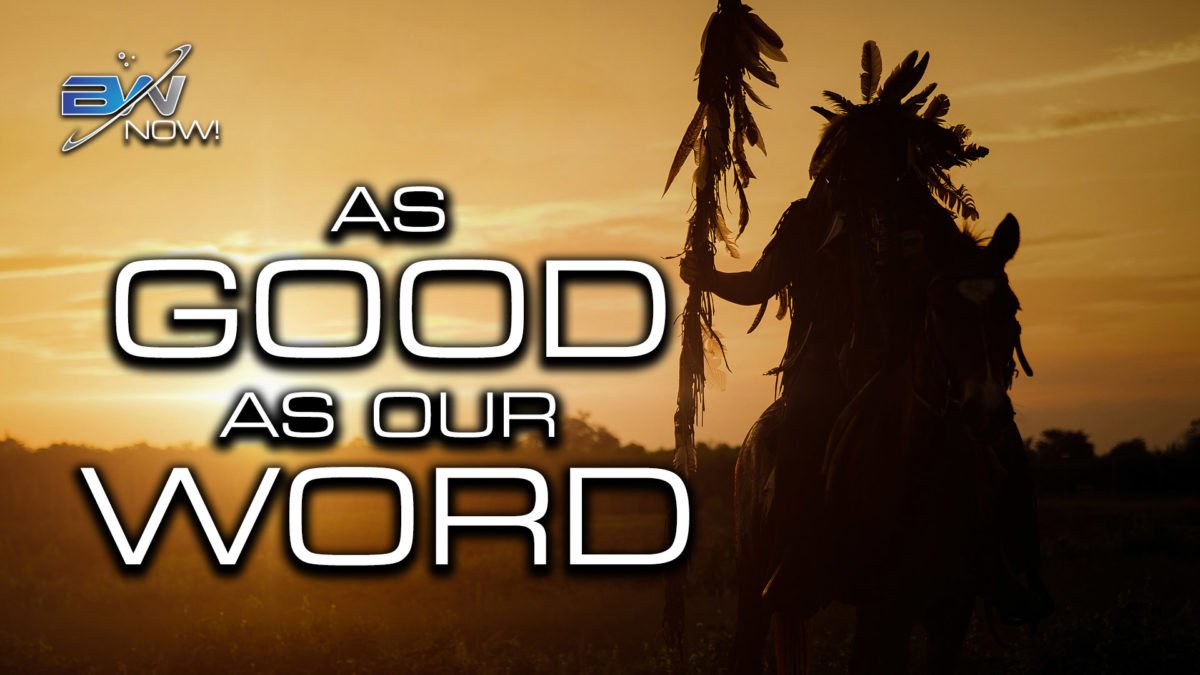
The Supreme Court decides that the Muskogee (Creek) Indian reservation in Oklahoma — created by a treaty with the USA — continued to exist after Oklahoma became a state. In a majority opinion written by Trump-appointee Neil Gorsuch, the tribe regains legal jurisdiction for most crimes on reservation land, a territory amounting to about half of the state. Serious crimes like murder or child rape must be tried in federal courts. This means some criminals convicted under state law will get new trials, including Jimcy McGirt, who appealed his child sex abuse conviction which led to this landmark SCOTUS decision.
Bill Whittle Now with Scott Ott is a production of our Members, who join by clicking the big green ‘Become a Member’ button.
Listen to the Audio Version
Bill Whittle Network · SCOTUS: USA Must Honor Indian Treaty, Half of Oklahoma Now Under Tribal Jurisdiction
12 replies on “SCOTUS: USA Must Honor Indian Treaty, Half of Oklahoma Now Under Tribal Jurisdiction”
Excellent comments below from some folks who appear to have knowledge and experience in the Federal/Tribal relationships and jurisdictions.
Looking at the bigger picture here, it seems to me that what might turn out to be important in this case has nothing to do with the Indian treaties. It may be more important that Gorsuch’s view–you broke it, you own it, so go Do Your Job and fix it, Congress–prevailed over Roberts’s view on institutionalism and stability. Roberts will vote to uphold a law he previously held unconstitutional because he lost the earlier case, so to overturn it now would destabilize the system and lead to chaos. Gorsuch says do what’s right and let the chips fall where they may.
I know which view I prefer.
Hmm. If reservations can host casinos, even in conflict with state laws, can they also have, say, legalized prostitution or opium dens?
ACTS is correct this is a complex topic, and correct that the decision’s effect may rather limited. But calling the decision the product of a government screw up is a bit oversimplified, I think. No one in the case disputed that Congress can “disestablish” a reservation by congressional action. Congress can, by legislative action, break its promises if it wants to. The question was whether Congress’ past actions were sufficient to do just that..
Justice Gorsuch, who is sometimes described as a “textualist”, said Congress did not disestablish the tribe because he could not see a statement actually doing that in any of the past congressional actions. The dissenters pointed out that the congressional action, coming when it did, left no doubt that the Congress intended, and effectively did, disestablish the reservation.
For example, the dissent notes the tribe held slaves and sided with the Confederacy during the Civil War. Still later, the Indian Territories, with white settlers flooding in, proved very difficult to govern. The following is a quote from the dissent, which describes the past congressional action:
Attuned to these new realities, Congress decided that it could not maintain an Indian Territory predicated on “exclusion of the Indians from the whites.” S. Rep. No. 377, at 6. Congress therefore set about transforming the Indian Territory into a State.
Congress began by establishing a uniform body of law applicable to all occupants of the territory, regardless of race. To apply these laws, Congress established the U. S. Courts for the Indian Territory. Next Congress systematically dismantled the tribal governments. It abolished tribal courts, hollowed out tribal lawmaking power, and stripped tribal taxing authority. Congress also eliminated the foundation of tribal sovereignty, extinguishing the Creek Nation’s title to the lands. Finally, Congress made the tribe members citizens of the United States and incorporated them in the drafting and ratification of the constitution for their new State, Oklahoma.
. . .
A century of practice confirms that the Five Tribes’ prior domains were extinguished. The State has maintained unquestioned jurisdiction for more than 100 years. Tribe members make up less than 10%–15% of the population of their former domain, and until a few years ago the Creek Nation itself acknowledged that it no longer possessed the reservation the Court discovers today. This on-the-ground reality is enshrined throughout the U. S. Code, which repeatedly terms the Five Tribes’ prior holdings the “former” Indian reservations in Oklahoma. As the Tribes, the State, and Congress have recognized from the outset, those “reservations were destroyed” when “Oklahoma entered the Union.” S. Rep. No. 101–216, pt. 2, p. 47 (1989).
To be fair the majority did not ignore these things. The majority argues it would have been easy enough for Congress to just say it was disestablishing the reservation in the law itself, if it really wanted to. The majority felt it could not just imply disestablishment. So, calling it a federal screw up depends, I think, on how narrowly or broadly you look at the congressional action.
I am very familiar with the Federal/Native American legal dichotomy, having served for many years as an Assistant U.S. Attorney in Arizona. Among other things, we prosecuted serious felonies that were committed in tribal nations like the Navajo Nation. Those felonies were investigated by the FBI, often with the help of tribal police.
I have frequently consulted with both FBI agents and tribal officers on the phone, attended joint conferences, and even taught at the Navajo Tribal Police Academy.
I can tell you that these offenses in my experience were regarded as important and treated accordingly by all concerned. Mr. McGirt, parenthetically, may find this a Pyrrhic victory since he will face prosecution by an attorney at least as experienced and competent as the Oklahoma authorities, who will have the current evidence, which has proven strong, as well as whatever else may be revealed by the FBI in the follow-up investigation. In addition, should he be convicted again, which I would expect, he will serve his sentence without possibility of parole, since parole has been abolished at the federal level for decades.
If you are curious about this unusual allocation of authority, or any other issue regarding federal criminal law, I would be delighted to discuss it further.
I remain a most interested member of the Bill Whittle Network.
John Stevens
Seem to recall this theme of jurisdiction on Reservations being repeated in many movies and TV shows over the years. I recall most violent crimes resulting FBI being called in.
The jurisdiction of the Tribal system in any Band is limited* and all matters regarding Indian Affairs are under U.S. Federal jurisdiction. Whether they like it or not (most do, btw) Native Americans born in the US are still Americans and thereby entitled to all the privileges and protections of any other American citizen. Which means that tribal groups cannot make or enforce any laws at odds with Federal Law. The Constitution, USC etc. apply on the reservations the same as anywhere else in the U.S. with some minor exceptions and special cases.
This is why the FBI has primacy over investigations on reservations. Felonies and the supervision of Tribal Law Enforcement are Federal matters. This is why your recollection of the FBI being deployed to reservations in moves and TV is correct. Federal agents have jurisdiction on reservations while state and local law enforcement agencies do not.
That said, the Bureau of Indian Affairs, which is in the Dept. of the Interior, just got a whole lot more significant because now half of an entire U.S. State is under their purview.
*This was accomplished with the 1871 Indian Appropriations Act which severely deprecated Indian sovereignty within the borders of the United States. America had gotten strong enough to flex her muscles internally and with that Act for all practical purposes made Indians into American citizens subject to American laws rather than citizens of sovereign Indian nations. Which also means that their reservation boundaries are malleable and subject to things like Imminent Domain …
Thank you for the response. Not sure I like any federal agency growing in stature. But it never seems to go the other way. Entropy in Federal Agencies is a “expletive deleted”.
Sometimes it’s a good thing, though the jury is out on the situation in OK. It’s doubtful that the people affected will see their lives materially improved and the opposite seems more likely to me.
By “good thing” I mean Federal control superseding state control. In places like the Soviet Socialist Republik of Kalifornia (aka Mordor) it’s good that Californians are protected and their state government restrained by the Federal government. Were it not for the constraints of the Federal government and the Constitution … California would be both workers paradise and gulag. But I repeat myself.
One faction of the Sioux Nation, I believe that is the Cheyenne River Sioux Tribe, claims ownership of the Black Hills because of a treaty with the United States government signed in 1868. When President Trump spoke at Mt. Rushmore on the 4th of July, a member of that tribe stated that the carvings on Mt. Rushmore are “offensive” to his people, and the monument should be destroyed. By Bill’s logic, that should be permitted. Does he really support such an action? The Sioux (originally from the upper Mid-West) took that land from another tribe, possibly several, when they began their westward migration earlier in the 19th century. There are no “Native Americans”. Everyone came from somewhere else. In the case of the so-called “indigenous” people, that was from Siberia during the last Ice Age. The decision of SCOTUS may indeed open up a never ending series of treaty violation claims.
Um, no, that’s not the case here. I doubt Bill would “support such an action”. The distinction in this case regarding Oklahoma is that the treaty was never formally altered or abrogated. So under U.S. Law that reservation still legally belongs to the Native Americans (it’s what they call themselves, I’m not making a statement pro or con regarding that) to which the treaty applies.
This is a very complex topic but in a nutshell — The 1868 treaty (“The Treaty of Ft. Laramie”) regarding the Black Hills was formally abrogated in 1877 and the lines redrawn to exclude the Black Hills. Because gold was found there. The alteration of boundaries was also at least in part due to the massacre of the U.S. Army 7th Cavalry. At the Little Bighorn river. Said 7th Cavalry being led by one General George Armstrong Custer.
You can argue whether that abrogation was fair or not, in fact Sioux, Arapaho and Pawnee Indians have been arguing since 1877 to this very day and still refuse to concede that their boundaries are not as they were under the original 1868 treaty but … No matter how you look at it the abrogation of the treaty was done formally and legally. Which is not the case in Oklahoma.
Oklahoma was a screw-up, in the legal sense. The SCOTUS ruling over that screw-up does not open the doors for cascading claims of broken treaties resulting in the Indians taking back the United States of America and ruling us all with neolithic tribal mores and taboos.
Now, all of that said, the SCOTUS ruling most certainly will result in a whole herd of tribal lawyers scrutinizing any and all treaty documents for similar screw-ups. So this is far from over but it will follow our own laws and be legal no matter how the chips fall and the dust settles. This situation was less a matter of the American government being “as good as its word” and more one of Indians applying existing laws to their advantage to exploit a foolish and arrogant oversight. This being their right, as equal protection under the law, the same as any other citizen or group of citizens.
The child molester McGirt’s case was just a vehicle. He’ll be re-convicted and sent to a Federal penitentiary. It’s not double jeopardy if the court that originally convicted him had no jurisdiction and the best he can hope for is to get credit for time already served off his Federal sentence. Unless his sentence is life. The Federal system does not do parole since the “truth in sentencing” laws passed quite a few years ago. A Federal inmate can earn time off by good behavior (up to 54 days a year) but there is no time off to be earned in a life sentence with no parole.
Re: “There are no ‘Native Americans’.”
I was born in Kansas City, Missouri, in 1961. I sure as hell ain’t native to any other country, despite my very Italian last name (which is shortened in my member name because people always mispronounce it). And I’m probably not even of Italian descent, being adopted and having no information about my biological parents.
I don’t see how I can be more native American than that.
Looks like Fauxcahontas cen get to be President after all!