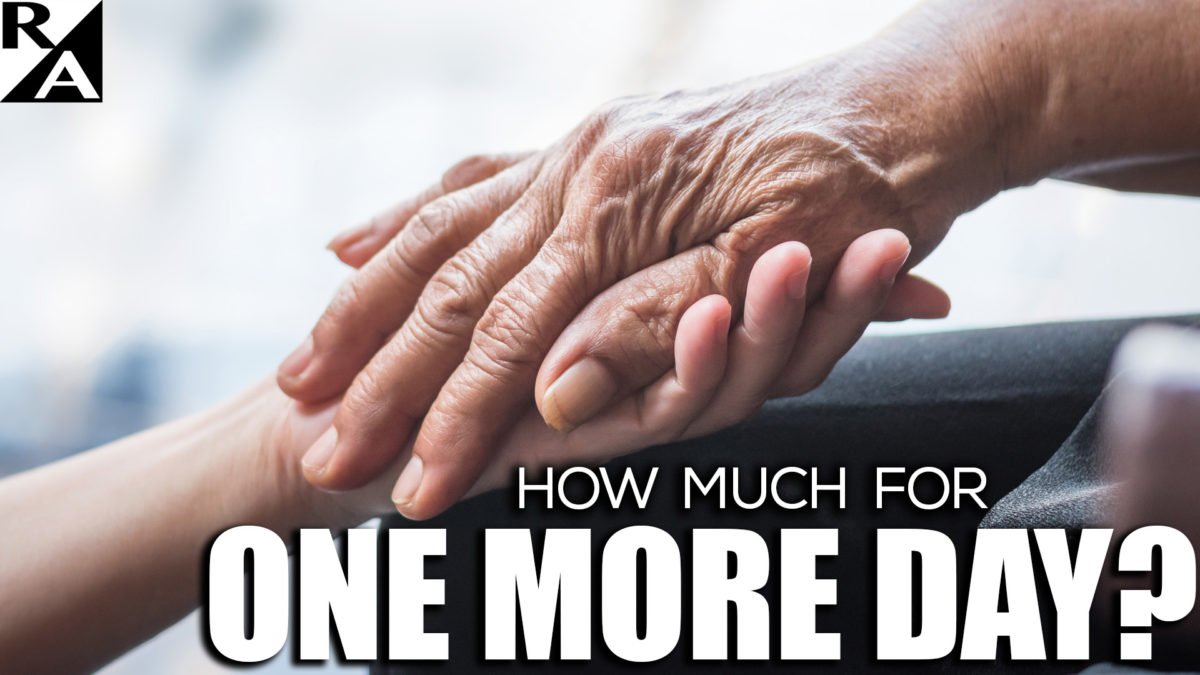
Aduhelm sparks controversy as a therapy drug for Alzheimer’s patients that attacks amyloid plaques in the brain, and slows the decline of memory and problem-solving by about 25% over time. It’s not a cure, and it can’t even restore lost mental capabilities. Now that the FDA has fast-tracked approval, should American taxpayers cover the $56,000/year per patient cost for relative minor results?
Scott Ott, Stephen Green and Bill Whittle create 240 new episodes of Right Angle annually, thanks to our Members. Join us now.
Video below hosted at Rumble.
29 replies on “Alzheimer’s Therapy Drug: Should We Pay $56,000 to Slow the Loss of Mom’s Mind?”
Sadly, science and medicine have gotten very good at giving us a good quantity of life, but not always a good quality of life.
I was born with a heart defect… a complex one. And I was born in the mid-70s which means they didn’t have the surgeries figured out for my condition. I have had 4 heart surgeries to keep me going with the last being 32 yrs ago. I did not have the final surgery which causes me to have low oxygen levels.
I think I live fairly normal, but going up is not easy for me… up hills, up stairs… I walk slow anyway and up gets me out of breath.
I would love to have a higher oxygen stat, but at what cost? What might another surgery do to me? How might my body respond?
I prefer to keep the quality I have.
And the day that I have to help the little girl in my picture cross the Rainbow Bridge will be a rough one. And I also know it is probably coming in the months ahead. She is 15 or 16 and has arthritis. She feels like nothing but skin and bones, but she is still eating, so I continue to work with her.
If it works they will find a way to get the price down but first you must verify that it works. This is a prototype price.
They should, as President Obama suggested, take the pill. It will be a win/win for the Democrats. They won’t be a burden (thereby reducing the amount left to spend on buying live votes) and, the sooner they’re dead, the sooner they can begin voting Democrat
I’m in a related position. I have cancer, and my treatment is quite expensive. The doctors think they can get me a decade, and I’m hopeful that by the end of that decade, they’ll be able to get me another decade, or maybe even a cure.
I’ve been on one drug that has gone generic over the past few months, so its price should be dropping quite a bit. Other treatments, such as the stem cell transplant, will probably remain expensive, but maybe alternatives will make them less of an option. (For example, if they could target only the specific cells that went cancerous rather than the entirety of the patient’s bone marrow…)
Fortunately, I have kick-ass insurance.
Selenium is great for increasing bone marrow production and white blood cell count.
When this topic was discussed on Back Stage – the value of a grossly expensive, marginally effective medication for Alzheimer’s Disease – I wondered why the FDA would champion Aduhelm. I suspect its potential value rests exclusively on who is needing it right now. Perhaps several high profile individuals in each of the three branches of government?
Agreed. I think these gentlemen are going about this the wrong way. For instance, why did Rendesivir come out when Ivermectin and hydroxychloroquine banned from hospitals, though it was proven to be more effective than rendesivir? And why is Google and youtube suppressing posts about vitamin d, c and zinc?
You guys are being naive if you think this isn’t about money and fall into the trap of weighing a loved one against a cash sum.
The real question is why does this cost so much to produce? Where are the explanations for this? What is so rare that it grows on the highest mountain and in the nest of the Phoenix that it should be so difficult to find?
My mother, like Bill’s, was lost to me for the last 10 years of her life. She was an empty husk, but still a human being. In the last stages of her life, she was on a feeding tube inserted in her stomach. I. prayed for God to end her suffering, which He finally did. However, when the doctors asked me to authorize the removal of that tube, and in effect allow her to starve to death, I couldn’t do it. To me, that was euthanasia, and a sin. But here’s the real question. If the Democrats are willing to allow millions of immigrants, both legal and illegal, to receive Social Security, Medicare and Medicaid payments, plus a myriad of other social welfare benefits, how can we in good conscience deny CITIZENS, many who have paid into these programs for all their adult lives, be denied them because of the cost. As Scott said, perhaps if these payments are allowed, it will lead to further research and greater benefits, up to and including a cure for this awful disease.
I had to put down my cat, Gracie, last November. She was almost 17 and had stopped eating and drinking. I hand-fed her treats to get some calories in her, but she was getting too weak to walk. I made the decision that morning to let her go. She was the fourth cat I helped cross the rainbow bridge and it never gets easy. 🙁
Its a very hard decision to have to say goodbye to a beloved pet, i’m contemplating that right now and putting it off. But as for this drug, i’ve read that the doctors studying it at FDA did NOT approve its approval by the FDA. They went over the medical recommendation. The studies showed that it caused little improvement and actually more harm in the way of brain bleeds & swelling, but the good federal employees were looking to please the pharma companies and toward their retirements. See Townhall.com, June 10, 2021, How a Questionable Drug Turned into a Goldmine at Taxpayers’ Expense by Devon Herrick.
Bill, I’m very sorry for your loss. I had to make that same decision twice last year and it broke my heart.
Now to the business of this drug. My first question is: Why does it cost so much? There was a comment made about the R & D cost of producing new medications, but all the large Pharm companies get some government grant money for R & D, whether directly or through the use of University facilities and students doing parts of the research. So the government has already supplemented the up front costs of any new drug. The Pharm company takes product cost, r & d cost, and adds in a substantial mark up, to tell the public that is the retail cost. They can charge that amount because they know it will likely be an insurance provider or the government paying the tab and then passing the cost to the customer per whatever plan or deal that customer has signed on for. Most people cannot pay ~$4700.00 per month in medications, but the producer of the drug doesn’t have to worry about that. They’re being paid by an entity wth deep pockets who then disperses the cost to all their customers or taxpayers. If either the insurance companies or the government said they won’t pay for it, then the price would go down significantly, because a drug with no customers doesn’t make Big Parma any money. But because Big Pharma is such a powerful lobby, our elected officials are more invested in them than in the public’s interest.
Going somewhat off topic here, but still indirectly valid to this segment:
This view that we would dip into someone else’s resources to have them pay “involuntarily” for healthcare (or whatever other good something) for our personal or family’s benefit is (or should be) a flawed way to look at it. In our constitutional republic, with provisions that tax laws are initiated in the House of Representatives, etc., means that, at least for us — in theory — taxation is not theft, but a conscious social and political decision to (willingly if grudgingly) pay for selected governmental services. And as it is now famous to attribute to Thomas Sowell, he said often there are no real solutions, only trade-offs. But our solutions and our decisions about those trade-offs are typically pretty open to debate, although I grant that things have really gotten off the “ideal” rails for some time now, with crony capitalism, rent seeking, etc.
But before our representatives can be honest with us, we need to be honest with ourselves, and give them the clear message that we know TANSTAAFL applies, and we expect them to manage and handle our resources, expectations, and obligations in a moral and honest way. That you might argue that is not happening is as much on us as on them.
And unfortunately we almost never hear, even from the Republicans, “ok, if you want to pay for X, what portion of existing expenditures for Y and Z are you willing to give up or diminish?”
And, what exactly can we do to highlight and correct those elements of cronyism, favoritism, rent seeking, normal or “illegal” lobbying, campaign funding, etc. that would cause things to improve as we wish. How have the elites become oligarchs in a nominal republic? Legislative and judicial malfeasance must have played a part, and may be the most difficult to revise or reform.
To finish this particular rant, I have been thinking lately that “we need to start getting serious” must be part of our rally cry to return to the America we feel we are now losing. We have not been serious for far too long now. MASA.
Flawed way? Constitution can be amended. Or just ignored. IUC the USA constitution started with enumerated powers for the state. And did not allow things like federal tax.
Then eventually it gained an amendment (16 or 17th?) to that effect. And in theory it still has prohibition on forcing citizens to certain service — but that did not stop introducing obamacare, or helped to take it down despite several rounds at SCOTUS. (And all the rights mentioned in the first handful amendments are trampled on routinely.)
Those who are robbed blind by the state either by or against the law are IMHO entitled to just call it the robbery.
Also, you can watch how those “representatives” actually work: pelosi puts down a 10k pages bill they are supposed to wot on before reading. And they vote on it. Your “conscious social and political decision” in action.
We keep talking about the colors of the emperor’s new clothes. O,O
What about the moral question of the medical CPI being above 540, being more than twice the next highest index?
Captive legislation by the medical mafia, milking the macroeconomic contracts stimulating the skyrocketing prices. Those companies are squeezing the entire population because they’ve already edged out any other form of care, i.e. Flexner Report.
Ask yourselves why ozone (O3) is listed as a toxic substance by the FDA. It can be made cheaply, and would wipe out most known diseases and cancers.
The oxygenating of the body allows for it to resume natural regeneration.
Anyone else sick of the medical tyranny?
Hm, ozone is listed as toxic for the simple reason it IS toxic. It can agressively oxidize most substances and form peroxids on kinda all C=C bonds. leading to bad things.
Sure you can use it to “wipe out cancer” by killing the patient first, but just shooting in the head would be more humane.
And all that was known when organic chemistry was still a new thing, well before the medical tyranny took over.
Thanks for the reply.
““wipe out cancer” by killing the patient first” is what chemo and radiation therapies do. Thanks to the allopathic monopolies. Flexner Report, for reference.
My oncologist recommended chemo even though my post op scans came back negative. His explanation was that the scans can only detect tumors the size of a cubic centimeter or larger so… he recommended chemo “just to be safe…”
There is nothing safe about chemo. Moreover, those drugs are exempt from the massive resale profits that the oncologists pass on to the patient ESPECIALLY if they are well insured. i.e. Dr. pay $2k then charges the patient $10k on the receiving end.
The quackery is real.
Back to ozone. So 3 oxygen molecules are toxic? What about ozone filtration systems for swimming pools? Don’t they make the water clean enough to drink? Can’t O3 be administered in a controlled way to enrich the oxygen levels in the body? Cancer cannot thrive in an oxygen rich environment.
What’s your take on this?
“OZONE: ITS THERAPEUTIC ACTION – Dr. George Freibott”
http://ozonedetox.com/ozone/ozoneActionFreibott.htm
In the common language lot of things gets called “ozone” that has nothing to do with that chemical at all (including smell after rain/thunderstorm”. Water purifying systems also may be just mislabeled and really use any any random oxydation agent. That works fine. And after whatever they use, including really ozone, it is already DONE its job and not present in the output any longer. Those systems must pass certification on residue chemicals. Using this to argue the substance is not toxic is just a pretty bad idea.
As for enriching body oxygen levels, most times that is another bad idea. The elevated concentration is hurting by also creating oxids and peroxids in excess. The organism has countermeasures but you can overshot that. And usually you have just enough O2.
In the cases where you don’t, doctors should work on the root cause, what is often tied to bad circulation, some lung problem reducing the useful surface or gas travel, or respiration muscles or obstruction in the higher airways. while those get back to work you may get some temporary assistance including higher concentration in the air intake, but it is supposed to be properly measured to just get back the normal levels. And it uses O2, never O3, for reasons that should be very obvious for those who studied biochemistry and physiology.
Thanks for that reply.
What about the rest of the world that actually does use ozone medically? I know that the allopathic medical industrial complex wants to maintain its monopoly here in the states, through captive legislation.
Germany does have any problem with medical ozone treatments.
https://isco3.org/officialdocs/
Err, I lost the thread. You stated the problem about calling ozone toxic. Most of the substance used in medicine are toxic. That alone is not necessarily a problem since packaging is done in factory that can put exact amounts in a capsule.
The practical problem is more often the therapeutic range — the difference between the effective and harmful/lethal dose. Those can be very close. And it’s still used based on risk/reward analysis.
The real problem is WHO does that r/r analysis. Ideally we should have doctors who know the science and have infinite time to explain nuances to patients. So then the latter can make an informed decision.
In reality we’re lightyears from that, even dropping the unrealistic parts. And going in the other direction over time. Resulting in global “for everyone and damn the circumstances” decisions made by pencil pushers in a ministry. Or an insurance company. Based on some aggregate data and lobby power. Doctors degraded to robots. Patients pay through the nose or can chose to find a different country not yet ruined. Don’t ask me where to find one.
Here is an extensive library of medical reference I found.
https://www.zotero.org/groups/46074/isco3_ozone/library
How do you access the content from here? I only got abstract and refs. The few that have URL are broken.
The page is set up similar to your file browser; Left pane is the library’s file tree, folders and sub-folders arranged by topic.
The center pane show the contents of the selected folder as a list of documents.
The right-hand pane show details about the selected document in the center pane. There is a URL link listed there under the info tab.
Not all documents have external links.
I figured out that much. And as said before found that a document with a link is already a rare find, and then the links don’t work, like the one in your screrenshot goes 404.
And the few that lead somewhere only have the same abstract as the db contains, no access to the article text.
So let me ask again, did you read any articles in this “library”? If so, how?
Or you just read the abstracts and try to quote that as information? For those who don’t know, it’s NOT the due process 🙂 the abstract is the equivalent of the article titles in your random newspaper that only serves as click bait.
Ahh..
Thanks for making that point.
The memory hole is real.
When I hit the 404 wall. I will search the archived instances of those pages before they were deleted.
Archive.today is a site, among others, where people can paste a dead link and get the earlier versions.
Besides that, I look to any citations or names associated and search for their other works. Many have personal websites containing their findings and holdings.
Beyond that, timeliness matter when researching because if how fast the information is being retracted, redacted, or deleted. If you find something worthy, pull in down and save it locally. Then archive the link for posterity.
The great libraries are burning again.
See also; Solutions Watch at CorbettReport.com
Like all of you’ve experienced, “it” was my grandpa who suffered and eventually died from Alzheimer’s. If the $56000 drug dosage option was available then, I don’t think it would’ve been an option for us, and I am certain that it would not have crossed our minds to impose such expense upon anyone else. Charity is an acceptable alternative, but the imposition of such expenses by means of forced taxation is anathema to individual liberty.
I realize this sounds callous, but there are some aspects of life that are inescapable:
You have to wonder how many people could receive this drug through Medicare in exchange for not funding research on Chinese trannies, or does Mario Kart help African senior citizens, or any of the other myriad stupid things the federal government wastes taxpayer money on.
Great points, all. And, Scott, yes it is a very personal thing for each of us. And you are correct, that generally, the costs come down while the efficacy goes up. I didn’t know which would happen first, my mom would lose her cognitive ability completely, or her lungs would stop working. Fortunately for all of us, it was her lungs. I don’t say that lightly, but the Sunday before she passed, my wife daughter and I spent a lovely afternoon with my mom. She was crystal clear, getting plenty of oxygen and basically holding court.
4 days later she was gone.
I think I got my one more day with my mom. See, she fell Saturday night and didn’t actually break anything. Sunday was a great day. I spent Monday and Tuesday with her obviously getting ill, but trying to line up 24/7 care as she was afraid to be alone.
The first hospice worked knocked on the door an hour after she passed.
So that Sunday was my one more day. I just didn’t know it at the time. But I am very grateful in hindsight to have had it.
I never got that with my dad. He had a massive coronary the night before they were coming for a visit. What would I give up to have a day like that Sunday with my mom, with my dad? Materially, pretty much anything.
The point is, you don’t know when the last trumpet sounds. So treat your next visit with a loved one as if it is your one day more.
I dread making the coming decision for my 4 dogs. But in one way, I already have. Back in 2019, I took my dog Jack, to the vet to look at his right rear leg that was getting misshapen and obviously painful for him. The vet thought it was bone cancer, and “He’s got 3 to 6 months to live if I leave the leg, and 6 to nine months if I remove it.” $1500 to remove. I went for it. He sent a biopsy sample to be analyzed, and it came back cartilage cancer. Much less dangerous. Now he’s got 3 to 6 years if the vet did not get it all. He’s ten now and will be 11 in October. He’s a fighter; he survived parvo while nearly a skeleton due to being on the street as a puppy in February.
I’m so very sorry for the loss of Pizmo, Bill. I’ve had to make that awful decision many, many times in my 70 years, for not only beloved pets, but for my mother and previous husband. I would love to spare my children that agony, but no one knows what the future will bring. My sincere condolences and wishes that warm memories will help with your grief.