As race and the history of slavery is very much to the fore, I thought I’d lay this fascinating story from the early 1700s before you.
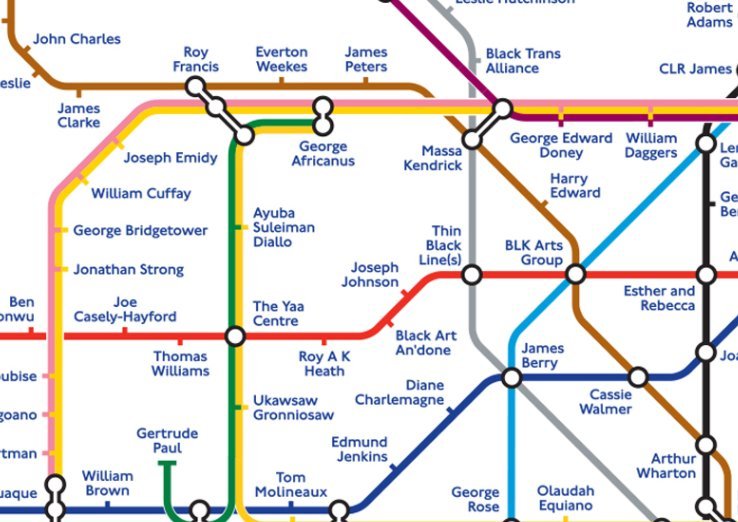
Last Black History Month, (the UK’s BHM is in October) one of the various things done was the production of an alternative to the iconic London tube map by Transport for London, with the station names changed to the names of prominent black people with link to Britain (as there are 272 stations a lot of the ‘people’ are actually groups, like the Black Trans Alliance, what fun!). There have been various alternative versions of the map over the years, like the one with all the station names in Welsh, it’s not a formal changing of the names and is harmless enough compared to some of the toxic stuff that comes out during BHM.
I had a look at the “black” map, and I recognised some of the names, Tom Molyneaux, a prize fighter from the early 1800s, Cesar Picton, who was a wealthy coal merchant in Kingston upon Thames in the late 18th/early 19th centuries and Ignatius Sancho, the first black man, (that we know of) to vote in a British general election, in 1774. Most of the names were less familiar and one struck me for some reason, Ayuba Suleiman Diallo, so I looked him up. I’m glad I did, because his story does not fit with the usual narrative around the certainly shameful history of the transatlantic slave trade. As is so often the case, I’m sure the people who made the map are unaware of much beyond Suleiman’s skin colour.
Ayuba Suleiman Diallo was born in Bundu, West Africa (today Senegal) in 1701 and was a prince of the Fulani tribe. Being of high status, he was educated, could read and write Arabic and studied the Quran. He was a Sunni Moslem of the Maliki school of jurisprudence. As a high-status man of his time, faith and culture, he also owned and traded slaves. In 1730, while on a trip to sell two slaves in order to obtain cash to buy paper and other supplies, he was captured by Mandingo slave raiders and sold to a slave ship captain of the Royal African Company called Pike.
As it turned out Pike was aware of his status, as they had met before when Suleiman was himself selling slaves. Pike allowed him to send a message to his family, but the reply came too late, and Pike’s superiors insisted on Suleiman being shipped out with the rest.
He was transported to Annapolis, Maryland and sold to one Mr. Tolsey, who owned a tobacco plantation on Kent Island, Chesapeake Bay. At first Suleiman was put to work in the fields, but he was ill suited to such heavy work and was soon moved to lighter work tending cattle. Being an observant Moslem Suleiman would go out into the woods to be alone to pray. One day in 1731 a child came upon him praying and humiliated him. Sulieman ran away. On being recaptured he was locked up in the Kent County Courthouse.
At first his reason for fleeing was not understood, but luckily an African translator was found, and he explained what had happened. On his return to the plantation Tolsey set aside a private area for Suleiman to pray undisturbed.
During his stay at the Courthouse Suleiman came to the attention of one Thomas Bluett of the Society for the Propagation of the Gospel. Bluett was impressed by Suleiman’s “affable Carriage, and the easy Composure of his Countenance”. Through another translator his background and the circumstances of his enslavement were explained. Tolesey allowed him to write to his father in Africa and on its journey the letter came into the hands of James Oglethorpe, Director of the Royal African Company (and founder of Georgia).
Oglethorpe purchased Suleiman for £45 and sent him, accompanied by Bluett, to England. By the time he arrived in England he had learned some English, but his status once there was vague. Strictly speaking he was a free man as soon as he stepped off the ship, but this point had not been fully established in law and he was worried he would be sold again. Sympathisers collected money and his freedom was purchased for the rather random sum of £59, 6 shillings, 11 pence and 1 ha’penny. According to the National Archives historic currency converter that equals a bit more than £7,000 or £9,100+. However, converting cash across centuries is a tricky thing. The figure is also equivalent to 595 days wages for a skilled tradesman., something more like £100,000.
By now it was 1733 and Suleiman was able to enjoy the company and patronage of London’s high society. He was even presented to the Royal Family. He helped Sir Hans Sloane, the father of the British Museum, with his collection of Arabic manuscripts. Suleiman practiced his faith freely, and he gently but firmly resisted his new friends’ attempts to persuade him of the merits of the Anglican Church. His portrait was painted by William Hoare.

In 1734 Suleiman returned to his homeland a free man. Although he regained his former lifestyle, things did not go all his way. He was imprisoned by the French for about a year, probably in part due to his close English ties. The minutes of one of the groups he met in England, the Spalding Gentlemen’s Society, records news of his death in 1773.
So, a slave who was himself a slave owner and trader. A slave owner in Maryland who moved his slave to lighter, more suitable work and allowed him religious freedom. English gentlemen who spent large amounts of their own money to free a fellow gentleman of a different race and faith. Not exactly the narrative we’re sold.
Of course, Ayuba Suleiman Diallo’s story is far from typical. I’m not suggesting the slave trade was anything but shameful, but this story does highlight the massively overlooked fact that the slave trade was already endemic in West Africa before the Europeans arrived there. The vast majority of the ancestors of black Americans today were sold by their “African Brothers”, not captured by the evil white man.
The story really isn’t just black and white.
2 replies on “Two years a slave, decades a slave owner…”
Here in the US, there is a Public Broadcasting Corporation (IIRC, usually just called PBS) that has a show hosted by Henry Louis Gates (I think the same one caught breaking into his own house after he forgot his key, and Obama hosted his farcical beer summit) called “Finding Your Roots”.
Various celebs and notable people will have their family histories traced back a few centuries along with the various genetic profiling that sites like Ancestry like to advertise.
It always seems to surprise any of the black skinned guests when they find ancestors that were also slave owners in Jamaca, Cuba or other Carib islands.
Thanks, Davey. I really appreciate your historical knowledge of not generally well-known stories and events. Plus, your ability to present this information is superior. We would all do well to be scholars of history like you.