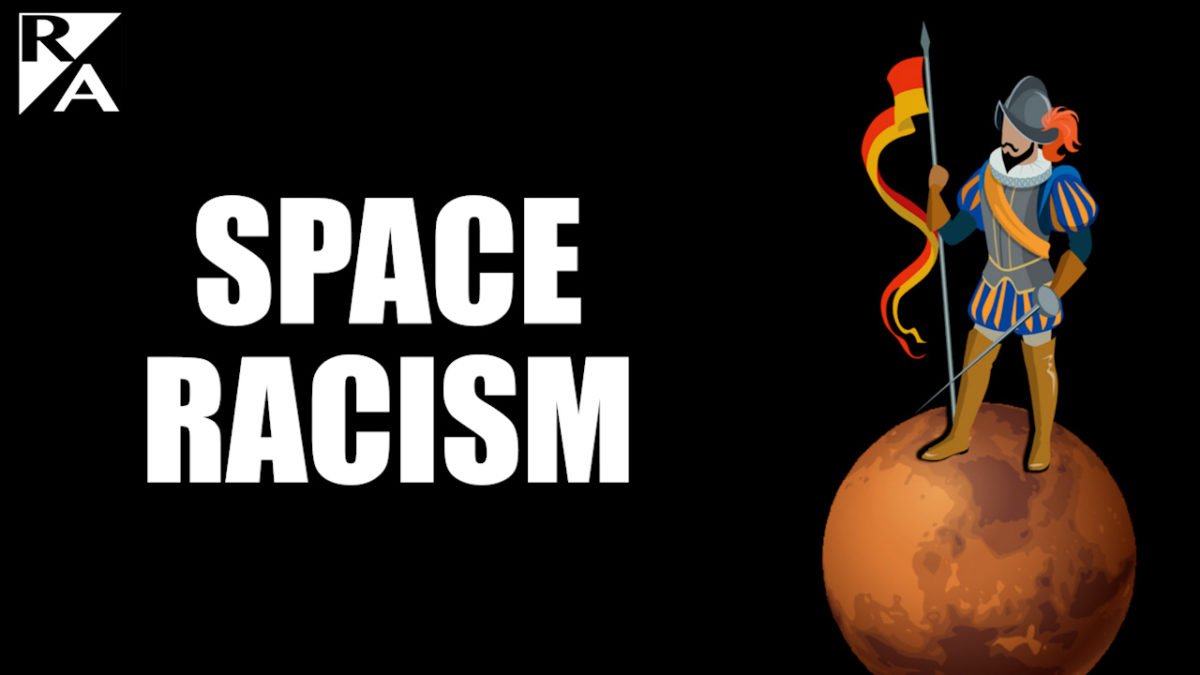
When we think of space exploration, it calls to mind Star Trek’s lofty title sequence narration, “to explore new worlds. To seek out new life and new civilizations.” But a growing number of academics see our yearning to explore as a lust for conquest. Even the terms “civilization” and “intelligent life” are fraught with imperialistic and colonial baggage — tied to eugenics and genocide — that we must disgorge before we set foot on other worlds.
SOURCE: Astrobiologists concerned about imperialistic consequences of galactic exploration [The College Fix, November 23, 2022]
Right Angle is a production of our Members and donors. To become a Member and unlock access to comments, forums, the Member-written blog, and Backstage content, tap the big green button above. To donate with PayPal or bank card, tap the big blue button.
17 replies on “Space Racism: To Explore Strange New Worlds, Seek Out New Civilizations…and Crush Them!”
Scott’s debunking of the ridiculous pseudo-science is categorically brilliant.
Bill, the number of civilizations in the universe is FAR lower than ANYBODY thinks. It is one.
S.N.O.B. Search to Not Offend Beings
The space woke is coming from assholes who know in their bones that I would abandon them in a heartbeat if we found a world where we could build a new America.
“Space Woke” LOL. It’s woke….In Space! I know it’s not really a joke; it’s already happening.
The banes of my existence are the JPL sample contamination and planetary protection people. The first ones make sure no one sneezes on the rock drill, etc and a sample comes back with human DNA (imagine that shitstorm).
The second ones make sure nothing from here gets into the Martian ecosystem (where it would most likely die rapidly if it survived the trip) by butting into our process with annoying requirements.. So it’s not just white colonialism raising concerns, it’s human DNA-ism and paramecium-ism I guess.
What I don’t understand is are we going there or are we not? If our intention is to go there, eventually the pristine ancientness of Mars is going to get violated. So why are we dicking around with these concerns (we BAKE the whole rover!)?
If we’re going, our only concern should be where the water is and any other resources, but we’re spending billions to return Mars 2020 samples so geologists can scratch their beards and ponder the origins of Mars.
If we’re going, we can study that stuff up close once we figure out how to not die there.
If we’re going, let’s %@#$ing go.
The greatest motivation for colonizing space is, essentially, for unlimited resources.
What to do about the indigenous species on those other planets is a whole nother question.
First, there is absolutely no evidence of any life anywhere else in the entire universe. The argumet that the universe is so big and so old that there HAS to be other life out there is not a valid argument because it does not define how big and how old the universe must be in order to create life.
Keeping within the laws of physics and chemistry, the odds of forming the theoretically simplest life form, by random process, is about 10^(170,000) against. (I can show you exactly how that is calculated, if you like.) Meanwhile, how does that number compare to the size and age of the universe?
If every atom in the universe was an amino acid, and if the entire universe was trying combining amino acids to form the required number of suitable-length proteins, a thousand times per second since the beginning of time, the universe could have tried about 4 x 10^95 combinations so far. That means the universe if still 10^(169,905) times too small and too young to have formed even the simplest possible life form – if we must rely on natural random processes.
Of course, if there is some other force beyond the laws of Science which, by definition, means a supernatural force then, all bets are off. There is no way to calculate the odds.
But first, let’s try to define the term “impossible” and compare it to those odds.
Suppose there was a world lottery where everyone in the world had a ticket and Joe Biden won. Is that impossible? No. It could happen. However, what if the very next week, he won again? Would you trust that the game is not rigged? What about 3 weeks in a row? How many weeks in a row could Joe Biden win before you say, “impossible” or “the game is rigged”? Would you have enough trust in the system to believe that Joe Biden could win the world lottery every single week for 326 years without cheating? I don’t know about you but, I would certainly have cried foul after the second week (odds about 10^20 against).
For the political Left, who do not believe in God, alien life is, statistically speaking, impossible. So, why worry about indigenous lifeforms that don’t exist? On the other hand, for those who believe in God, there may be an abundance of life out there and, discovering alien life IS proof of God (a super natural force).
Scott’s comment of those who oppose sucking all the Platinum out of a wayward asteroid was right on. Only those who oppose the idea bought platinum high.
Which made me think of previous discussions of mining asteroids for gold and platinum and other precious metals. Isn’t what makes these materials worth something is the fact they they are useful and scarce? If you were to dump 10 Billion Pounds of Space-Gold on the Earth market, wouldn’t that instantly make everyone’s Earth-Gold worthless?
Bill has talked about grabbing some space asteroid platinum as a good thing, sort of like injecting wealth into the world economy but I don’t remember the economic thinking behind it. To incentivize a space billionaire to actually invest in doing it, they would have to be careful not to grab too much for the reason you said.
Bills talk of Star Trek and species v race, and how most of the other creatures were still humanoids but of differing colors. It reminded me that of the creatures I recall none blended species versus race better than …..
Nancy. The shape shifting salt sucking creature. Even still, a head, 2 eyes, a mouth, long hair, hair itself, a bi-ped, 2 arms.
Tribbles were that species most unlike humans in Star Trek, TOS (The Only Series).
My Trekkie friend would joke about Star Trek Aliens using 1960s film methods. “Human body. Funny head.” Seems cosmically unlikely, but hey they didn’t have CG. Even James Cameron’s Aliens were dudes in a suits 20 years later.
The title of this post could have made for an excellent Deep Purple song – “C’mon, c’mon, c’mon, let’s go Space Racism!”
I’m surprised that The Radical Left isn’t supporting colonization. “By 2030 you’ll eat pond scum and you’ll love it” sounds like a slogan straight out of The World Econommic Forum
The theory of evolution is espoused by the Left as the one and only explanation for life as we know it. Survival of the fittest is how evolution works. Consideration and empathy for the colonized is in our best interests in many situations. It may even help our survival. But in many situations it may not. So how wouldn’t the Left be happy when our microbes eat the next planet’s microbes?
“Survival of the fittest” is a flawed phrasing. It is survival of the better (or best) adapted (aka, the luckiest). Natural selection is a passive result, not a directed one leading to designed characteristics or physical forms. I read somewhere (perhaps in Your Inner Fish) that one of our three ear bones evolved from a fish jaw bone, over some 100’s of millions of years.
The subject of explaining life, or how it started, is called abiogenesis (but I prefer autobiogenesis), which addresses both the issue of how life obtains the energy needed for existence (aka metabolism) and how it replicates at the biomolecular level, and reproduces at the cellular and organism level. Evolution then is reproduction with variation. See Nick Lane’s Transformer [2022] for some of the latest thinking about this. Interesting and credible conjecture as to how life might have started, with some decent evidence accumulating and much more work needed to fill in gaps, as the current picture is still not fully and completely understood or replicable by experimenters in the lab.
Your first sentence is true. Adaptations occur from mutations that allow for more efficient living. Reading a text on embryology, which somite eventually forms which part of our body, would fascinate you.
As for how life began, you should read “Is Atheism Dead?” by Eric Metaxas. The possibility of life as we know it forming through autobiogenesis is so remote as to be incalculable. He quotes many scientists who study the field and began as naysayers.
We are the Pak’lids. *sigh*
Dr. Carol Marcus is on #teampondscum