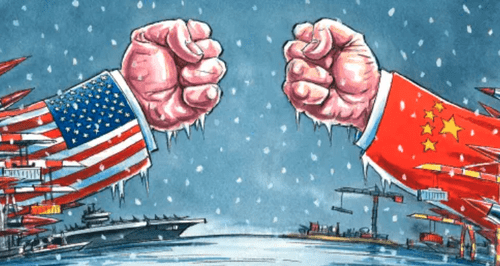
Buchanan: Are The US And China Stumbling Toward An “Islands War”? | ZeroHedge
In a diplomatic coup, Prime Minister Scott Morrison announced a deal last week with the U.K. and U.S. to have those Anglo-American allies help build a nuclear-powered submarine fleet for Australia.
A $66 billion French deal to provide Canberra with diesel electric-powered submarines, among the largest defense contracts Paris had ever negotiated, was blown off.
“A stab in the back!” said Foreign Minister Jean-Yves Le Drian, who had been kept in the dark on the secret talks.
“There has been duplicity, contempt and lies.” Le Drian compared President Joe Biden to former President Donald Trump.
President Emmanuel Macron recalled his ambassadors to both the U.S. and Australia. In two centuries of U.S.-French diplomatic relations, no such recall had ever occurred.
What does this Australia First submarine deal mean?
Canberra, which has sought to steer a middle course between its great customer China and its great ally America, is coming down on the side of the Americans in the rising great-power quarrel.
This “AUKUS” partnership, says Beijing, will “severely damage” peace and stability in the Indo-Pacific, and Beijing is demanding to know whether Australia regards China as a “partner or a threat.”
This new clash comes as China is using its military to speak for its claims to islands and islets hundreds of miles off its coast.
Several Chinese claims collide directly with the territorial claims of neighbors who are longtime U.S. treaty allies for whose territory we are committed to fight.
China claims, for example, the Paracel and Spratly Islands and almost all of the rocks and reefs in the South China Sea, many of which are within territorial waters claimed by Vietnam, Malaysia, Singapore, Indonesia, Brunei, the Philippines and Taiwan.
China also claims Taiwan itself, 110 miles off its coast, as well as the nearby Senkaku Islands, which Japan controls and for which Tokyo appears to be preparing to fight. A Chinese-Japanese clash over the Senkakus, the Biden administration has said, will bring the U.S. in on the side of Japan.
In a recent CNN interview, Japan’s Defense Minister Nobuo Kishi said the Senkakus would be defended as Japanese national territory.
And Japan has been expanding its Self-Defense Forces, adding the latest U.S. F-35 fighters, converting warships into aircraft carriers, and building new destroyers, submarines and missiles.
Earlier this year, the Biden State Department said the U.S.-Japan security treaty covers the Senkakus and our Philippines security treaty covers Manila’s claims to Chinese-occupied islets in the South China Sea.
Message: If Manila chooses to fight to retrieve its islets from Chinese occupation and control, America will fight on Manila’s side.
Still, China has yet to back down from any of its claims.
It has sailed warships and planes to hassle U.S. and allied ships and planes in the South China and East China Seas and sent fleets of bombers and fighters into airspace on Taiwan’s side of the Taiwan Strait.
To prevent Taiwan’s independence, Beijing has said, it will fight.
Should fighting break out between China and the U.S. over these claims, the war would be about islands that are thousands of miles from our West Coast but within a few hundred miles of the China coast.
Other East Asian nations are also communicating their interests and intent through military demonstrations.
After claiming to have tested a new long-range cruise missile, North Korea last week tested two ballistic missiles. At that same time, South Korea was testing its own submarine-launched ballistic missile, becoming the first country without nuclear weapons to do so.
This past summer, there were reports that Pyongyang had restarted a reactor in its main nuclear complex at Yongbyon, suggesting that Kim Jong Un may be ramping up his nuclear weapons program.
And, regularly now, U.S. planes stationed in Alaska scramble to intercept Russian military aircraft. This year, the number of intercepts, 14, is on pace to set a record since the Cold War. In the most recent case, two Russian bombers and two fighters came within 30 miles of the Alaskan coast.
This summer, Russian naval vessels came within 34 miles of Hawaii.
Russian ships and planes off Alaska are perhaps responding to U.S. warships and planes in the Black Sea.
World War II began in Europe when the British, Sept. 3, 1939, declared war on Germany over its invasion of Poland to retrieve what Berlin claimed were its territories, including Danzig, taken from Germany at Versailles against the will of the people of Danzig and in violation of their right of self-determination.
If World War III breaks out between China and the U.S., it is likely to be over islands of Asia claimed by China, with the U.S. fighting not for its own territory but for the island territory of allies, probably islands in no way vital to the security of the United States.
Which is how world powers often end their days as world powers, fighting unnecessary wars on behalf of other nations.
7 replies on “Buchanan: Are The US And China Stumbling Toward An “Islands War”?”
Meh, I see the same things going on and don’t agree with the conclusion of this article.
Japan, the Philippines and Australia are not only vital trading partners, they’re crucial allies on a global strategic level. It’s important to remember that you have to be a friend to have a friend.
India is a lucrative and important trading partner but not really what could be considered a military ally. India is quite powerful and would be a fantastic ally to have on our side against China. India also has little or no love for the Chinese.
India is also an ideal counterbalance to the spread of radical Islam in Asia, btw. India thinks even less of Islamic Pakistan than it does of China.
China, India and Pakistan are nuclear armed nations too.
This isn’t about a ‘squabble’ over some meaningless islands in the middle of nowhere. It’s about free passage of the high seas and what China intends to do if it controls certain vital sea lanes. China, by interdicting sea traffic in those areas can literally choke the life out of opposing economies.
Nor is this just about commerce, it’s not a matter of only money. Without money a nation cannot build or buy weapons. Part of the reason some of the effected nations are vital trading partners is that they buy weapons from the U.S.
Selling them weapons keeps our defense industry strong, tooled up, well manned and spurs research and development of effective superiority to the weaponry of potential enemies. Selling our allies weapons keeps America strong too.
Selling our allies weapons also insures that our combat and logistic systems are compatible, that parts made here will work in jets, tanks, radars etc. in use there. We can support those systems and no one else can. We can keep the lines of supply open better than anyone else in the world. This keeps our allies loyal to at least some degree across their own political ebb and flow and the change of leadership that entails.
Then there’s the matter of treaties and agreements with our allies. If we break our treaties when it suits us then it won’t be long before we cannot hold others to treaties that suit us and not them. We cannot go back on our word and remain credible to both our allies and our enemies.
If a war breaks out in that region for the reasons stated in this article that failure to honor our word in the recent past (Ukraine, Afghanistan, etc.) is going to be a major driver for the enemy Chinese. It shows weakness and screams for opportunistic military aggression on the part of adversarial powers.
Yeah, it’s not quite as simple as that, not even close. There’s a lot more to this than just the few points I have made here. “Vital to the security of the United States” is a very broad topic that is given short shrift in the above article which ignore many very significant aspects.
Whenever you see someone oversimplify issues this complex you should be suspicious. They have an agenda and that agenda might not be as good for America as it appears at first blush.
There are things Pat Buchanan says that I like and things he’s said that I don’t agree with at all. He’s made some pretty grievous mistakes in the past and been called on them pretty solidly. This quote would argue that Pat Buchanan gets to decide what is and isn’t an “unnecessary war” and in doing so throw allies, trade, treaties and friends under the bus. With little or no consideration for the national security implications of doing that.
Trump in contrast got almost all of that right, even demanding that if you want to be our friend you have to hold up your end of bargains too. Trump is abrasive but he’s the right kind of abrasive.
Pat’s good at conservative political commentary and not so hot in the strategic military scope. He should stick to what he’s good at, which is Constitutional conservatism, rather than say stupid things like “there’s not enough carbon monoxide in diesel exhaust to kill anyone” and other tarnished gems he’s come up with in the past.
In fairness, Pat Buchanan has contracts to write position and policy articles like the one cited here so … I have to wonder if this isn’t more to get people like me to argue against him than it is a matter of his own sincere position.
Yep, most of us have formed our positions on subjects.
Very true. However, the more informed a position the more likely that position is to be the correct one.
I.E. —
“Which is how world powers often end their days as world powers, fighting unnecessary wars on behalf of other nations.”
… is a matter of personal judgement and an emotional appeal. We on the Conservative side have emotions too, but we try not to fall prey to emotion over reason. That’s a pitfall of the Left that we must try to avoid because we can see the results before our very eyes.
… is not a true statement either. Britain was a world power with a global empire. It didn’t lose that position by “fighting unnecessary wars on behalf of other nations.” I can’t think of a single instance where Britain did that. Britain fought wars to preserve its empire and to counter regional European aggression. Britain fought with many other nations and against many other nations in many other nations but not on behalf of other nations. The Soviet Union was a world power and didn’t fall from that pedestal by fighting unnecessary wars either. The USSR fought a lot of proxy wars but those didn’t involve anything like what Buchannan is talking about in this article. Americans and Russians did not face off in peer power combat but American and China just might do that.
… is deceptive because if we go to war with China over the situations in this article we would be going to war for reasons of our own interests. If those interests coincide with the interests of other nations so much the better for them but … That doesn’t make such a war ‘on behalf of other nations’ it makes it on behalf of our own interests.
(A good contrast here is Bill Clinton involving us in the Balkan Wars, where we had virtually zero interest in anything regarding that region and those conflicts. Clinton was not preserving American trade and economy or supporting American military interests. He just did that for reasons of his own and it was a stupid thing to do.)
… is a statement that sounds very erudite and credible without actually having a preponderance of facts to support it.
I have a very hard time believing Pat Buchannan is not aware of these bigger picture factors and wonder why if he wants to make his point he doesn’t address them.
There’s always the chance that I’m missing something and wrong so I welcome any discussion that would enlighten me further.
The title of his Op-Ed was a question. So, I deduced that he was merely trying to get some folks to ponder the whole issue.
Getting folks to THINK today can be quite challenging.
Also wholly true, though the parts quoted that I’m objecting to are statements not questions. It might be difficult to pick up on the difference without actual experience in this kind of thing, I don’t know.
My fault is thinking too much maybe? In my old age I find I have time on my hands to ponder the worlds ills, how they got to be ills and what can be done about them. Which is a little bit futile because there’s not a damn thing I can do about them now. Though I did try to do my fair share and then some earlier in my life.
Don’t get me wrong, I’m not a neo-Con hawk and I don’t want a war with China. Better than some I know what that’s like for the people on the pointy end of the spear and it’s no fun at all. I would not spend American blood and treasure in any but the gravest extreme.
Still, there are measures we can take as a nation to preclude the need for war and sadly … I don’t see us taking those steps under the current administration. Tragically it seems to me like we’re now doing just the opposite.
Bill Whittle did an excellent, short video on this kind of thing a few years ago …
https://www.youtube.com/watch?v=X9VCs_GpJIg
The Chinese leadership isn’t stupid, in fact they’re quite smart. They won’t engage in a shootin’ war unless they believe they can win it. I don’t think they believe that — Yet.
One thing that scares the hell out of the Chinese is the fact that in America our leadership potentially changes every few years. A war with the U.S., poorly fought and dragging on until an election, is one of the surest means at China’s disposal to ensure that an aggressive, victory oriented President is elected. Then look out.
A chief danger is that the Chinese will come to believe they can prosecute a limited war in a brief period of time. Say 2 – 3 years or so. Then win that war before a more aggressive President is elected in the U.S. Thus presenting the next administration with a fait accompli and a new balance of power that he’s loath to upset. A new balance of power that is in China’s favor.
With a China-friendly, stuttering, stammering, weak potato in the Oval Office that becomes a more real possibility.
So publishing things like the statements and attitudes I took objection to in the article work in China’s favor. Whether that was Pat Buchannan’s intention or not it’s Neville Chaimberlain class appeasement. “Just give them what they want, it’s not worth fighting over” is the gist of the message.
That kind of thing is more not less likely to work to our disadvantage because it does not cover the whole situation.
China knows it can’t win a war in which we are resolved to defeat them. For now.
China knows that a houseplant like Joe Biden might even welcome something like that to show he’s not the weak, mewling cowardly grasping liar he appears to be.
So I prefer not to help China start any wars even though there is so little I can do about it. My son is a moderately high ranking naval officer on the West Coast. I’d as soon China avoided the temptation of a shootin’ war as not.
Which is why I have so much to say on this issue.
Air Force Secretary Says His Priorities are ‘China, China, and China’ – News From Antiwar.com
Small Excerpt:
President Biden’s new Air Force Secretary Frank Kendall made it crystal clear that China is his main focus during a speech at the Air Force Association’s Air, Space and Cyber conference. According to an Air Force press release, Kendall mentioned China 27 times in his remarks compared to a single mention of Russia.
“So what are my intentions now that I have this job? At a breakfast on Capitol Hill shortly after I was sworn in, I was asked by Sen. Jon Tester what my priorities were. My answer was that I had three; China, China, and China,” Kendall said.
Si vis pacem, para bellum=If you want peace, prepare for war.
Doesn’t seem like The Biris can prepare for war. China might see that as an advantage clearly in their favor.
NO, I don’t want war either. But, you have to evaluate things as they are in reality. Of course, each of us may have a different perspective on exactly WHAT that REALITY is.
And why did Biden leave all that military equipment in Afghanistan? Was it for the Taliban? Iran? China? A little bit for each?
BREAKING: Chinese Defector Claims COVID Outbreak Was Intentionally Released in October 2019 at Military World Games (trendingpolitics.com)
Whistleblower Confirms Lawrence Sellin’s Reporting at Gateway Pundit From July – Wuhan Military Games Were China’s First Intentional COVID Super-Spreader Event #BioTerrorism (thegatewaypundit.com)
Feds Buying Chinese Drones Despite Military Warning That They Pose Threat To National Security | The Daily Wire
Other little tidbits to add to the mix.