
So, the next few posts in this series are going to focus a little more on understanding the structure of the Orthodox church and its core beliefs and practices because understanding them is kind of important to understanding why Roman civilization continued and flourished up to the fifteenth century in Byzantium but floundered and collapsed in Rome and points West.
Previously, I warned the Catholics not to come at me over the fact that our two communities haven’t seen eye-to-eye on a lot of things for the better part of over 1500 years. This week, it’s the Protestants’ turn to get their feathers ruffled.
Now, I’m going to say this again: this is the Orthodox point of view. I’m not asking you to take it for your own or to even like it. I’m asking you to accept it as the Orthodox and Eastern view, a view that is very decidedly not Romanocentric. If you can do that, then we can do that “agreeing to disagree” thing. But if you think you’re going to come at me with how the Holy Spirit departed the church in the early centuries because the Pope was bad (it didn’t and the Pope wasn’t always a bad guy), how Christ “shrouded” the Real Truth until Luther/Calvin/Williams/Smith/Henry VIII/Parham/whoever your Modern Prophet Who Talks To Jesus On The Two-Way Radio is was born (go join the Gnostics and talk about how super Magickal and Spiritual you are and how you’re the Mostest Spechulist Widdle Snowflake in the Universe), or how Holy Tradition is wrong and obscures the truth of the New Testament (where in the name of God do you think the New Testament came from, you bloody-minded, squirrel-brained imbeciles?!), then I make you the same offer I made the Catholics last time:
https://www.youtube.com/clip/UgkxhDFpMKGnjdpEiZ8v-5j1sCQ0mBCqeJGT
I’ll throw the Golden Gate and the Brooklyn Bridge in free for you fine folks!
Sorry if that seems harsh but if I have to suffer through Yet Another Conspiracy Theory about how there wasn’t a “real, true church” from about 50 AD until Whenever The Great Restorer You Like Was Born AD, then I might start stabbing people with wet noodles. The true, universal and complete (that’s what “catholic” means), and Apostolic church existed in the entire Roman Empire, East and West, from 33 AD without a breach. Even the Roman Catholic Church is an off-shoot of the ancient church — just a section that went off to do its own thing due to political realities and is no longer in agreement with the Synod of the other ancient churches and the newer churches that arose from them (Jerusalem, Antioch, Alexandria, Constantinople, Russia, Bulgaria, Armenia, Ukraine, Japan, the Orthodox Church in America, etc). Some Protestant churches are off-shoots of the Roman branch but most of them… well… no offense, but y’all are a little nuts, okay? It’s like you forgot how to read the New Testament sometimes even though you seem to worship the words in it more than the Word it speaks of.
 I love y’all. Really I do. But the phrase “nuttier than a whole sack of squirrel sh*t” has been heard leaving my mouth when discussing Protestants.
Why is that, I wonder?
Oh yeah, because of the lack of respect for the ancient traditions we call “Holy Tradition!”
Now, before you start up with your Sola Scriptura arguments, I want you to ask yourself one very, very simple question. I want you to be honest with yourself about it, too. The question is this:
When and how was the New Testament written and compiled and how did the church continue to spread the message of salvation and teach the faith before then?
https://www.youtube.com/watch?v=4003xkcTJmI
Now, I answered part of this a few entries back when I said that the books that would come to comprise the New Testament were written between about 35 AD and 95 AD. That’s the “when” part. The “how” part is “they were written with quill or pen on parchment or papyrus.” Remember, the printing press is still about 1,400 years from existing in Europe (and about 850 years from existing in China). The New Testament did not get delivered, already leather-and-cardboard bound and printed in columns with the chapters and verses numbered and words of Christ in red in modern English on Pentecost 33 AD. I mean, the Holy Spirit brings a lot of gifts, but that wasn’t one of them. 😉
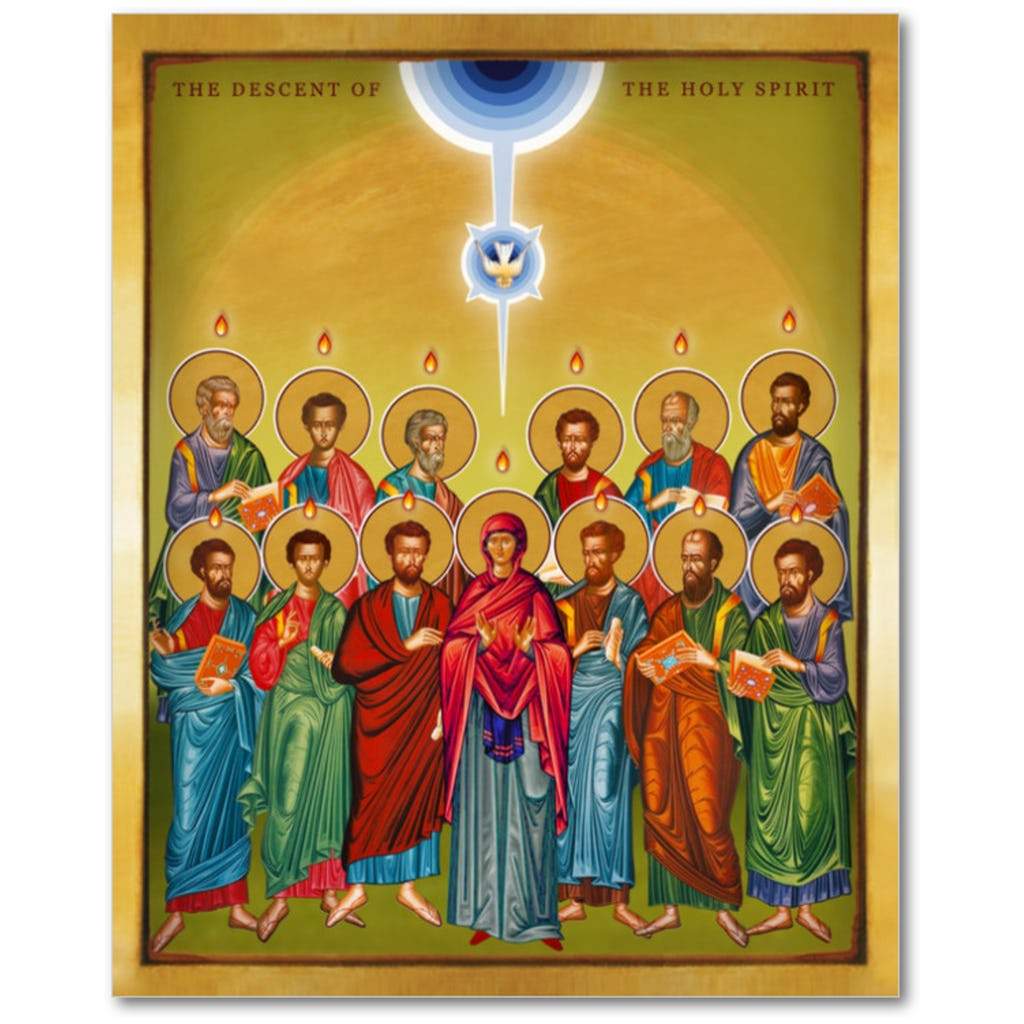 Please don’t smite me…
Copies of the various gospels, books of instruction (like The Didache), the epistles, and other important documents had to be copied by hand and then delivered by individual human carriers (telegraph, telephone, and email being quite some time in the future). Any given church might have two, maybe three of the Gospels and a handful of some of the epistles alongside some books of local instruction, letters and writings that were not later made canon, and letters and writings that would later be held to be heretical (in error).
So then, how did the Church as a whole continue to ensure that it was teaching things correctly when the New Testament was still being gathered?
The answer is two words that some of you are gonna hate: Holy Tradition.
 Some of you are making this face right now
Remember, the people who founded the early churches were the Apostles or the Equal-to-the-Apostles (like Mary Magdalene). They had been taught by Christ Himself and had witnessed His earthly ministry. They could teach from memory and, guided and guarded by the Holy Spirit, they did not change the teachings that had been given to them. They made use of writing when it could be useful. They also wrote the first ikons (to the Orthodox, ikons are not paintings, they are writings). These could be very useful in instructing and inducting new Christians since the Romans would see only “pretty artwork” but the message contained in the ikon could be understood by Christians who had not learned to read. The Apostles would lay their hands on those who were to take over the teaching and administration of a given church and would ask that the Holy Spirit guide and guard the new deacon/priest/bishop the same way He had guided and guarded the Apostles. Then the Apostles would go off to found another community.
That laying-on-of-hands is important. That’s how tonsuring and ordination is done. Every single deacon, priest, bishop, metropolitan, and patriarch of the current Orthodox Churches can trace their lineage through the direct laying-on-of-hands all the way back to Pentecost. It’s an unbroken line that, in the West, only the Pope can match. It was also one of the first sacraments. Others were baptism by full immersion in water, the Eucharist at the shared meal at the “love feasts,” the anointing with holy oil the newly consecrated and the sick, the blessing of matrimony, and the practice of confessing ones sins before God.
“But, those are all mentioned in the New Testament!”
 Dude, is it just in one ear and out the other?
Yes, they would be mentioned in it. Once it was written. Once it had been compiled. Once every church had a copy of it. But what about the churches in the first few centuries who had only oral teachings and a handful of notes to work off of? They were somehow able to follow the teachings without needing a copy of any of the written Gospels or the Epistles. Indeed, it would be because of the importance of Holy Tradition that the physical written texts were preserved, copied, and shared between the communities! The New Testament itself is one of the fruits, one of the products, of Holy Tradition!
Holy Tradition itself arose out of Judaism, one of the few “early” religions to place importance on written Scripture as well as oral traditions and observing annual celebrations (like the Passover). Most religions from early history did not have a strong literary component and did not require literacy to achieve rank within them. So, the emphasis on keeping records of the actual teachings in writing and preserving and copying those writings came to Christianity straight from the faith of the Jewish fathers. Remember, almost every last Apostle was Jewish. The first council in Jerusalem actually dealt with the question of “did Christians need to convert to Judaism first?”
Much of the formality of Orthodox liturgy and the Catholic mass likewise arises out of Judaism. Jewish practices at the synagogues and Temple formed the basis for how worship services were carried on in Christianity. Like the first century Jews, our worship services consist of:
- An opening blessing
- Prayer
- Readings from the Law (Judaism)/Readings from the New Testament (Christianity)
- Readings from the Prophets (Judaism)/Readings from the Gospels (Christianity)
- Sermon
- The Eighteen Blessings (Judaism)/The prayers to prepare for the Eucharist (Christianity)
- The Dismissal
(Taken from The Historic Church, pages 26 – 27, by Archpriest John Morris)
The other things that make some Protestants twitch also come out of the first few centuries following Pentecost. By the time that the New Testament canon was set (sometime in the fourth and fifth centuries), the Church already had a rich support in Holy Tradition to keep it from falling into error and worse. It also had a structure that protected it from being overly influenced by the government — a structure that worked well in the East but was discarded in the West.
But we’ll get to that next time.
— G.K.
2 replies on “Byzantium — The Church, the New Testament, and Holy Tradition”
I will continue to thank you for the work you put in these posts. And again, I knew most of this.
Yes some Protestants go wacky. Most I have known do not. Every one I have joined believe the Nicene Creed, and have similar steps in the Assembly to the ones you mention. But they also have worship in the singing of psalms, hymns and spiritual songs. Any church I joined emphasized the Bible; and mainly the New Testament. But the Old Testament was taught. If any of these were habitually missed, I talked to the leaders. If corrected, fine. If not, I was gone. I only left one. And quite a few did laying on of hands in ordination. Trace all the way back? No clue. Never claimed.
If you want perfection, forget it. Won’t happen. I’ve heard it said “if you find a prefect church, don’t join it. Because you will ruin it.” And “the Church is not a museum for Saints, but a hospital for sinners”.
In fact, the Protestants were protesting the Roman Catholic church excesses; in particular, the indulgences.
“Hey, here’s some money. Am I good with the sin I’m planning to do? No? Here’s some more. Good now? Ok! Excellent!”
Doesn’t work that way.
I agree, the Roman Catholic church got too involved in politics, and got too powerful.
But a lot of the ritual and vestments in most Orthodox church’s I don’t see as commanded, and for some reason find off putting. But if you get something out of it, good!
Worship in Spirit and Truth. John 4:23-24.
Please believe I think we have more in common than not. I tend to be informal, especially with friends. John 15 says we can be friends with Christ if we obey his commandments. I try. I need His grace though.
Yeah, I’m actually going to touch on the problems with Augustinian transactionalism when I get to him (which is where the transactional view of salvation originates and thus things like ‘the treasury of merit’ and ‘paying for sins.’)
Long story short, the Orthodox don’t hold the transactional view and see salvation as a gift offered freely in order to redeem the whole of humanity from its entrapment in a fallen world. We don’t have anything like the doctrine of Original Sin — none of us are “guilty” or carry any specific blemish from Adam and Eve. We just live in the world that resulted from their disobedience.
Most mainline Protestant churches don’t bother me too much but I do find them fundamentally kind of… I dunno, I guess amusing? There they are protesting Rome and trying to proclaim that they are the One True Ancient Faith like the Orthodox don’t exist and like there wasn’t a whole big ol’ branch of the Christian Tree who never agreed with the Pope back when he started trying to mix religious office with political office. I just don’t feel comfortable in them because of the lack of inertia they have to protect them from going with The Current Thing. You’re not going to find the Orthodox changing doctrine because our entire tradition is to go back and see what we’ve always believed. Clarify something, yes (like we did with the whole “is Christ God or just Some Dude?”) but not change (like the Anglicans did with their whole “yeah, we’re totally going to let women be priests even though the highest office women ever held in the church was deaconess. Oh, and now men can marry men and women can marry women even though that’s never been done.”) I also find their services to be just emphasizing too much the emotive experience and not enough the spiritual experience. But then, I’ve been to too many who tried to “trick” children into “being saved” (again with that transactionalism) by playing on their emotions when they are too young to understand the nature of sin and the fallen world or what the gift of salvation is.
I had been going to address the issue of the “ornateness” that a lot of Protestants (particularly those raised in a Puritan style church) find off-putting but the entry was getting long enough. In short, the reason why the Orthodox and, in the early years, the Roman Catholics, did the whole “fancy vestments, ornate altar cloths, gold candlesticks and censers, fancy decorations for the church,” thing is based on the first-fruits. Since Christ was made Incarnate, taking on mortality and the flesh and by His defeating death, imbuing mortality and the flesh with divinity and granting us all salvation, we should be thankful and offer up the first-fruits of our hands to Him. So, in response to and gratitude for defeating death and then heeping us with gifts (creative ability, business ability, green thumbs, fashion sense, whatever — these ‘gifts’ all come from God), we should make certain that we use our gifts to glorify Him.
That means building hospitals, schools, sending out and financing missions and all that primarily but it also means spending our wealth in positive ways so that the excess goes to do something for the church. If the bills are all paid and there is plenty of money in the poorbox (which these days is more like a bank account that members can borrow from if they need help with bills), the hospitals are doing well, schools are doing well, the missions are doing well, then that extra wealth gets put towards supporting monasteries and monastics at large by buying the things they make (like incense, copies of the Bible, ikons, vestments, altar cloths) by giving the money to them or using the money to buy food, seed, or livestock to donate to them. Monks do a lot of “making things” along with working the land and living off it because idle hands are the devil’s playthings. 😉 They also don’t think they should be getting rich off just being called to the ascetic life so they have to trade something back to the community at large for supporting them.
So, tl;dr version would be “all those fancy things are just the physical representation of extra energy and wealth that we wanted to use for beneficial stuff instead of buying a new car we don’t need.”
Anyway, yeah, we all agree on the fundamentals but some of the things that Western Christians believe make those of us with the Eastern view do this: o_O and have little thought bubbles with “wtf?” 😉 However, there are some that are just so goofy that we’re like, “sure, call yourself Christians but you deny Christ’s co-equality with the Father and we had that fight and said it was heresy back in the fourth century, you Arian nutters.”
— G.K.