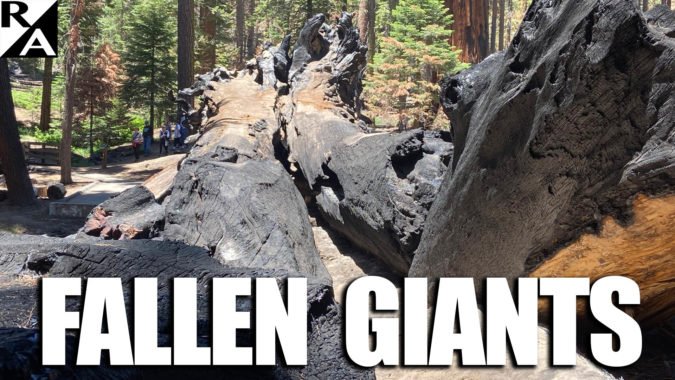
Along the Trail of 100 Giants in Sequoia National Forest Bill Whittle and his wife see three dead ones…apparently murdered by the best of human intentions. What can we learn from this irreplaceable loss?
Bill Whittle, Stephen Green and Scott Ott create five new episodes of Right Angle each week, thanks to our Members.
Listen to the Audio Version
Bill Whittle Network · Sci-Fi Drama 'Cracka' Flips Script, Enslaves White Supremacist to Black Master
17 replies on “Fallen Giants: 1,800-Year-Old Sequoias Murdered by the Best of Human Intentions”
One of the best Right Angles ever!!
The Mississippi River is going to change course into the Atchafalya. There’s nothing that the USACOE can do about it, but they still keep trying, and are making the eventual and inevitable event even worse.
If I were in charge, I’d send some funding into building new infrastructure (like building shipping channels straight south to the Gulf from the industries that are currently located along the last 100 miles or so of the Mississippi) that is designed to work with the natural framework of the wetlands, and then start slowly to let the water go where it wants to go. The delta will grow (as it is and has been for the last couple of decades, as our understanding of wetlands has improved, the most important factor of which is that they need feeding from the river). The wetlands will work. Shipping and industry will be more efficient and make a smaller impact on the ecosystem, as well as have greater protection from hurricanes. Win for everyone.
re: Grand Canyon. Try the North Rim.
I’ve watched a few “reaction” videos done by people in Europe, mostly made as they watch videos from the US about “10 best national parks” or some other video about the diversity and variety we have here. I was mostly saddened by the fact that they all seemed to not have such a thing, no national wonder they would compare to one of ours. No one said anything like “Oh that park looks like X where I went as a kid on a school trip”. Even in a country like England, there should be some places people would find awe inspiring and beautiful. We’re just lucky we don’t need passports to see all of ours (though maybe the EU has done away with that somewhat).
“We’re destroying the foundations of these magnificent giants”. That almost sounds ike something else going on right now. If only I could put my finger on it…
Thanks for the reminder that we live in a wondrous country and that we should spend more time reveling in it.
The number of fire adapted natural communities is surprising to most people. Fire is a natural cleansing agent and is required to suspend the processes of succession. Here in Florida the flat woods, prairies and scrub lands depend on fires every 3-5 years (depending). It’s actually quite fascinating as to how species have adapted and thrive. But we humans don’t like fire, we don’t like breathing the smoke. It’s a real conflict. I like that Florida has been setting aside more and more land. We need to do more of that.
Hey Guys, if you want to touch the bark of a Sequoia, just come by my place as I have two of them, too close together and too close to the house. I am in awe of them, but also in fear of them, as they are quite large already considering that they are less than fifty years old. At over fifty feet tall, they are already over ten feet around the base a foot or two above the ground, perhaps more than half again that big around right at ground level. I live at 6,000 ft on the eastern slopes of their home mountain range (Sierra Nevada) while the Giant Sequoias naturally live on the western slopes. Doesn’t sound too bad until you realize that I live on the western edge of the Great Basin in climate officially designated as High Desert, while just west over the mountains from me about forty miles, the proper habitat for the Giant Sequoias is on the upslope from the Pacific Ocean’s moisture pool, at an elevation about 4,000 ft lower than I am here. I don’t expect these giants to make it to old age, and only hope that they do make it through the rest of my old age! BTW I do walk on their roots pretty regular, especially while mowing the lawn …. but that’s just me, once a week or so for about five months of the year. However, Bill is absolutely correct about the detriment that would derive from the tourist masses doing so!!!
Bill’s story about forest fires in Yellowstone reminds me of something I have been saying for decades:
What a leftist treehugger calls “essential biomass” is the exact same thing that a forest fire experts calls “fuel load.”
I was a Marine Corp brat and every year my dad would take us to see America. We have seen many of the National parks and forest including the Sequoias and Redwoods three times.
But, the one I have yet to see is the Escalante National Monument Grand Staircase, Escalante Petrified Forest, River, Town and more in Utah. My brother and uncle went to see all of it in a month long trip when he retired from the Navy.
He said, “everywhere we went, the people told us our money was no good there, hotels, sight seeing tours, restaurants, and even their gas while they were there was all free. My dad’s ancestors were two brothers from Spain, one was the Captain of the guards (my dads lineage) and the other was a missionary that settled in Utah.
The want and need to go see these wonders within me is still there and stronger than ever.
Here in Alaska we get some pretty big forest fires and a year or two after we have a different green landscape to enjoy. The cycle of God’s nature is a wonderful creation.
Attempts to stop beach erosion on the east coast by building groins just moved the erosion and made it worse. Dredging projects off the Dunedin, Florida coast in the 60’s caused beach erosion, and destroyed the area’s fishing industry. I watched a video that purported to show how long it would take nature to cover all traces of mankind if we all suddenly vanished. 300 years. As Jeff Goldblum said in Jurassic Park, “Life finds a way.”
Thank you for that, i’ve never seen those wonder monsters, they’re on my bucket list. Guess i need to move them to the top. BUT isn’t this indicative of the entire clmate change agenda? We have to change something not knowing what or where our changes are going to go?
Thank you so much for doing this episode! We appreciate you three being the bearers of truth and shedding light on important issues.
I had an opportunity maybe 16 years ago to visit those magnificent sequoias and the redwood forest and beyond when we took an RV alongside another family and drove from San Francisco to Las Vegas… and at Yosemite I learned that forest fires are necessary for the growth of the forest…
Thanks for this reminder of the great grandeur of the natural world… and our role as humble stewards… not mr. fix-its…
That was one of the best messages I’ve ever watched from you. You reminded me of things I had forgotten and you taught me things I didn’t know. We humans are brash and constantly thinking that we know best. It is truly wonderful to watch nature perform as she does without interference from us cocky, misguided at times humans. Thank you for this wonderful video!
There are those people who are “Karens” who just can’t leave other people, and things, alone!
Related to: G. K. Chesterton — ‘Don’t ever take a fence down until you know the reason it was put up.’
We knew at least as early as the 1970 Earth Day era that natural ecology had a great deal of interconnectedness, some of which we understood and much of which he did not or had not yet unearthed.
Bill grasped the horror of extinctions in general. God’s creatures, no matter how small, when they are gone, they are gone forever.