Wishing you all a great 4th July tomorrow from over here in Blighty. To celebrate America’s birthday here is a piece about a lesser known aspect of Anglo-American history.
This year is the 80th anniversary of the Battle of Britain and the formation of the Home Guard in the summer of 1940. After the Fall of France Britain prepared to withstand the expected German invasion should the Luftwaffe gain control of the skies over southern England. The Home Guard, nicknamed “Dad’s Army” and the fighter pilots that fought in the Battle of Britain, given the title of “The Few” by Churchill, are two great icons of Britain and her dogged defiance in the Second World War, so why I am writing about them to celebrate the 4th July? Because there were Americans in both Dad’s Army and The Few.
Briefly called the Local Defence Volunteers, the Home Guard were an auxiliary force made up of those too old or too young to join the regular Army. Their job was to relieve the Army of various duties and to be a more or less expendable force to slow the Germans down should the invasion happen. They were an eclectic bunch, with a fascinating history and became a quite sophisticated body with over 1.5 million members.
On 1 June 1940, very much against the wishes of the American Ambassador, Joseph Kennedy, the 1st American Squadron of the Home Guard was formed in London. All highly irregular, the British Foreign Office and other bureaucrats shared Kennedy’s misgivings, but Churchill did not. The legal difficulties were overcome by personal intervention of King George VI. Many Americans living in London ignored Kennedy’s advice to leave a country he fully expected – one might almost say hoped – would soon be the next victim of Hitler’s forces. Some not only stayed but joined the Home Guard to help in the defence of Britain and of freedom.

They were commanded by the New Yorker, General Wade H. Hayes, who commented “We would have felt ashamed of ourselves if we had sat on the side-lines and done nothing but indulge in wishful thinking.” Termed a squadron as they were a motorised unit, they used a fleet of cars for transportation. Like the rest of the Home Guard they wore a variation of British battledress, but with a red American Eagle shoulder flash. Maintaining an average strength of 60 to 70 men, the unit served throughout the war.

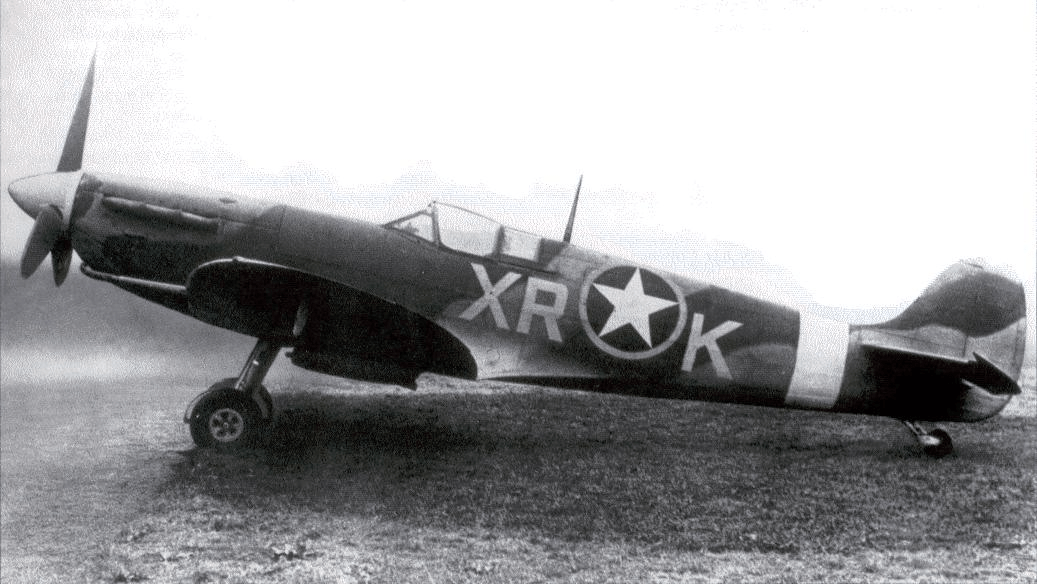
Rather more vigorous, numerous and glamorous than the Americans in the Home Guard were the young American men who courageously joined the Royal Air Force to fight against Hitler. In total there were nearly 250 of them. The RAF recognises 9 who took part in the Battle of Britain itself. These men were flying Hawker Hurricanes and Supermarine Spitfires in a wide number of regular RAF or Royal Canadian Air Force squadrons. In September 1940, the RAF formed 71 Squadron, made up of (almost) exclusively US airmen, this was followed by 121 and 133 Squadrons, known collectively as the Eagle Squadrons. They wore RAF uniforms with their own shoulder flash. In all 244 US citizens and 16 Britons served in the Eagle Squadrons. There is a memorial to them in Grosvenor Square, opposite the old US Embassy.

On 29th September 1942 all three squadrons were transferred to the US Army Airforce as the 334th, 335th and 336th Squadrons of the 4th Fighter Wing of Carl Spatz’s 8th Air Force. I’m delighted to say all three units are still active in the USAF today.

The 9 American members of The Few were:
Flight Officer deP D Brown
Flight Lt. C R Davis DFC, d. 6th Sept. 1940
Pilot Officer A G Donahue, d. 11th Sept. 1942
Pilot Officer W M L Fiske, d. 18th Aug. 1940
Pilot Officer J K Haviland
Pilot Officer V C Keough, d. 15th Feb. 1941
Pilot Officer P H Leckrone, d. 5th Jan. 1941
Pilot Officer A Mamedoff, d. 8th Oct. 1941
Pilot Officer E Q Tobin d. 7th Sept. 1941
This is the official RAF list; it is thought that these may not be the only Americans who took part in the Battle of Britain. As they had to pretend to be Canadians to join it is possible that a handful of the 114 Canadians among The Few were actually American. Note that only two of the men on the list survived to see the Eagle Squadrons transfered to the USAAF. I’d like to pay tribute to them all by telling you the story of one of them.
Billy Fiske was born into a wealthy banking family in Chicago 1911. He had some schooling in France and went to Trinity College, Cambridge. In France he took up bobsleigh and went on to win gold at the 1928 Winter Olympics. At the 1932 Winter Olympics in Lake Placid he carried the US flag during the opening ceremony. He gave up his place on the team for the 1936 games rather than have anything to do with the Nazi regime. He was also an important figure in the development of Aspen as a ski resort.
When war broke out on 1939, he had been working in both London and New York. He came back to Britain and joined the Royal Air Force. Like other Americans he had to pretend to be a Canadian to join the British forces; the arrangements made for the US Home Guard did not extend to them. So he was also putting himself on the wrong side of US law by fighting for a foreign power. In 1944 the US government gave pardons to all the men who had done this.
He joined the flamboyant 601 Squadron, nicknamed the “Millionaire’s Mob” due to the wealthy playboy make up of the squadron. They were known to play polo on motorcycles, they had their uniform tunics jackets lined with red silk and wore blue ties, rather than the regulation black. The line-up of their fast and expensive personal vehicles was said to resemble a high-end car show. Billy fitted in well and his natural skill as a fighter pilot was praised by his CO. The squadron was stationed at RAF Tangmere in Sussex.
On the 16th August 1940, only a month after his first combat sortie, the squadron scrambled to meet an attack on their own base by Ju87 “Stuka” dive bombers. During the battle Billy’s Hurricane took a bullet through the engine and he was forced to make an emergency wheels-up landing. On landing his plane burst into flames. Two ground grew got him out of the cockpit, but the base medical building had been put out of action by a direct hit. After being given a shot of morphine he was driven to Chichester Hospital where he was treated for severe burns to his lower body. He died 48 hours later; he was 29.

Billy Fiske was buried with full military honours at St Mary and St Blaise Churchyard, Boxgrove, Sussex. There is a stained-glass memorial window to him in Boxgrove Priory. On 4th July, 1941 a plaque was unveiled in his memory in the crypt of St Paul’s Cathedral, where Admiral Lord Nelson and the Duke of Wellington are buried.
Billy, and his fellow Americans, were not only volunteering to put themselves in harm’s way, they were placing themselves in potential legal trouble and having to go way out their way to do so. They had a strong love a freedom and, in wonderfully American fashion, a lack of patience with, or reverence for, bureaucrats and red tape. By taking that bold step they became the first of huge numbers of Americans who would temporarily call Britain home during the Second World War, 28,000 of them were never to see their own homes again. In 1958 HM the Queen and Vice President Richard Nixon attended the dedication of the American Memorial Chapel in St Paul’s Cathedral. The Pathé newsreel of this ceremony is below.
In this bizarre and trying year of 2020 I wish each one of you a fantastic 4th July. Know that America’s efforts and sacrifices in the cause of freedom are not forgotten here in Britain, but above all, enjoy the day and celebrate America. Have faith that she will come through these stormy waters as she has done in the past.
4 replies on “Happy 4th July from Over Here”
Thank you for your history lesson!
Now we know why they’re trying to tear down statues and monuments, our history (yours and ours) is so monumental!
You are so well-versed in these events…
Happy American Independence Day to you!
Thank you for your kindness and for honoring these patriotic Americans. I am curious, what is the general attitude of Britons toward American Independence Day? I imagine that the thought of celebrating it must seem rather awkward to many on your side of the Atlantic and the Channel. Again, thanks for the well wishes.
Good question about the 4th July over here. In an ordinary year, if the 4th falls on a Friday or Saturday you coukd expect to see a fair few pubs, bars and restaurants putting on 4th July/US themed events in the bigger city centres, London certainly. Maybe I should do a blog on the whole US Independance from a British perspective thing.
Thank you Mr. Packer for some little repeated and little known history of events and deeds in WWII. I am humbled and encouraged by your willingness to remember it to those of us who hadn’t heard it and your respect of the nation and its people that came to defend freedom so far from their home so many years ago.
God bless.