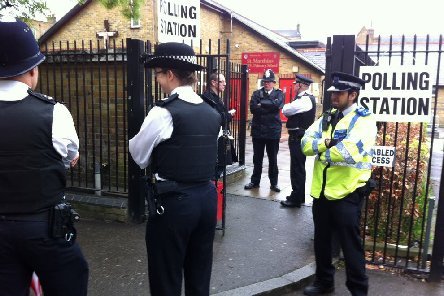
Last Thursday there were elections across the UK to various bodies. The Pseudo-Conservative government of Boris Johnson got a bit of a kicking, but not as much as they deserve. One result is really out of the usual two-party narrative and says an awful lot about changes in Britain.
Located just to the east of the City of London and the heart of docklands, the London Borough of Tower Hamlets has long been a leftist stronghold. In the 1964 Council election the only non-Labour Party councillors elected were two independents and three Communists. Back then it was very much a white working-class place, with dockworkers providing a solid left-wing cadre.
 The borough includes iconic East End places such as Bethnal Green, Bow, and Whitechapel, scene of the Jack the Ripper murders in 1888. It also has a long history of immigration, with French Protestants (Huguenots) in the late 17th/early 18th century and Ashkenazi Jews from Russia and eastern Europe in the late 19th. The Borough as also famous as the location of Cable Street, where the British Union of Fascists was seen off by local Jews and various leftist groups in 1936. It is also home to Brick Lane, the wildly overhyped, very large collection of distinctly average curry houses (I’m a Southall boy, our Punjabi curry houses are way better!).
Many of these themes come together in the Brick Lane Mosque, on the corner of Fournier Street, just yards from where the body of Ripper victim Alice Chapman was found. The building itself was built in 1743 as a Huguenot Church, has been a Wesleyan Chapel and a Synagogue. Since 1976 it has been a Mosque.
Since the 1960s one particular demographic has changed a lot. Today 40% of the population was born outside the UK and Sylhetis from Bangladesh are the single largest ethnic group, at (officially) around 32%. The Moslem population is the highest in the UK at 38%. The ethnically British population is about 31%. These figures do not, of course, take account of illegal immigration, or the soon to be released 2021 census.
Naturally, Bangladeshi Moslems have become a bigger and bigger force in local politics, especially in the local Labour party. In 2010 one Lutfur Rahman, born in Bangladesh (then East Pakistan) but raised in Tower Hamlets from an early age, was elected by Labour Party members to be their candidate for the new position of directly elected mayor of the borough.
However, there were questions raised within the party about Mr Rahman’s fitness to be candidate. He was claimed to be receiving help from the Islamic Forum of Europe, a group that seeks to disconnect Moslems from secular leftism and establish an Islamic social and political order. It was also claimed he had rigged ballots among other malpractices. The Labour Party’s National Executive stepped in and removed Rahman.

After some attempts to get back in the Labour boat, Rahman stood as an independent, and won, becoming Britain’s first Moslem executive mayor. He served out his first term, and then won re-election in 2014. This time he was opposed after the election, and a case of electoral misconduct was brought against him.
In 2015 he was removed from office having been personally convicted on various counts. He was found guilty of vote rigging, bribery, and of using local Imams to use religious intimidation on local Moslems. He was barred from standing for public office for five years. As a solicitor Rahman had to inform the Solicitor’s Regulation Authority of his conviction and was therefore also disbarred from practicing law.
Rahman was not idle during his five year “time out”. He founded the Aspire party and started challenging the Labour stranglehold on local politics.
Last Thursday the Aspire party won 24 of the 45 council seats, with Labour at 19, and the Greens and Conservatives 1 each. Seven years after his conviction, Lutfur Rahman stood again for mayor, and won!
So, it seems in Tower Hamlets, in 2022, being convicted of electoral fraud is not a bug for a candidate, it’s a feature.
Tower Hamlets is far from being alone in having, shall we say, a bright, enriched and vibrant political culture. My home town of Southall is no stranger to the pork barrel, and places like Bradford, Leicester and Luton are much the same. I don’t know whether Rahman and his party’s victory is fairly won, or due to shenanigans. If it was a fair election, then that means the a big portion of the folk in Tower Hamlets are utterly comfortable voting for a man convicted of multiple counts of electoral fraud a handful of years ago. Either way, it doesn’t look good for British politics.