Early unmanned interstellar exploration is likely to be a combination
of
better
astronomy
and very tiny unmanned probes used to characterize the interstellar resources
around us. This would include not just habitable
planets around nearby stars but also exploring the local interstellar medium
(it is hard to design a ship to sail on a sea you don’t even know the density
of accurately), any nearby but hard to see astronomical bodies (rogue planets,
brown dwarfs, small black holes, etc.) and possible interstellar precursor
destinations (like Oort Cloud objects, the solar focii, the heliopause,
etc.).
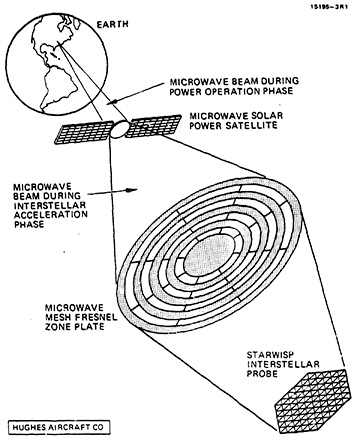
The first generation of unmanned interstellar probes would likely
be very tiny fly-by probes that are launched by some form of beamed propulsion,
like the early MASER pushed Starwisp
probe or the LASER pushed Breakthrough Starshot
probe. These might be mass produced and
launched in large numbers (Breakthrough Starshot would like to send 1000
probes) at promising nearby interstellar destinations found through
conventional astronomy.
ven before they arrived at their destinations, these probes
could begin providing useful science.
For one thing, they can study the local interstellar medium as they pass
through to pave the way for improved interstellar vehicle design. Better information on particle density and
size distribution will be needed for designing more survivable starships. Information on the magnetic field will be
useful for the possibility of using magnetic fields for steering
or braking
interstellar vehicles. And, of course,
the density and distribution of various atoms (particularly easily fused ones
like the various isotopes of hydrogen) would be essential for any
interstellar ramjets. They
may even discover some other property in interstellar space we don’t suspect
(weak repulsive gravity? dark matter? primordial black holes? gas-stations?)
that we could make use of in future attempts at interstellar travel. Another thing they can do is serve as
calibration targets for astronomical observatories remaining in our solar
system. These early interstellar probes
could shine various carefully calibrated colors and intensities of
communication LASERs, or MASERs, or radio-frequency bursts back at the solar
system (or even set off small
anti-matter catalyzed fission explosions) that would allow observatories here
to verify their calibrations and assumptions, which would allow astronomers to
make more precise observations and have more confidence in those observations.
Next generation unmanned probes could be larger and more capable,
with more efficient and powerful
propulsion systems that serve as stepping stones toward even larger still
manned missions. Or… the evolution of
interstellar probes may take an entirely different turn, resulting in probes
that are smaller still and produced in even greater numbers! Perhaps these could be milligram to picogram
in mass depending on the technology and design strategy, and fired by the
millions, billions, or even trillions as a “particle beam” by some beefy
space-based accelerator towards target star systems. Probes so small would not be able to carry
usefully sized sensors or a communications system powerful enough to transmit
anything they found back to us (unless they could carry some quantum-entangled
particle that could transmit information to its twin remaining here). Instead what they would do is merely attempt
to turn any stray matter they encountered into copies of themselves until this
colony of microscopic self-replicating machines reached some critical
size. At that point (like locusts) they
would change their behavior and begin building equipment to explore the solar
system. We are basically shooting
“spores” that we hope will eventually grow into a usefully sized probe.
Since we would want to minimize the original size of the “spores”
for these probes they might not be smart enough to do much at first, but once
they have reproduced to a useful size they could build a communications
receiver to download a more complicated operating system that we transmit to
them (in fact, we’d probably start transmitting that information on a loop
shortly after we fired them at the destination). Those transmissions would then instruct this
little “makerbot” to produce the actual probe(s) to explore that solar system. Some
of those probes may have even been designed after the initial spores were
launched based on later information gathered from our home-system astronomical
observatories. After building probes to
explore the system, the little makerbot could be instructed to begin expanding
and build infrastructure in that system, such as a beamed power station in that
system to decelerate (and power) larger, manned, follow-on missions there. They could even start making space-habitats
in case we decide we want to settle that system someday in the future. Alternatively, the makerbot could be put into
hibernation, to listen for future instructions in case we come up with some
future use for it, or just spy on the system and let us know if anything new
happens.
The hard part about these tiny probes might be how to decelerate
them or ensure that they find something to ‘feed’ on. A picogram level molecular-machine spore
probe might have a slight chance to survive aerobraking, lithobraking (slamming
into something), or even passing through the outer atmosphere of the star
(especially for red or brown ones). The
targeting and poor survival odds problem would be solved by firing trillions of
them at the target system so that even though each individual spore has
terrible odds there is a pretty good chance at least one would hit something
useful and survive. Those odds could be
improved by targeting the retreating portion of the system’s preferred
direction of rotation.
Or the spores might be made large enough to have a tiny magnetic
sail wire it could spool out. The spore probe could then use the magnetic
fields in interstellar space and the target solar system for deceleration
and maneuvering. The spore probe could also get power from
the current generated in its sail wire during passage through those magnetic
fields. Such a probe might be as big as milligram
size and fired in beams consisting of only millions of units.
Even if the author decides Humanity in his story will not pursue
this technique of interstellar exploration, it could still be put to use by
others in the story. If there are alien
species in the galaxy, perhaps one of them could use this method and that might
create some interesting story possibilities.
What if a human spaceship or colony is hit by one of these tiny spores
that begins consuming the hull or environment to create more of itself. It could look like a “grey goo”
horror episode until the spore has consumed enough material to reach critical
mass, then it stops reproducing and it’s now mature AI apologizes for the
inconvenience before leaving Or else it
just radios back to the alien home system and waits for further instructions
(with the resulting answer taking years while the humans do… what?… with
the artifact.) Or perhaps an alien
“makerbot” has already explored the star-system the humans arrive in
and their presence awakens it from its slumber.
How does it respond to this new group of explorers? Or maybe the original spore probe has, over a
long time, built a huge infrastructure with solar power collectors and beamed
power/propulsion arrays and alien space habitats that all lie empty and silent
waiting for some now long-dead ancient race of aliens that never got to use
them. If the alien race firing the beams
of spore probes at distance stars is an AI or uploaded digital race, that may
even be that race’s form of interstellar colonization. The AI or digital beings just wait until the
spores have built a big-enough computer (or robot bodies) for them to inhabit
and then they transmit a copy of themselves to the new star-system by radio or
laser (or quantum-entanglement if that is allowed in the story) communication.