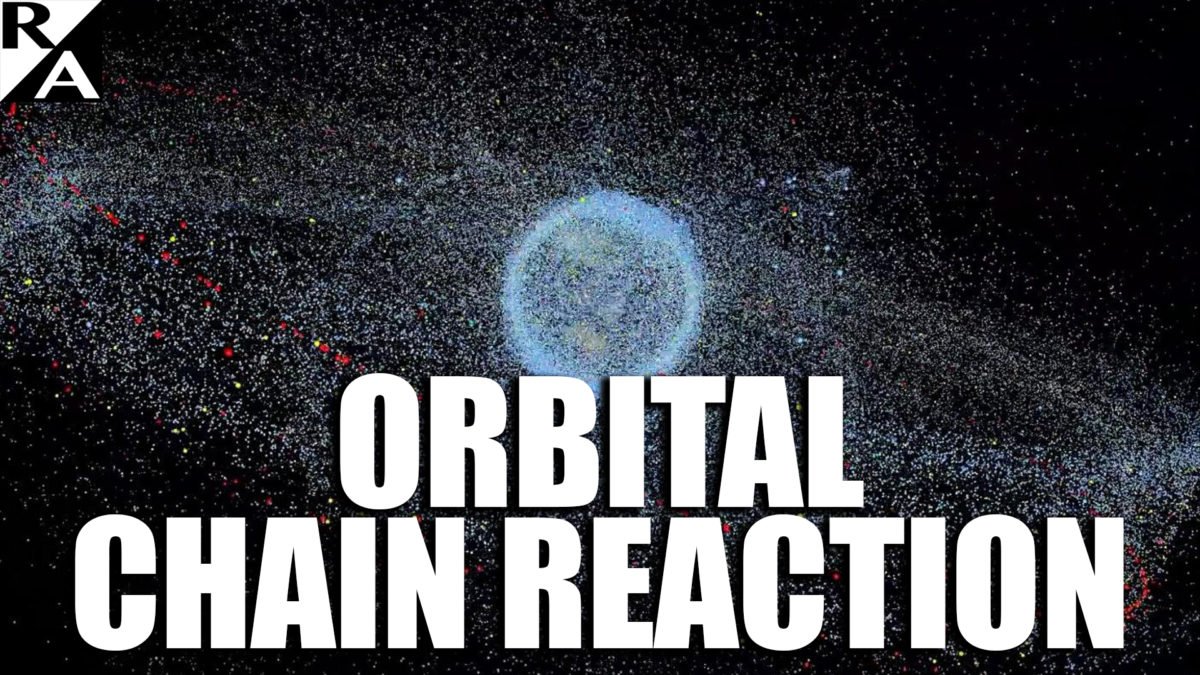
Russia performs an anti-satellite test, that scatters disintegrating fragments and sends the International Space Station (ISS) crew scrambling for safety. The Kessler Effect describes a chain reaction of space debris in cascading collisions that eventually shuts the door to future space access because no launch vehicle can navigate through the orbiting belt of garbage. What can we do to avoid getting locked out of space for generations?
Bill Whittle, Scott Ott, and Stephen Green create 260 new episodes of Right Angle each year, fueled by our Members. Join them to unlock access to Members-only features.
Video below hosted at Rumble.
Listen to the Audio Version
30 replies on “Locked Out of Space: Russian Attack Threatens Space Station, and Kessler Effect Cascade Crisis”
Instead of pushing pure alarmism, I expected you guys maybe ADD some information to what is easily accessible. Like the required density of stuff to trigger that chain reaction. I tried some estimates and with anything reasonable it just never worked out.
While a satellite or ISS hit by junk can easily render it broken and/or kill crew, it does not just create so much additional debris, It’s not Hollywood where all cars immediately explode. And when the collision does create fragments, most of those I expect to leave the orbits of interest by default.
In order to hit something else you need lot of that something else around. With the theory being around for that long, why the “how much” kept in the dark still?
In the meantime I’d be way more worried about debris around the Moon. Where every landing using traditional propellant makes a lot of particles fly up with considerable speed. It’s a nice engineering challenge even to just protect the landing module from them. If we ever get to the part that Moon is used as regular destination, that will pose a serious problem.
Certainly pollution is a thing we should avoid everywhere, including space, but the most imminent danger on our planed I see with the oceans, and “somehow” that is the area the public is least aware, while chasing all kinds of phony targets like CO2. It doesn’t take too that much material to poison the plankton and then we can say goodby to most of O2 production in the atmosphere for a few million years.
The Swiss are working on a space junk cleaning program right now. Launch of their initial test satellite is in 2025.
https://www.swissinfo.ch/eng/the-world-s-first-space–garbage-truck–will-be-swiss/46203780
We should build a giant space vacuum cleaner like they did in “Spaceballs”.
Bill, hit this moving target 100mi in space dead on. If we don’t initiate a program to clean up space junk, and it is solvable, now we will lose space forever. Forget about climate change this is a much bigger problem. One that we can actually fix. But it has to be now.
Wouldn’t the aliens fix it?
The thing is that these orbits are not permanent. Most of the debris are in orbit which will decay in a time span of years up to a couple decades. The ISS has to be periodically boosted to maintain its orbit. Without these boosts, it would have come crashing down years ago.
Here’s the NASA page on space debris: https://www.nasa.gov/news/debris_faq.html
And here’s an infographic which shows the relation between orbital altitude and decay times: https://www.flickr.com/photos/ulalaunch/51267101942/
To quote Douglas Adams: Don’t Panic!
Outstanding.
many thanks.
We are such slow learners. I remember reading a science fiction story maybe 20 or 30 years ago about exactly this: being locked down to our planet by all the debris in orbit around us.
Bill said “It’s like a shotgun blast.” I get the point but … That’s not a real precise analogy.
It’s like a shotgun blast that goes on for a very long time. A shotgun blast is a rapid pulse of chemically propelled projectiles that quickly sheds energy and falls to kinetic zero rapidly. The projectiles The Guys are talking about above do not behave that way. It’s a useful comparison and I’m not quibbling here, I’m just pointing out the differences.
Eventually, all the fragmented objects and orbiting junk will fall to Earth. That’s just garden variety physics and all orbiting bodies share that eventual conclusion with a blast of shotgun shot. The real problem is how long that’s going to take, not whether it will fall or not. Even our Moon is falling very, very, very slowly.
So, as I understand it this is the situation, any engineers out there are welcome to correct me if I have something wrong. What I say below applies more to circular orbits and less, sometimes a lot less, to eccentric orbits.
The higher any body is in orbit, the slower it moves. The lower it is, the faster it moves. The crucial factors are angular momentum and altitude not energy. Gravity pulls on all things proportional to the inverse square of the body creating the gravity.
You’re probably familiar with this effect though perhaps not aware how it applies to orbiting bodies. We’re all familiar with Galileo’s experiment where he dropped two unequal masses simultaneously from the Leaning Tower of Pisa. (I’ve been there, it’s pretty cool.) Both masses hit the ground at the same instant. A more massive body does not fall any faster or slower than a less massive one. Because at the surface, gravity is a constant.
However, angular momentum, being a type of momentum, is different between unequal masses. At the same speed, the greater the mass the greater the momentum. If you blow a bead of styrofoam through a straw it has very low momentum and will not travel far. If you blow a glass bead the same size through that straw, it will go much further. The glass bead is more dense and contains more mass so it will have more momentum at the same initial velocity.
Achieving that same initial velocity is a matter of the application of energy. We’re talking here about bodies already in orbit so we can ignore that.
Orbiting bodies are falling but not straight down towards the center of the Earth. If you simultaneously from identical height drop a bullet of 165 grains weight and shoot the same weight bullet parallel to the ground, both will hit the ground at exactly the same time. The fired bullet of course will travel a much greater distance. Gravity is constant and acts identically on both bullets. The variable is velocity and angular momentum also comes into play with orbiting bodies.
The particulars of how a body will act are identical though the math can get a bit complicated. This is why rifle ballistics are often referred to as ‘trigonometry with noise”. Orbital body trajectories are also ballistics.
Roughly speaking, without adding any energy to the orbiting body, through natural orbital decay it takes years for altitudes of 300 miles, decades for 500 miles and centuries for 700 miles to fall back to Earth. These altitudes are all in the “LEO” or Low Earth Orbit range.
Just for scale, the first Sputnik was 133 miles, the ISS is 211 miles and the HST is 309 miles in altitude. Most of the problematic space debris falls in that range or close to it. These are all “deorbit in years” altitudes.
By contrast GPS satellites are up around 10,000 miles, well outside of the problem area. They will take millenia to fall back to Earth.
The thickest parts right now of the “space junk shell” are denser the lower they are. Remember too that as the size of a shell increases in altitude, the less dense it becomes. This is simply because for every degree of circumference the volume increases proportionately. The same amount of material in an eggshell is hard and dense if compressed to the size of a pinhead and inconsequential if spread over the area of a football field. The same millions of objects 150 miles above Earth make a pretty dense shell. Move them all out to around the orbit of the Moon and it’s not nearly so dense because you have a much larger volume without increasing the quantity of objects.
The idea of adding to the shell of dangerous, lethal space junk in orbit just to “test”, or more likely demonstrate, a satellite killing system is stupid. It should be banned by treaty and enforced by the strongest possible measures. Most of the junk “up there” got there as an inadvertent, unintended consequence of space exploration and exploitation. To make it worse on purpose is criminal, it affects every human being on the planet. It’ is a planetary issue negatively affecting human advancement no matter who does it.
But as near as I can tell it’s not a “forever” thing. It’s a “we’ll punish ourselves for a dangerously long time if we allow this” thing.
If I got something wrong, by all means point it out.
Don’t think you got anything wrong. But I would add a few quibbles.
The reason the shotgun analogy falls short for me is that it minimizes the danger. This is due to the presence of a lot more potential pellets. If there were nothing for the first group of pellets to hit there would be very little danger.
However, there are a lot of other objects that can become more pellets when struck by the first volley.
The good part is that decaying the orbits of the big stuff is not really all that hard. We know where they are to significant accuracy. A push in the opposite direction of travel would cause the orbits to decay much more rapidly. Let’s take a single example ( I won’t use numbers)
A booster rocket is in a LEO with some Velocity. For the sake of argument it is going L-R on your screen. If I put a JATO on the “front” and provide an incremental vector R-L such that the magnitude of the velocity decreases significantly, the orbit will decay much faster.
The magnitude of the “push” depends on the mass of the object. I have no idea how much push a JATO could give, but several can help get a good size aircraft off a short runway. They might be significant overkill.
This is not a difficult task, given the proper data each one could be a senior design project for the many Aerospace Engineering universities out there. The equations and data are available.
The execution is not quite trivial, but there is no new science required.
I will add that this would be a much better use of Bezo’s resources than the vanity projects he currently has going.
Rather than bumping dickheads with Elon about rockets, where he’s losing … Bezos could be a hero of space exploration and get his name in the history books for good by solving this problem. So …
Yeah. I agree. But he won’t get to pose with Captain Kirk or anyone else that way.
He would get to pose with Bill Whittle, that would be cool, too.
Exactly so. Each shotgun blast is another shotgun blast for every target it hits, but the energy of the blast is lessened every time the next one occurs proportional to the energy imparted to and absorbed by the target via intertia.. The only real energy added to the entire system is from the initial blast, whatever form later impacts take.
The law of conservation of matter and energy and all that kind of thing.
The resultant “pellets” or fragments continue to decelerate due to this loss of energy and their orbits decay more and more for every impact against their vector and every impact with their vector adds something to their energy. Impacts against their direction of travel steal the kinetic energy from them, impacts with their direction of travel add energy to them. There is no net addition to the energy in the entire reaction either way. Discounting things like the explosion of onboard propellants and with the baseline assumption that all bodies are more-or-less inert.
I don’t think the additional energy from detonation of small amounts of hydrazine and such are going to add significantly to the equation. Gravity will add some energy but it will generally be in a favorable vector.
That is completely unlike a nuclear chain reaction, as far as I can tell. When you break off a neutron (or anything else) from an atom you get a net gain in energy. 1 neutron hits another molecule and frees 2, which free 4, etc. The breakage of the nuclear bonds is where you get a net gain in energy.
Inert metallic fragments do not follow the same physical properties as atoms do. The situation described is only self sustaining to a point, it does not result in a catastrophic runaway reaction that fills the LEO area permanently with a non-traversable barrier.
IOW, the “moustrap” effect will eventually die out as energy is bled from the system. There is no “spring” holding potential energy that adds kinetic energy to the orbital problem like it does with the mousetrap example in the Disney clip Bill refers to? Yes, that’s a question, sorry if it doesn’t look like it at first glance. You know this topic better than I do.
Do I have that more-or-less correct without having to post any numbers?
I’m not saying this orbital junk problem is a good thing, or even neutral. I’m just trying to get some perspective on the problem and it would be a waste of resources not to pick the brain of someone like you.
So flop your engineer’s brain out here on the table, I’ve got my brain picks all sharpened up and ready … 🙂
I think given the amount of matter in LEO, the Kessler effect is a very real problem. The real issue is not all that debris taking out other debris, it’s being in the way of the next vessel that tries to pass.
So it actually doesn’t matter that there is no energy added, it would create a very effective barrier to launch.
I’m not saying it’s not a real problem, it’s a very bad very real problem. It’s a horrible problem. I’m trying to get some idea of the scope and duration of the problem.
There are examples of large, dead or inert satellites in orbit that are prime “targets” for impacts generating many more sub fragments which increase the probability of collisional cascade. Finding a way to safely de-orbit those potential target masses would greatly reduce the risk of a Kessler Effect event.
It’s not the problem of tiny things running into tiny things, as I understand it. Paint chips running into paint flakes make smaller and smaller paint flakes.
The problem is that something fairly chunky, of around 1kg or more, runs into something much chunkier, of up to thousands of kg, and then there’s hell to pay.
A 5g loose nut doesn’t do much but punch a nice clean hole at orbital speeds, unless it hits something really solid and fairly dense. It will probably kill the spacecraft it hits but it’s not a total barrier to launch.
Whereas a couple pound (1kg+) object moving at those speeds and breaking up even more itself when it hits, plus fragmentation of the target … Creates a much bigger issue.
Would not a good policy be to find a way to de-orbit any and all large, inert or inactive orbital bodies? Plus punish the hell out of anyone who does live killsat tests above say 150mi?
Or am I missing something else here?
Nope I think you’ve got it. But since we are dealing with nation states, whose job is it? Like I said, a great deal of the larger stuff could be dealt with fairly easily.
I think we’d have to take that on. It’s one of those “if you want something done you have to do it yourself” kind of situations as far as I can see.
Is there a lot of difference between the engineering for a kinetic kill and approach and capture? I’m assuming the latter is quite a bit more involved but is it prohibitively so?
The reason I ask is because if we already have kinetic kill — Then approach, disable and de-orbit is adding to an existing system. We already have the tracking and intercept aspects to build on.
Then antisat becomes multipurpose. We can use it to attack enemy satellites without risking a collision cascade and we can practice/test by dropping those larger pieces of space junk back into the atmosphere.
Letting my sci-fi side run wild a bit … It would be great if those things could be captured and moved into an orbital salvage area where they were both contained and could be stripped and the metals reclaimed by an orbiting station … eventually.
But I think the more urgent problem is getting them off the potential target list so that they don’t contribute to a Kessler Effect event.
Capture and use would be great. Rendezvous in known orbit is not quite trivial, but pretty darn close. What you do once you have connected with the object is a question of physics. is it easier to de-orbit and burn up or get it to a usable area.
There are quite a few technologies on the horizon that will greatly reduce cost-per-lb to orbit. That means even more junk but it also means that getting up there to clean it up is much cheaper too.
It seems to me that any entity, whether corporate or government, that wants to continue exploiting and capitalizing on space as a resource — Has in it’s best interests the prevention of a Kessler collision cascade.
Rather than all this carbon nonsense this is the kind of thing the UN should be expending its time and money on.
It is an international, global problem. The least the UN could do is make some sort of effort to ban the sort of testing the Russians and Chinese have done relatively recently.
… and still I suspect those “tests” were more of a demonstration of capability aimed at intimidating NATO and the US in any event.
I wonder if this is going to hinder the James Webb Space Telescope that apparently will put the Hubble telescope to shame. This is a 10 billion investment that is to be launched this November 2021. It would be a horrible shame? We want to reach other planets and we can’t even take care of this one!
A similarity is drawn to the amount of junk which had accumulated on the route to the peak of Mr. Everest. It took great initiative and push to bring back the tons of stuff simply left, especially at the various camps and ignoring bringing back bodies which still litter the trails. What drove the cleanup was not just a cost laid on those who sought the peak but on enforcing that those attempting the climb were required to bring back additional junk from previous expeditions. Since it enormously expensive to put stuff in space, perhaps requiring those capable of launching satellites should be require to bring back junk as well and if there isn’t compliance to “prevent” the launch in the first place, perhaps but leaving the attempt as “junk on earth”.
Time to break out a vehicle seen in Spaceballs or Appliance Wars, something akin to a giant Hoover Vacuum Cleaner (vacuum problems aside). Sorry, the visual was too much for me to not mention.
Perhaps this could be a new job for the current VP. I understand she has some experience in this realm. 😉
I’ll see myself out.
Lol, as we used to say … “Chrome off a trailer hitch”?. That kind of thing?
I was going for subtlety, but yes.
Many organizations use a Risk Assessment Matrix in order to weigh probability against severity. In this case the severity is so high, that even if the likelihood is very low, the score would be high enough to demand attention.
Alas, people are people and in this case the ones needed to act are politicians, so nothing will happen.
As I tell people, lack of making a decision to do something is actually making a decision.
Politicians Risk Register only goes as far as losing re-election, and then which think tank / NGO / lobbying group is their next career step
This is just like how us Normals didn’t realize the importance of safeguarding our electoral process from fraud until after 2020 happened.
Or how we had a referendum on the federal debt back in 2012 – good luck even trying to have an adult conversation with *anyone* on the Left on that topic until catastrophe happens.
The worst part about today’s Left is that when a disaster strikes, instead of looking for solutions their first instinct is to find ways to exploit it to push their radical agendas
This is just another example of general human apathy, mostly based upon ignorance and inability, that will likely threaten our future as a species.