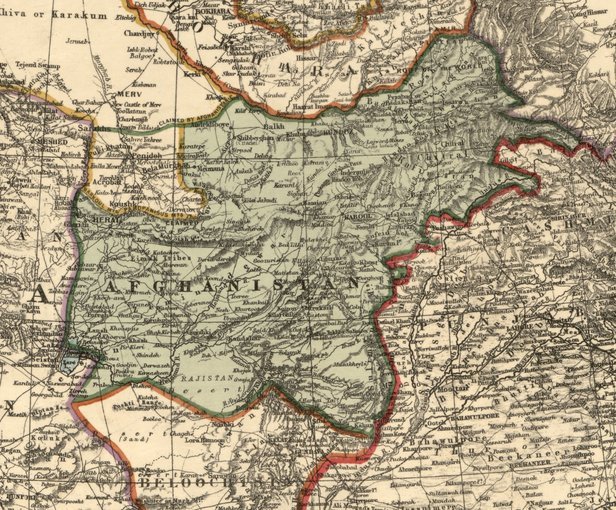
As you might expect, just like in the US, Afghanistan has much discussed here in the UK recently.
In any discussion about Afghan affairs in Britain it is practically a legal requirement that at some point someone will say in a smug, know-it-all way something very like this “Of course, they should have learned from our experience, we invaded Afghanistan three (or four or five times, the speaker is usually making the figure up) and we never conquered them, best to leave the Afghans alone.” The listeners usually nod sagely, sometimes someone will describe Afghanistan as “The graveyard of empires.” Followed by more nodding, and the discussion moves on. Embarrassingly even usually well-informed friends of mine have said this sort of thing. They are mistaken.
The territory we call Afghanistan has been invaded, for various reasons and with different degrees of success, by the Persian Empire, Alexander the Great, the Kushan Empire, the Rashidun Caliphate, the Mongols, the Timurid Empire, the Sikhs under Ranjit Singh, the British, the Russians/Soviets. All these powers did fall in time, but none of them fell as a direct result of invading Afghanistan. It was a factor in the fall of the Soviet Union, but that’s about it. Some graveyard.
Britain engaged in three full scale wars with/in Afghanistan, in 1839-42, 1878-80 and 1919. None of these were attempts to conquer Afghanistan. The first two were to ensure a regime in Kabul acceptable to Britain that would keep the Russians out and control the country. They were (more or less) successful in that they did keep the Russians out at least. The third war, in 1919, started with the Afghans invading the British Raj. By that time Russia was convulsed by revolution and civil war and the threat from that direction was very much reduced. After the British pushed the Afghans back and defeated them, a peace treaty was drawn up. The treaty ended the subsidy paid by Britain to the Emir of Afghanistan in exchange for control over his foreign policy and acknowledged his right to go his own way. The treaty also fixed the Durand Line as the border between Afghanistan and the Raj, it is still the Afghan/Pakistan border today.
Over the course of a century Britain also fought nearly sixty smaller campaigns and expeditions against tribes either side of the border between Afghanistan and what is now Pakistan. The annexation of the Punjab in 1846 gave the British Raj a border with Afghanistan and responsibility for keeping the borderlands quiet. The wild Afghan hill tribes (to whom a line on a map meant nothing) preyed upon trade through the mountain passes and the rich farmlands of the Punjab. This responsibility ended in 1947 with the end of the Raj itself.
Both Afghanistan and the Afghans can be tough as old boots and certainly invaders inevitably wish they were back home, but it is not some magic place peopled by invincible warriors. In the first and second Afghan wars Britain suffered some serious and humiliating defeats, the destruction of Lord Elphinstone’s army and its attendant civilian followers in 1842 is one of the very worst disasters in British military history. The battle of Maiwand in 1880 was another sharp and painful defeat. However, these defeats were avenged and both wars ended with victory for Britain. The disasters of 1842 and 1880 didn’t bring down the British Raj any more than St Claire’s Defeat in 1791 or the Little Big Horn in 1876 spelled doom for the USA.
The Red Army intervened in the far north of Afghanistan in 1929-30 in order to destroy bases and manpower of Basmatchis, who were resisting Soviet rule in central Asia. They did what they needed to do; and left. In 1979 the Soviets moved in to support a deeply unpopular communist Afghan regime. This time the commies were there for nearly a decade and suffered greatly. The Afghan war was one of many factors in the fall of the Soviet Union.
The US intervention in Afghanistan in the wake of 9/11 can be seen as very much in the same vein as British interventions in the 19th and 20th centuries. The highly interconnected nature of the world today means that an Afghan regime unable, or unwilling, to control what happens within its borders is a potential threat much further afield than those borders. The US acted out of self defence and justice. A big difference is that America then stayed and has tried to help Afghanistan to become a functioning nation, a typically brave, generous and ambitious task, but possibly a triumph of hope over experience.
We talk about Afghanistan as if it were a settled nation state, which it really isn’t, not as we usually understand the term. It exists largely because cartographers don’t like blanks on maps and because “This place is a chaotic rocky sandpit full of murderous nut jobs” is too long and honest to be the name for a country. It’s not that no one holds power in Afghanistan, lots of folk hold power, just not usually the government. Outside the cities authority is traditional, tribal and tough. It is not a stable place. Since the first one was adopted in the 18th century, the Afghan national flag has been changed more than thirty times, a world record.
It remains to be seen what comes next. Maybe the last two decades have been enough to seed a genuine and strong desire for freedom, although it’s doubtful. That said, I know enough about Afghanistan to know that I don’t know nearly enough to make predictions. Many women have been bold in standing up to the Taliban’s return to power and women especially have a great deal to lose. Wesley Bruce has pointed out on here that the Northern Alliance is resisting the Taliban in the Panjshir Valley and that the losses of US weapons and equipment may not be quite as catastrophic as they seem at first glance. I hope Wesley’s right about the weapons and that supplies can be got to the Lions of the Panjshir. As always with a crisis, there are opportunities as well as dangers. Sadly, only Beijing and Moscow seem to have the will and the wily-ness to take advantage of those opportunities.
I am confident of some things, firstly the soppy but toxic old git in the White House is far from capable of dealing with the horrible situation his haphazard withdrawal has precipitated. Secondly, his administration is too self-absorbed, Woke and naïve to do any better. Thirdly, Afghanistan will not be ruled by a coalition of Kabuli hairdressers, journalists, self help coaches and homeopaths. We need to deal with the country as it is, not as we would like it to be. Lastly, the current humiliation will not be the end of the USA or even of US pre-eminence. At least, it doesn’t need to be, the only country that can defeat America is America.
We’ve already seen a horrible attack on the remaining US troops and civilians of all nations. There are still thousands of US citizens and Allies in the country, Lord Elphinstone may yet lose his title of “Author of the biggest and most horrible disaster in Afghanistan”. I really hope he does not.
4 replies on “Some thoughts and background on Afghanistan”
Every time I try to explain what happened to people who ask why the Afghan National Army collapsed so quickly, I start with “because there is no sense of an Afghan nation.” There never has been. It is, at best, a feudal society, with all that entails.
That said, if US hegemony wanes, it is not because of Afghanistan, it is because of the US. What is happening in Afghanistan is merely symptomatic of the rot of the American Left, now in power.
“… soppy but toxic old git …” is quite good. Thank you.
Well said. There are some signs that India may be stepping up partly to block its foes Pakistan and China and partly because some of the northern tribes are Sikh and Hindu. Supplies are getting into Panjshir by helicopter. That’s not much but they are killing about 300 Taliban’s per attack with almost no casualties of their own. A nation of snipers with the high ground is powerful in defense. While people publish big numbers for the Taliban 75000, 90000, 900000, the latter numbers are old and include women and children. As the minutemen in the American revolution knew you don’t have to kill all the red coats only killing the officers wins the war.
Islam is a major problem. Its beliefs are incompatible with all forms of liberty. We need a solution to it in about fifty countries not just Afghanistan.
That was great; I learned a lot. Thank you.