On this, the 20th anniversary of the day after the 9/11 attacks, I thought I would share the story of a remarkable event that happened on another 12th September 124 years ago. The story reflects elements of the last two decades and I offer it here as a stirring and inspiring tale of incredible bravery and as a reminder at this sad time that 9/11 and everything that has happened since are part of a very old and continuing story.
Back in August I mentioned the 60 minor campaigns and expeditions mounted by the British Raj into Afghanistan and the tribal lands along its border, the famous Northwest Frontier, today the Khyber Pakhtunkhwa (KPK) province of Pakistan. This story comes from one of those campaigns.
The Pashtun (back when I was alive, we knew them as Pathan) tribes in this area were, and indeed are, not overly worried about a dotted lines on maps in Bombay, London and Kabul, and cheerfully carried out their age-old activities of banditry and raiding on both sides of the border. In order to limit their predations, as well as maintaining a military presence along the frontier, the British Raj paid cash subsidies to tribal leaders to keep their warriors quiet. How well this worked you can see from the fact that 60 campaigns had to fought in this region over the course of a century.
In 1897, the Afridi border tribe had been taking “Cash for Peace” for 16 years. In August the Mullah of Haddah was preaching war against the British infidels and declared a Jihad. In September the Afridis persuaded the Orakzai tribe to join them and together they captured the posts protecting the Khyber Pass and attacked forts in Samana mountain range. The Tirah Campaign had begun.
Some forty odd miles southwest of Peshawa and the Khyber Pass were around 500 men of the 36th Sikh Regiment under the command of Lt-Col. John Haughton. They held two small hilltop forts Fort Gulistan and Fort Lockhart, and some other smaller outposts in the Samana mountains. One of the outposts was a signalling detachment of twenty-one men of the same regiment under Havildar (Sergeant) Ishar Singh in a tiny, fortified position on a ridgeline between the two forts, known as Saragarhi.
A strong force of Afridi and Orakzai tribesmen had vigorously attacked Forts Gulistan and Lockhart without success several times over the preceding week. On the 12th September they turned on the twenty-one men at Saragarhi.
Shortly after 09:00 hours Sepoy (Private) Gurmukh Singh signalled by heliograph to Fort Lockhart that they were under attack. The grim reply stated that, until reinforcements arrived, no help could be sent.
The soldiers of the 36th regiment were all Jat Sikhs from the Punjab, neighbouring Afghanistan. You could say the Sikhs and Afghans have history. The revered 18th century Sikh martyr Baba Deep Singh died fighting the Afghans, and in 1762 the Afghan king Ahmad Shah Durani massacred between 10,000 and 20,000 Sikhs and desecrated the Harimandir Sahib, the Sikh holy of holies. Indeed, the 17th and 18th century history of the Sikhs is the story of the struggle to survive against the Moslem Mughals and Moslem Afghans. They knew what mercy to expect from the men massing outside the tiny fort shouting Allahu Akbar.¹
Ishar Singh and his men resolved to hold out as long as they could, with Gurmukh Singh staying in touch with Fort Lockhart. Initial Afghan attacks were beaten off. The tiny garrison was called upon to surrender, with threats and promises. These calls were met with contemptuous refusal and the attacks started again.
We know a fair amount about how the battle went as Gurmukh Singh continued sending signals and position was observed from Fort Lockhart. From his position Lt-Col. Haughton was able to see the Afghan forces massing against Saragarhi and estimated that there were between 10,000 and 14,000 warriors. Despite his original message Houghton did lead sorties to try to draw some of the Afghans away from Saragarhi, but it would have been suicide to stay in the open too long and there was little more he could do.
Sepoy Baghwan Singh was the first to die, Naik (Corporal) Lal Singh was badly wounded and was brought back within the walls. Two attacks were made on the gate and beaten back. Attempts were made to undermine the walls and brushwood was set fire to mask the Afghans’ movements. Eventually the wall was breached and fierce hand to hand fighting ensued. With supreme courage Havildar Ishar Singh ordered his men back the final redoubt, while he covered their retreat. He was overrun and killed and the Afghans stormed in. The rest of the men fell one by one.
In his little signalling tower atop the fort, Gurmukh Singh was the last man left alive. Touchingly, his final signal was actually for permission to end signalling and pick up his rifle. Permission being given, he did just that. Enemy after enemy fell to his bullets and bayonet. It is said he killed from 20 to 40 Afghans before they set the shed ablaze. We cannot know if this true, but he certainly died hard and the Afghans did set fire to his tower rather than finish him off man to man. He shouted the Sikh battle cry Bole So Nihal, Sat Sri Akal ² as he died. Incredibly, his heroic death happened nearly 10 hours after the first attacks. There is no reliable number of the Afghans killed by the tiny detachment, but it is most likely in excess of 400.
Left. Men of the 36th at Saragarhi after the battle.
Reinforcements arrived on the night of the 13th September and on the 14th the position was retaken. Over the next few months, a force of over 30,000 British, Indian and Gurkha troops pushed the Pashtuns back, the Jihad fizzled out and peace returned in April 1898, for a while anyway.
When the story of the last stand at Saragarhi was read out in the House of Commons in London there was a spontaneous standing ovation. All the men were posthumously awarded the Indian Order of Merit, the highest order available to Indian troops at the time. Each man’s family was awarded 500 rupees and 50 acres of land. Two Sikh Gurdwaras (temples) were built in their memory by the Raj, one a part of the sacred Harimandir Sahib/Golden Temple complex in Amritsar, and one at the military camp at Ferozepur, the district the men were from. Finally, a plaque was placed at the battle site.
The unutterably brave and dogged fight of so few against so many should always be remembered and deserves to be as well-known as Thermopylae, Roncevaux Pass, and the Alamo. The 36th Sikh Regiment still exists today as the 4th Battalion of the modern Indian Army’s Sikh Regiment. They still bear Saragarhi as one of their many battle honours. Both the Indian and British Armies celebrate the 12th September as Saragarhi Day.
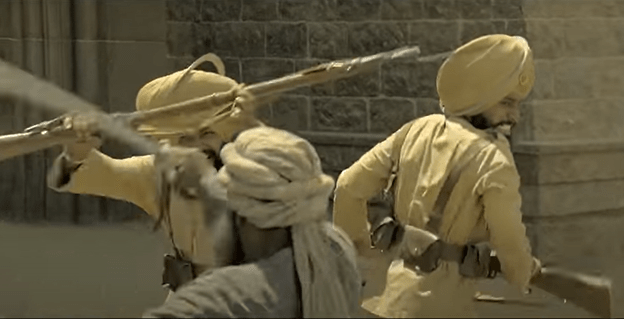
 The battle has become better known in recent years and there have been a number of documentaries and films made, most notably Kesari, a 2019 film starring Akshay Kumar as Havildar Ishar Singh. You can see it on Amazon Prime. It is a Bollywood movie so, of course, a romantic sub plot had to be written in (yawn) and they have a go at making the British officers into villains (resigned sigh), there is a romantic song with a montage, but they did stop short of having a full-on dance number and there are some great (if fictitious) incidents. Oddly, the massively over the top fight scenes in the last stand are somehow a fitting tribute to the unreal, superhuman courage of that handful of Sikhs. In his final fight they even give Ishar Singh a khanda, a traditional Sikh broad, long straight sword. Historically inaccurate, but very fitting, Baba Deep Singh was wielding a khanda when he died fighting the Afghans in 1757. There must have been a lot of dust in my room when I watched the film, so much that I had to wipe away a manly tear as Gurmukh Singh bawled out his battle cry at the end.
There is a lot of time, history and politics separating Saragarhi from 9/11 and the last two decades in Afghanistan, and they can be seen as totally separate. I would suggest that would be a mistake. Where do current affairs end and history begin? A week, a month, a year, or when someone makes an event into a movie? I would say the differential is bogus. Bill has said that the story of 9/11, and the events following that horrible day, are part of a very long story indeed, and he’s right. We do not live in a neat modern box, cut off from history. We are on a road, the same one as our ancestors, just further along it. We need to remember that we are not alone on the road and the milestones and signposts along the way.
Ladies and gentlemen, on this 12th September I give you the 21 brave Sikhs who are one remarkable, milestone on that long road.

¹ On the 15th Sept. 2001 a Sikh called Balbir Singh Sodhi was murdered in Arizona. His killer wanted revenge for 9/11 and the superficial visible similarities between religious Sikh and Moslem men (beard, turban/pagri etc.) led him to shoot Balbir. Killing an innocent Moslem would of course had been just as utterly wrong, but to murder a man of a people who have been victims of aggression from Moslem powers for over 400 years was a cruel and horrible irony.
² The battle cry is known as the jaikara. Bole So Nihal, Sat Sri Akal, which means “one will be blessed eternally who says that God is the ultimate truth”, as well as a battle cry it is a cry of religious fervour, of joy and celebration as well as being part of the Sikh liturgy.
One reply on “12th September”
Well told!