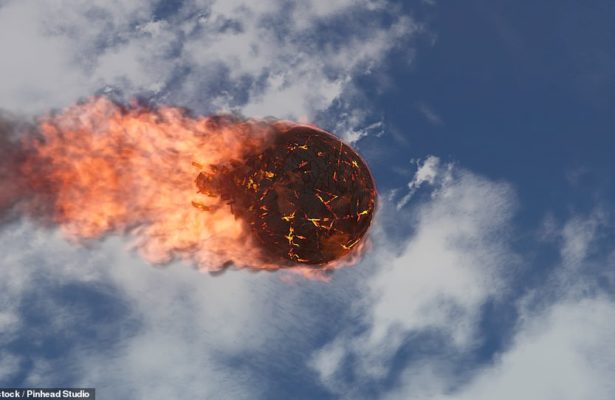
On December 18th, 2018, the chilly air over the Bering Sea was hit by the biggest meteor to strike the Earth since the Chelyabinsk event on February 15th, 2003.
Some instruments estimate the yield at approximately 200 kilotons. The meteor came in nearly vertically at roughly 58.6 degrees north latitude by 174.2 west longitude.
Peter Brown at the University of Western Ontario, Canada, made the discovery by combing old data and posted his findings on Twitter. The fireball had been captured by US military space assets, in full color (click images to enlarge):


Lest we think this is a serious event, requiring that we “do something or we’re all gonna die in 12 years”, the explosion took place 16 miles above the  ground. Meteors are not an unusual occurrence. Click on the thumbnail to the left to see a map of the last 30 years of global strikes.
NASA actually does have a program designed to find and track dangerous near-Earth objects, but it doesn’t have enough funding to do a really good job of it. The probability of being hit by a large object is so low that the program cannot get enough support to build a truly foolproof early warning system.
That doesn’t mean that there aren’t big things out there that might hit us. According to NASA, a soccer field-sized asteroid came within a mere 75,000 miles of Earth in June 2002. Missing us by less than one-third of the distance to the moon, the asteroid’s approach was the closest ever recorded by an object of its size.
Had it struck us even a glancing blow, it wouldn’t have been a planetary extinction event, though it certainly would have messed up our climate for a few years. Extinction-size asteroids, five miles in diameter or larger, do manage to hit us once in awhile, but these are very, very rare events indeed. The last one happened 65 million years ago.
But it probably took the dinosaurs by complete surprise. Their space warning assets were lacking.
3 replies on “Ka-boom! 173 kilotons and nobody noticed”
There is not much point having an early warning system for something you can’t prevent. That’s why the moneys going into space flight so there is something we can do about an in bound asteroid. When we get the rock swatters then money will flow for the rock spotters.
Good point, except that we’re talking about a very small fraction of the total budget. Knowing in advance that something is coming does a bang-up job of focusing the attention, like being hanged in the morning.
I’ll bet those dinosaurs were conservative. Asteroid deniers!