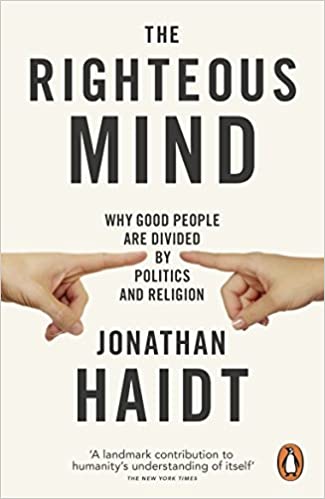
 Title- The Righteous Mind Why Good People are Divided by Politics and Religion
Author– Jonathan Haidt
Type– Nonfiction / Psychology & Politics
ISBN-978-0307377906
Description– The book presents three key theories of moral psychology and uses them to explain how different people when given the same issue or goal (say crime reduction) can come to drastically different conclusions as to the cause/solutions to said problems.
The First concept is simply that when presented with a situation/problem we make decisions subconsciously (instantly) and that our rational mind acts (moments later) simply to justify the decisions made by the subconscious. This is where our gut feeling comes and is why it’s so difficult to change someone’s mind, as without a monumental effort of willpower an individual is unable to overcome their subconscious choices. Haidt covers this idea in more detail in his other work The Happiness Hypothesis where he uses the metaphor of an elephant and rider.

The Second Theory presented is the Moral Foundation Theory which suggests that individual thought and decision making on a given subject essentially pass through a series six moral value filters which influence our perception and decision making process. Each individual subconscious will weigh these different moral values which lead to individuals focusing upon different aspects of a given problem/situation.

This leads to the Third Theory which is that an individual’s political/spiritual leanings are a result of their individual focus within the Moral Foundation. Through research Haidt has developed a simplified moral matrix for various political ideologies, which can help us better understand why people of differing political viewpoints make certain decisions.

Importance/Utility– Understanding where someone’s moral focus is allows us to craft arguments and rebuttals that are more likely to influence cooperation and consensus rather than conflict. For example knowing that the Liberal Mind is heavily focused upon the moral value of Care/Harm tells us we should craft our arguments from that emotional point of view (Facts may not care about Feeling, but Feeling also don’t care about Facts) rather than from a more nuanced or factual approach.
Rating– 8/10 Overall this is a very useful text for understanding why it is difficult to change an individual’s mind and also offers insight into better methods of communication between people of differing political/spiritual view points. The ideas presented are a little complex for individuals who lack experience with psychology or moral philosophy, but Haidt does a good job of trying to simplify these ideas. I mainly subtracted points because to fully understand the ideas you have to read his other books or watch several video interviews to get some of the context.
Recommended Format– This text contains several graphs and diagrams so physical or digital copies would be recommended as some of the concepts might be lost in an audio version.