 In the south of England, at the east end of the West Country where it meets the plain old South, is the county of Dorset. It is a lovely place, with a great combination of coast and countryside and is a little out of the way. Some of my fondest childhood holiday memories are of Dorset. The atmospheric ruins of Corfe Castle, the absurdly picturesque Lulworth Cove, the massive Iron Age hill fort known as Maiden Castle, the mysterious (and NSFW) chalk hill figure at Cerne Abbas, and of immense interest to small boys of all ages, the Bovington Tank Museum.
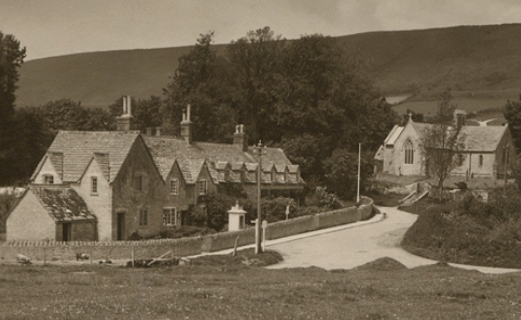
Like the rest of rural England, Dorset is dotted with small villages. One of these villages was Tyneham, a place of less than three hundred folk, in a pretty valley running down to the coast. Tyneham House, a classic stone Elizabethan manor house built around a medieval great hall, had been the home of the Bond family since the 17th century and many of the other residents in more humble properties had roots every bit as deep.
During the Second World War Tyneham was in the wrong place at the wrong time. Between the Army’s tank training centres at Lulworth and Bovington and the coast, with a radar station nearby and not far from where some of the training for D-Day was to be carried out.
In 1941 Tyneham House had been requisitioned by the government for use as an RAF administrative centre and accommodation for Women’s Auxiliary Air Force (WAAF). In 1943 the whole village received notice that their homes were to be surrendered to the government as they were in an area that was to be used for tank training and preparation for D-Day. The War Office – today the Ministry of Defence (MoD) – sent a letter which concluded.
“The Government appreciate that this is no small sacrifice which you are asked to make, but they are sure that you will give this further help towards winning the war with a good heart.”
Of course, the villagers reluctantly accepted their relocation. They appreciated the genuine immediacy of the need. Mark Bond, son of Ralph, last head of the Bond family to live at Tyneham, described his father’s attitude as “resigned patriotism”. They were also reassured verbally that they would be able to return to their homes after the war.
Ralph’s wife Evelyn pinned a note to the door of St Mary’s church.
“Please treat the church and houses with care; we have given up our homes where many of us lived for generations to help win the war to keep men free. We shall return one day and thank you for treating the village kindly.”
Thousands of British and American troops trained around Tyneham, many from the US army’s 1st Division, based close by at Swanage. D-Day went ahead, and Allied armies began the painful and urgent process of liberating as much of Europe as possible from Hitler’s National Socialists before it could be “liberated” by Stalin’s International Socialists.
VE-Day came and went. Then came the General Election when Churchill was dumped in favour of Clement Atlee and Labour. VJ-Day came and went. Then 1946 and 1947 did the same. The people of Tyneham were still not allowed back to their beloved village. They lobbied the government; but were met with the usual wall of impenetrable cotton wool. Finally, the government compulsorily purchased the village in 1948 and Tyneham House in 1952.
The people of Tyneham did not forget or give up on their village. In 1956 Lilian Bond published her book Tyneham, A Lost Heritage and as late as 1974 Albert Gould wrote to the Prime Minister, Harold Wilson.
“Tyneham to me is the most beautiful place in the world and I want to give the rest of my life and energy to its restoration … Most of all, I want to go home.”
Of course, there was still a need for space for training. However, there was nothing like the urgency of 1943. England is not a big country, but it is not so small that in time of peace locations could not be found that did not involve uprooting a whole village against the villagers’ will.


The failure to return Tyneham to its rightful owners and inhabitants happened under a Labour government, but the decision could have been reversed by the Conservatives in 1951, it was not. The plain and unlovely fact is in that bureaucratic convenience won out over property rights, a fact that provokes a mix of anger and nausea even today.
Over the years most of the houses have been reduced to picturesque ruins. The medieval hall of Tyneham House is protected, but the fine old Elizabethan house itself suffered the same fate as the rest. The church and the school survive, acting as museums of pre-war village life. The ghost village is on MoD land, where live firing is still carried out, and is mostly out of bounds, but it is possible to visit it now, usually at weekends.
From time to time there are articles about Tyneham, talking about the village’s attractive dereliction and giving the impression that the failure to hand the village back after the war was some sort of sad but inevitable natural disaster. The articles often have titles like “The village that died for England” or “The village that died for D-Day”. These titles are naively misleading at best, if not downright lies. The death of Tyneham was not an heroic sacrifice for the war effort and it was far from inevitable. It was the result of bureaucratic convenience and indifference. In 1968, Ralph Bond’s son, Major General Mark Bond said it was “…a long, sad and rather disgraceful story.”
The next time a government (it doesn’t matter what government), is asking you to give up rights (it doesn’t matter what rights) “temporarily” because of an emergency (it doesn’t matter what emergency) then remember the pretty little ghost village in southern England.
2 replies on “The cautionary tale of a ghost village in England”
Thank you for sharing that bit of history, Davey. A poignant illustration of the consequences of giving up freedom to a government…any government.
Benjamin Franklin: “Those who give up an essential Liberty, to purchase a little temporary safety, deserve neither Liberty not Safety.” I would add ” and will get neither. “