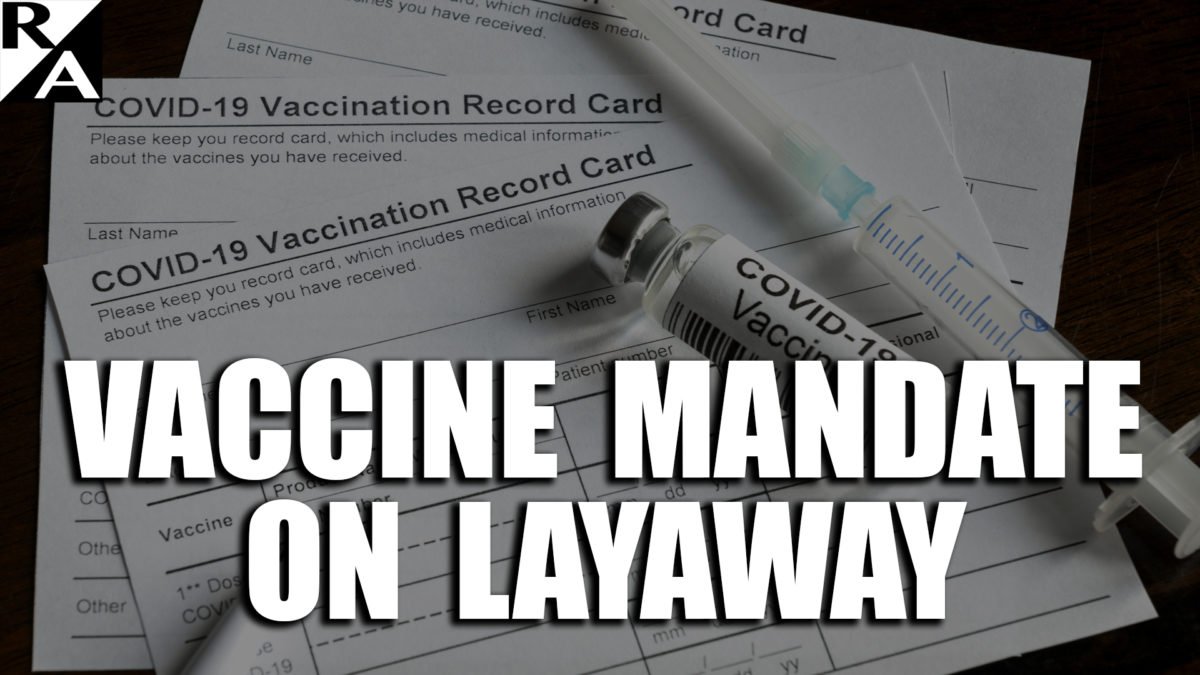
ABC News reports that that Biden vaccine mandate on federal employees is on hold until after the holidays, even as the administration pushes private employers to enforce such a precaution against a resurgent COVID-19 pandemic. If federal departments can procrastinate on this priority, what about the rest of the country?
Stephen Green, Scott Ott and Bill Whittle create 260 new episodes each year, and have been doing so for more than a decade thanks to people like you who believe in these ideas and want to see them spread more widely. When you become a Member you join this team of producers, and get insider access to their blog, forums and rich dialogue in comments that the unwashed masses cannot see. Just click the big green button above.
BTW, if you’re not a joiner, but simply want to encourage this work, click the big blue Donate button where you can use your credit card, or PayPal account for a one-time or recurring donation.
Video below hosted at Rumble.
10 replies on “Vaccine Mandate on Hold for Federal Staff as Biden Pushes Private Employers to Enforce It”
This Federal mandate has really hit hard in my community, which hosts a DOD/Navy laboratory, the community (made up mostly of federal/contractor workers) being quite conservative and ‘resistant’ to this vaccine and it’s mandate.
Most people, when they think of Federal workers, I believe think of the bloated bureaucracy in Washington, D.C. and surrounding areas, which lean heavily (in attitude and in dependence) Democrat. This is not the case in my community.
I am retired (from said workforce), but am still in communication (mostly through neighbors and church) w/ current fed workers, who have diverse opinions on both the ‘vaccine’ and its mandate. Still, I was shocked to hear how many (40%??) were bucking the mandate, to the possible detriment of their careers. They were out protesting on their lunch hour in town, waving their flags and holding up their handmade posters, and I honked as I drove past in solidarity.
I am now thankful that this threat of firing (which is hard to conceive of, do you know how hard it is to ‘fire’ a federal employee?!) has been lifted from their worries, at least temporarily, and I believe Brandon will not so much see the light but be forced to not reinstate it in the New Year, because of public sentiment.
But, I have to wonder (and have no data…) how many people succumbed to this fear (of losing their job) and actually got the ‘vaccine’.
Time will tell, and now they have a reprieve of a little time…
Stop calling it a vaccine.
Bill, I’ve lived in dry counties too. It’s not that “you’re not allowed to drink alcohol” in those places. They can’t outlaw drinking alcohol, that was decided by the 21st Amendment.
It’s that you’re not allowed to BUY or SELL alcohol. That comes under the purview of the county tax umbrella, it’s a tax thing that’s used to prevent alcohol sales.
The silly thing about this is that you can step across a county line into a “wet” county, buy alcohol, and step back across into the dry county with your alcohol. The dry county isn’t allowed to outlaw simple possession of alcohol, again a 21st Amendment issue.
The net effect is a minor inconvenience for the residents of those dry counties and a major boost in tax revenue streams for the wet counties that border them. Those wet counties getting all the alcohol sales revenue that the dry counties would get … If they were not dry counties.
In short, it’s stupidity and has no positive effect whatsoever. Just the opposite.
Except to wet counties that border dry counties. They lobby and do everything else they can to keep their neighboring counties dry.
I ate in a restaurant in a dry county where similarly you could bring your own bottle and they would only charge for the glass, ice, mixer. Most folks were unaware they needed to bring their own or knew the process. They had a shelf all around with dining room with liquor bottles. If you wanted a drink they simply asked you to point to which bottle was yours. Beyond that it was business as usual.
Well I lived in a couple of dry counties in Texas and there was a positive effect to the ban on alcohol sales. True you could drive across the county lines to get booze. But because of the ban on sales in the county, you had to plan your drinking deliberately. As a result we had fewer alcohol-related auto accidents, alcohol-related domestic violence and fewer alcohol-soaked winos lying around on the street. If they managed to bum a few dollars, they had to walk 30 miles to the nearest border to get booze. That and the fact that homeless folks were required to get jobs, caused the hobo crowd to stay on the trains till they got to Austin or Houston and skip Tyler or Cleburne.
Also the cops set up speed traps and patrols along the borders where the liquor stores congregated to pick up the idiots who couldn’t wait to get home to get snoggered. This gave the cops a smaller area to guard against DWIs. So, you could drink, you just had a more difficult time driving and drinking. Even if you started drinking at the border, you had a reasonable chance of getting home before your blood alcohol level made you legally impaired.
So dry counties aren’t crazy. There’s a method to their madness.
That’s an interesting take so I did some quick research and looked up a few things …
Dry counties tend to have gotten that way due to religious considerations of the residents, and stay that way for the same reason. It may not be that being dry is the key factor but rather a higher percentage of religious people in the county … Which leads to lower crime over all in general. Not surprisingly quite a few dry counties are populated with a preponderance of Mormons. Who traditionally eschew alcohol anyway and likely there would be little difference in alcohol related crimes if the county was wet.
That goes for particular dry counties but …
That’s not the case for all dry counties. Some dry counties are seeing as much as 25% or higher incidence of methamphetamine production labs and concomitant rise in general drug use compared to their neighboring wet counties.
This not only because alcohol isn’t available so people turn to other recreational psychoactives but also because those counties, again being populated by religious people, tend to be safer, quieter and have less trespassing. So the labs are easier to keep hidden and it seems that applies to drug habits too. Turns out meth makers and addicts like dry counties too and for the same reasons the religious people do.
Alcohol related car crashes occur at about the same rate in either wet or dry counties but there is a difference in the character of the crashes. In wet counties they tend to occur closer to home and in dry counties they occur farther from home.
There is also the argument made that dry counties cause more car crashes because people have to drive further, drink, then drive home again. Which simply puts them on the roads longer and increases the risk of an intoxication caused crash proportionately to miles/time driven intoxicated.
While some studies I looked at indicated there was a discernable drop in alcohol related crime in dry counties, it wasn’t anything remarkable and when taken into account with overall crime didn’t really make a statistical difference. Dry counties have problems that offset the effect of restricted or forbidden alcohol sales yet do not see the tax revenue that alcohol sales generates enabling them to bring financial solutions to bear. It’s a wash, pretty much.
Strangely enough, and this surprised me, locales that prohibit only Sunday alcohol sales often have as low or lower rates of alcohol related crime as is observed in dry counties. Apparently making people take a day off drinking, or at least plan ahead and avoid spurious, spontaneous drinking, works as well or better than just going dry completely.
This information is a synopsis that I’ve compiled from various educational (college and university) studies and public crime statistic resources. There’s actually a lot to the subject and it’s a complicated one like pretty much any other social issue.
The reason I went and looked all that up is because I’ve heard your position before. But it was often sourced from the mouth of a politician that knew he would get more votes if he campaigned on a platform of keeping his county dry.
That plays well in a community with a large segment of religious people, especially if those religious people are Mormons who don’t drink anyway. Which is sort of a “dog in the manger” scenario and brings me to another point.
Religious people can be unpopular for a lot of reasons that have nothing to do with their religion. Being a Christian myself this is something I’ve studied and observed over the course of my entire life.
The reason the Catholics and the Protestants fought in Ireland for so long, and are still nothing close to bosom buddies, isn’t because of differences in their faith(s). It’s because those of one faith subscribe to a particular sort of politics that the other does not. This is clear when you consider that the US has both Protestants and Catholics serving and voting side-by-side, many of whom are of Irish descent, in nearly all aspects of American society. Without so much as a thrown punch or a kick each towards the other. This being also the case in the larger world.
Ireland’s politics divided across religious lines because the Catholics wanted an independent Ireland and the Protestants wanted to remain a part of Great Britain. There is really nothing in either faith to promote one position over the other, they are both Christian sects and pretty much have the same foundational principles.
It’s not a difference in the faiths, it’s a difference in politics that led to the strife in Ireland. The label’s of Catholic or Protestant were conveniences, many on both sides practice neither faith nor claim to.
In America we had an historical issue that has some similarities. When the Mormon Church was founded it gained congregants that tended to group and act together. This is a completely understandable and unremarkable in itself. People tend to want to be around others with whom they share interests and approval.
Had this not happened during the expansion and settlement phase of the US it wouldn’t have had the impact that it did.
The Mormon Church (and no I’m not going to say “Church of Jesus Christ of the Latter Day Saints or “LDS” every time I talk about Mormons so if that irks anyone, get over it) has a self styled history of persecution at the hands of fellow Americans. The Mormons usually claim this was due to religious intolerance and bigotry. Some might have been but most of it wasn’t.
It was political in the most basic sense of the word “politics”.
When during expansion and settlement of the US you had a county in say Arkansas, Texas or Kansas for instance, that had a population of 5,000 – 8,000 people and all of a sudden over a period of weeks or months that population surged to 25,000, still not a huge population for those very large area counties to carry … But all the newcomers were Mormons — A political problem started to crop up pretty quickly.
The Mormons would vote en masse as their Elders and Clergy instructed them to. That meant that whatever the issue in the above example county, the Mormons were always going to win. Period. Using the figures above, a vote of 8,000 to 17,000 is going to go only one way. Every time.
This had the practical effect of stripping political power from anyone who wasn’t a Mormon. People who had lived in their homes for decades, sometimes generations, suddenly found themselves politically disenfranchised. The “newcomer” Mormons didn’t care and the non-Mormons couldn’t do anything about it. Legally.
Even then, it might not have become the issue that it did had the Mormons wanted mostly the same thing everyone else did. With that kind of political clout all sorts of things, perhaps legal and perhaps not, become possible. Things like stacked courts, biased juries, judicial favoritism, “public domain” land seizures and … alcohol laws … to name but a few — Became pretty serious bones of contention.
This resulted in violence in an already under patrolled less than fully lawful frontier. Neither side was blameless and neither was without significant blood on their hands. The Mormons would often lose a brush war with non-Mormons because while the Mormons formed a tight knot of solidarity the surrounding non-Mormons had the tactical and strategic advantage. Many Momon enclaves were driven out or fragmented and those Mormons who didn’t leave learned it wasn’t a good idea to try to impose their political will unfairly on others.
(Note: It’s true that the majority rules in local politics but consider how you’d feel if you woke up next year to discover that a preponderant majority of Hindus move into your town and outlawed eating meat. You might not give up your steaks, hamburgers and pork chops without a fight.)
This is also what drove the Mormons to Utah and the rest of the story is pretty common knowledge.
The reason I went into all of that is because a lot of dry counties are that way because of Mormon influence. Not all of them, to be sure, but even of those not still majority Mormon today that policy was instituted when Mormons held political sway over the local government.
So when people claim they live better lives with less crime and social problems because alcohol can’t be bought in their county it’s very likely more a matter of politics than it is actual manifestation of community safety. There can be more reasons than just alcohol sales involved and like I said …
Like any other social issue it’s complex.
“Smacks of irony”? Smacks pretty hard.
Lol, good one. I had to put that up on a bigger monitor to see the small print at the bottom and when I did that it made perfect sense. In a non-sensical Lewis Carrol sort of way.
Are we getting any closer to calling this a flu shot, which is what it is? Everyone who uses the ‘v’ word is feeding the fearful more fear and the fearless with more frustration about the lie.
Even with the flu shot, the efficacy of each year’s vaccine varies. This is due to the guesswork involved in predicting which strain will be the most prevalent each year. Roughly 55-60% of the country gets a shot and each year 40-60k people die from flu related complications, mostly the elderly and those with other health issues.
Some years, the prediction of strain is off and we get years where in excess of 100k die in the US. Again, the demographics are the same.
However, with the new style of “vaccine” they are targeting a specific indicator on the virus and will be less potent for all other strains. So all these variants are less likely to be effected by the existing shots. But, if you had covid (any strain) and recovered you are safe from all variants.
As we all learned in Jr High biology, the subsequent strains of any virus tend towards easier to transmit and less virulent. This is why we don’t have flu shots for every strain every year, most of them are eminently survivable.
Remember, the “common cold” is a virus. We don’t bother trying to inoculate for it as it is not deadly and spurs immune system growth.
This is now all smoke and mirrors and falls under the heading of never let a crisis go to waste.